
‘I come from the shop floor’: Rob Ashton wants to rebuild the NDP from the working class up

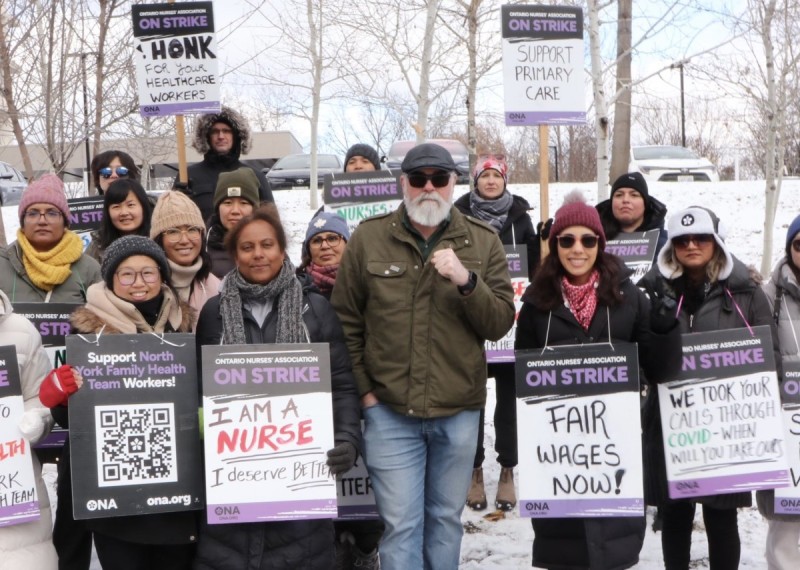
NDP leadership hopeful Rob Ashton on the picket line with striking Ontario nurses. Photo courtesy Rob Ashton/X.
For years, critics inside and outside the New Democratic Party have warned that the party is drifting away from its historic base. In election after election, the NDP has struggled to connect with the very voters it was founded to represent: the people who work in Canada’s warehouses, schools, docks, offices, hospitals, and factories—and who increasingly feel abandoned by a political class that speaks past them.
It is into this debate that longshoreman and union leader Rob Ashton has launched his candidacy for the NDP leadership. A political newcomer in the traditional sense, Ashton has never held elected office. But he has spent more than three decades on the docks and in union halls, rising to become national president of the International Longshore and Warehouse Union (ILWU). In an era when Canada’s Parliament is dominated by lawyers, consultants, and professional managers, Ashton represents something increasingly rare in federal politics: a leader who comes directly from the rank and file.
Ashton’s candidacy is a bet that the party can reconnect with working class voters only if it is led by someone who speaks their language—not as a rhetorical tactic, but as lived experience. He argues that the NDP must once again name class conflict for what it is, and fight unapologetically for the people being squeezed by corporate power and political complacency.
When we sat down to talk, Ashton was blunt: the NDP has lost trust, not because its values have changed, but because it has failed to communicate them clearly and consistently. He believes he can bring those voters back (the ones who went Liberal out of fear, or Conservative out of frustration) by offering a politics rooted in everyday struggle rather than insider calculation.
What follows is our conversation about the NDP’s future, the failures of Canada’s political establishment, and Ashton’s bid to rebuild the party from the shop floor up.
Christo Aivalis: One question many NDP supporters are asking is how each of the leadership candidates will win voters over to the NDP. Why do you think you are best positioned to win back voters?
Rob Ashton: I come from the shop floor, Christo. I’ve lived this life for 32 years as a longshoreman, and I’ve represented longshoremen for the last 10 years as their national president. I know what they need and what they want. We’ve had NDP voters go Conservative this time, and others vote Liberal, worried about that self-appointed king down south and about Pierre Poilievre taking power. Under the NDP with my leadership, I can bring back those voters who went blue because I speak their language. I know the struggles they face. At the same time, NDP supporters who voted Liberal—and other Liberals—will see that Carney isn’t who he made himself out to be during the election. He’s actually a bigger conservative, dare I say, than Brian Mulroney. Those voters will see that the NDP is the party where they belong, with a true working class voice. I’m the candidate who can bring everybody back to the NDP.
Increasingly, Canadians are concerned with the Temporary Foreign Worker (TFW) Program, and while some politicians have critiqued it, few have called for its abolishment like you have. Why is it time to end the TFW program?
The TFW program is written for the ruling class. They bring people into the country only to force them into lower-paid, more precarious work. You don’t have the ability to unionize, and you don’t have the ability to refuse unsafe work. Because if a worker does speak up, employers have the right to send them back to wherever they came from. We have to get rid of this program. We have to create a system that works for all workers, both Canadian citizens as well as temporary residents, because that is what this country should be about. And that’s what the NDP is about: lifting up all workers and giving them a safe workplace.
There have been many recent examples of companies leaving Canada and shipping jobs abroad, even after getting subsidies from the government specifically to preserve those jobs. As leader, how would you stop this?
Look at the auto industry and Aloma Steel, which was just given $400 million by the federal government and $100 million by the provincial government—and they’re planning to get rid of over half their workers. Or in the case of the auto sector they just go south of the border. The underlying problem is giving away public money for nothing. Under an NDP government led by me, there would be strings attached. If we give you money, the first thing you do is make sure Canadians keep working. No outsourcing, no cutting jobs, no shutting down and leaving. If you take the cash and walk away, you’ll have to pay it back with interest. That’s the promise we make to Canadians: we’ll protect your jobs and the public money we give to support these companies.
Do you support worker and public ownership as a way to prevent these kinds of outsourcing practices?
You bet. One of our policies is to put workers on the boards of companies in this country so we have a real say in how they’re run. When workers help guide a business, it grows in a way that actually benefits the people who make it run. We’ve already seen it in British Columbia, where a mill that was on the brink of shutting down was saved because the workers, their union, and the government stepped in together—and that mill is still operating today. So yes, public and worker ownership is absolutely a viable option.
Under my leadership the NDP will reconnect with workers in hospitals, mines, and shop floors across this country. Because I am a worker, I come from the ranks. pic.twitter.com/rXBbz7MSMQ
— Rob Ashton (@Rob_T_E_Ashton) November 28, 2025
One thing I’ve noticed about your campaign is that you’re not shy about talking in terms of class conflict. Liberal and Conservative politicians are clearly on one side of that class war against Canadian workers—but even the NDP has sometimes been hesitant to name that reality directly. Why is it important for you to break from that and say it plainly?
The class war message is how I’ve lived my whole life—not just as a leader, but as a longshoreman. It’s class warfare, pure and simple. Everything that’s happened in this country since colonization has been class warfare. Even environmental issues are part of it, because the ruling class uses them to divide workers by pitting environmental activists against the people doing the jobs. Once we start communicating that clearly, and workers see they’re part of this class war, we’re confident they’ll come back to the party. Because the Trump government down south, the Carney government here, and the Poilievre opposition will do everything they can to make their friends richer while keeping the working class underwater. These are messages we’re going to keep pushing—until we’re sick of saying them, and then we’ll push even harder.
Building on this, you’ve mentioned in previous interviews that Canadians are angry about the status quo, and rightfully so. But we’ve also seen this anger manifest in ugly ways, often aimed at vulnerable elements of society. Do you view a campaign of class conflict as a useful way to channel that anger?
Definitely. The anger we’re seeing in Canadian society is a big part of the class warfare we’re in right now. Look, when governments or political parties are run by people like Donald Trump—and others like him, dare I say, almost fascist—they lead with hate and tell you to blame your neighbour for your problems. But it’s not your neighbour keeping you from paying your rent or buying groceries; they have no control over that. You have to look at the governments and corporations that built this system—a system made by the ruling class for the ruling class, so the rich get richer and workers stay down. And when I say workers, I mean everyone being squeezed: people on disability, on old age security, and everyone else trying to get by.
Like most of the candidates in this race, you do not currently sit in Parliament. If you become NDP leader, what is your plan to get into the house, where would you look to run, and would you consider a by-election to do so?
I don’t have a seat in Parliament, and that’s not a bad thing. Right now, we have seven strong MPs defending workers and pushing back against outdated, ruling-class legislation, like Leah Gazan working to repeal Section 107 and Alexandre Boulerice fighting for a better EI program. Not having a seat gives me the freedom to travel the country, talk to people, and go to places where the NDP hasn’t been seen in years—whether that’s rural communities or Indigenous nations—to hear their concerns and explain how our party plans to fix them. As for a seat in the House, I live in the BC Lower Mainland, so I’ll be looking at running somewhere in that area. But if a by-election comes up, I’m not just going to walk in and take it. We’ll have a conversation with the local riding association to see if they already have a candidate, if they’re comfortable with me running, and if I can truly represent the community. All of that has to be considered.
Finally, many observers have raised the issue of bilingualism in this leadership race, and your name has come up alongside other candidates. What concrete steps are you taking to make sure you can communicate your vision effectively in French?
Oh yeah, I ended up on This Hour Has 22 Minutes because of my terrible French [laughs]. All joking aside, French is really important to me. I only fully committed to this race about two and a half months ago, and I never imagined I’d run for leader. I live in BC and don’t have a lot of Francophone friends here, but I’ve started taking lessons and speak with Francophones on my campaign team, who are helping me learn. When I get elected on March 29, I plan to immerse myself in French language and culture in Québec.
I was at an event last night in Saguenay, talking to people who explained how important the French language is. Back in the 1950s, the ruling class in Québec spoke English while the working class spoke French, and then came the Quiet Revolution in the 1960s, when Quebécers began reclaiming their identity and power. That’s how much the French language matters—not just to Quebécers, but to Francophones across Canada. So it’s more than just learning the language; it’s about understanding the identities of different communities, whether Francophone or Indigenous. As leader of Canada, you should always be learning more about the society you serve.
This interview has been edited for clarity and length.
Christo Aivalis is a political commentator and historian, holding a PhD in Canadian History from Queen’s University. His writing has appeared in Jacobin, The Breach, Ricochet, Maclean’s, the Globe and Mail, and the Washington Post.