
Institutional neutrality or institutionalized silencing?

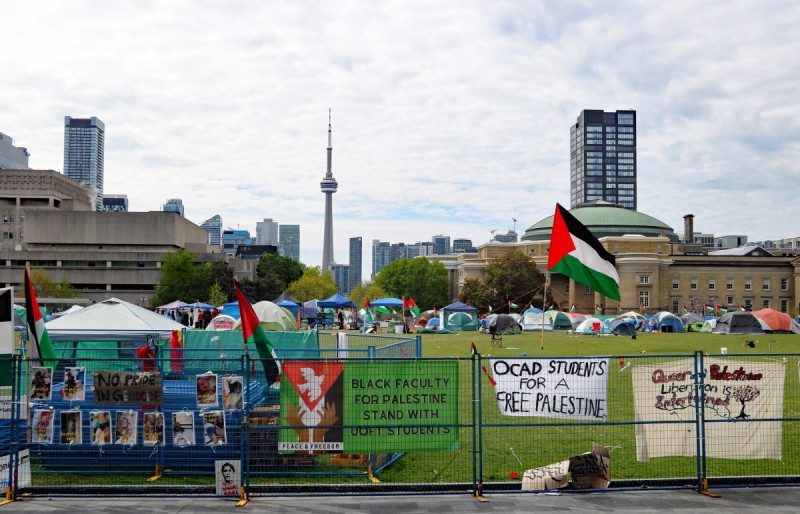
Pro-Palestine encampment at U of T’s King’s College Circle in 2024. Photo by Can Pac Swire/Flickr.
The partial ceasefire in Gaza offers an opportunity to reflect on how universities have responded to a level of student activism not seen since the protests against apartheid South Africa in the 1980s. One of the most notable developments has been the adoption by dozens of universities of policies promoting so-called “institutional neutrality.”
At first glance “neutrality” is a laudable aim of universities whose mission is to promote research that raises “deeply disturbing questions and provocative challenges to the cherished beliefs of society at large and of the university itself.” According to a University of Toronto memo from 2024, introducing what it called a new approach of not making statements on local or global events, the university’s role is not to act as an arbiter among competing positions.
But whether framed as “impartiality,” “neutrality,” promoting “diversity” or even as “statements about not making statements,” the language of neutrality after the events of October 7, 2023 has come to set the terms of a deeper question reverberating through universities: how should institutions ‘balance’ pro-Palestine research and activism against claims from some pro-Israel groups that such work is offensive or even antisemitic?
If we turn the clock back to anti-apartheid activism at the University of Toronto in the 1980s, we can see more clearly what is—and is not—new about today’s invocations of neutrality.
South Africa and institutional neutrality
The University of Toronto divested from apartheid South Africa much later than most of its peer institutions and it employed the language of neutrality to justify its stance. In 1985, U of T President George Connell affirmed that individuals, himself included, were free to boycott South African products and speak out. “The University is a community in which that kind of engagement can take place,” he said. But he was adamant that the university should not engage in what he called political action by taking a stance on investments.
We should remember that what many today regard as a factual view—that apartheid South Africa was an unjust, racist state—was far from universally accepted in the 1980s. The apartheid government worked hard to present the country as an outpost of Western civilization besieged by violent communists. Some opponents of anti-apartheid activities at U of T claimed that the African National Congress led by Nelson Mandela was a terrorist organization. U of T Faculty Association President Fred Wilson captured the way anti-apartheid activists were being portrayed when he said that they were being dismissed as “a group of left-wing, crazy radicals.”
Facing growing activism, including the overnight occupation of his office by student protestors, President Connell appointed retired history professor, Archibald P. Thornton, to review divestment policy in September 1987. By then 21 US and five Canadian universities had fully divested from South Africa. Acknowledging the basic principle of fiduciary responsibility, the Thornton report outlined two competing views on divestment that hinged on wider principles about neutrality.
One view—central to U of T’s approach then and revived today—cautioned that taking a ‘political’ stance would curtail the rights of those holding different views. The university, as a pluralistic community, could not adopt a monolithic viewpoint. Thornton noted a second, contrasting view, quoting theologian Father Gregory Baum who had said: “An appeal to neutrality becomes an ideology favouring the powerful.”
Thornton favoured the second view: “Where you put your money is where your support is,” he said at a press conference. Thornton’s conclusion, praised by many including activist Ursula Franklin, whose letter is saved in his archive, was that financial involvement in a racist regime was not a neutral position: “Investment in South Africa is a form of aid,” Thornton said.
On January 21, 1988, with Thornton in attendance, the governing council passed a motion requiring the university to divest its holdings in companies with interests in South Africa. The minutes recorded President Connell’s last-ditch effort to persuade the council to vote ‘no.’ Connell warned that a ‘yes’ vote would set a precedent, encouraging groups advocating for other causes—including, as he put it, “the Arabs in the Gaza Strip.” That time was to arrive, and once again, neutrality would be a point of contestation.
Palestine, divestment and neutrality
The high point of pro-Palestine activism at U of T to date was the encampment at King’s College Circle in May and June 2024. Drawing on the South African precedent, students demanded that the university’s $4 billion endowment divest from companies profiting from Israel’s illegal occupation of Palestinian land. In essence, students argued—consistent with Thornton’s reasoning—that the university could not claim neutrality while financially supporting a state the International Court of Justice had found was plausibly committing genocide in Gaza.
In response, U of T attained a court injunction to end the encampment, casting itself as a defender of the rights of all community members to enjoy King’s College Circle—rights it claimed were infringed upon by the protesters. But it went much further, echoing pro-Israel groups in portraying the encampment as violent and tainted by antisemitic language—not as a legitimate site of protest, but as a political space marked by hate.
Considering the evidence, Justice Markus Koehnen of the Ontario Superior Court rejected the U of T’s claims of antisemitism and violence, ruling that the university had not provided a strong prima facie case. He agreed that encampment participants were “young idealists fighting for what they in good faith perceive to be an important human rights issue.”
But the view that advocates for Palestinian rights are antisemitic—and that institutions should oppose such discrimination—preceded and outlasted the encampment, leaving some community members fearful of discussing Israel-Palestine at all. When Canary Mission, a pro-Israel website that “documents antisemitic and anti-Israel activity on North American campuses,” targeted 153 faculty members who supported divestment—many of whom are racialized and some who are Jewish—the administration did little more than send colleagues, whose headshots were framed with square boxes presumably to provoke attacks, a neutral-sounding email containing “general safety tips.”
Neutrality, then and now
Viewed historically, senior administrators have invoked the language of “neutrality” in response to strong student demands. There is nothing new about this impulse, and the very need to continually “rediscover” neutrality underscores that universities make value judgments every day—from acknowledging that they operate on Indigenous land to deciding how their funds are invested. Crucially, however, President Connell justified institutional neutrality in the 1980s precisely on the grounds that individuals and groups remained free to oppose apartheid South Africa.
What is different today is that claims of “institutional neutrality” now underpin a broader view: that university administrators should give equal weight to pro-Israel and pro-Palestine perspectives, regardless of established facts and even university policy rejecting the conflation of antisemitism with criticism of the State of Israel.
Because one prominent pro-Israel position holds that pro-Palestine speech is offensive or even antisemitic, this logic produces profound tensions within institutions committed to scholars’ freedom to express ideas without punishment. While U of T set up a working group on “civil discourse” to address tensions within the institution, it ignored the fact that such tensions stem from the university’s own contradictory stance—ironically one justified as “neutral.”
As global opinion shifts toward supporting the human rights of Palestinians, this is the moment to confront that contradiction and champion open debate above institutionalized silencing.
Some sources for this piece are taken from the A.P. Thornton collection held in University of Toronto’s Thomas Fischer Rare Books and Special Collections library.
Mark Hunter is professor of geography at the University of Toronto.