
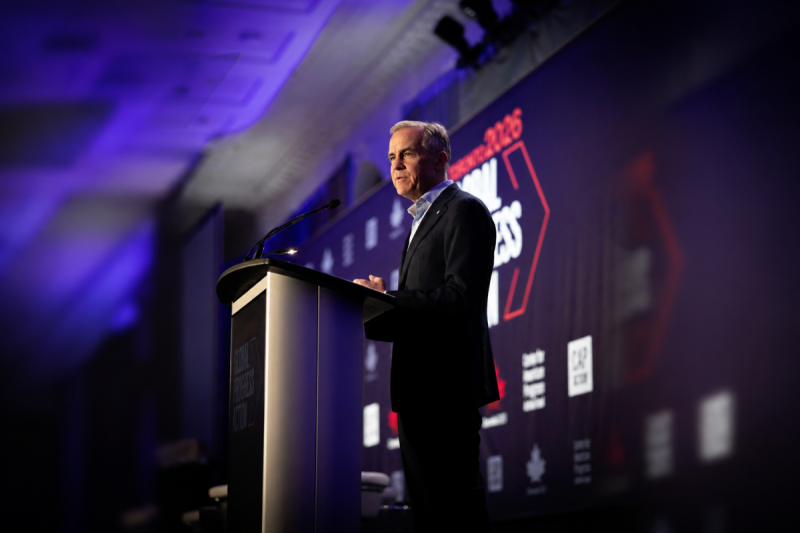
Mark Carney exposes the usually hidden fangs of capitalism

Photo courtesy Mark Carney/X
I come to this as a student of occupational health and safety law and regulation. A comparison has drifted into view as the Carney government enthusiastically pursues its “build, baby build” manifesto. Certain assumptions are common to the overall capitalist agenda. These assumptions make it easier to legitimate the exploitation of people and their environments. They make this rapaciousness look normal, unchallengeable. This is what has happened over time in the occupational health and safety setting. It is here that the comparison with the Carney government’s unabashed rush to serve capital’s interests by turning back the clock to our extractivist past—indeed, to revive it by putting it on steroids—becomes revelatory. The urgency of the Carney government has brought the assumptions which naturalize capitalism out of the shadows.
The normalized slaughter of workers
April 28 is the day that people who care set aside each year to participate in what is now an international event: the National Day of Mourning. It is a day to remember those who have been killed, severely injured, or made sick while working. The sadness is coupled with the hope that the slaughter in the workplace will end.
And it is slaughter. Worldwide, the WHO/ILO records that, every year, 2.2 million workers die because they went to work. To put that more dramatically, 6,000 workers die every single day. In Canada, around 280,000 workers’ compensation claims are registered annually. There might be many more workers who have valid claims—a 2020 Workers Health and Safety Centre study reported that as many as 64 percent of injuries go unreported to a workers’ compensation board. There is much evidence of systematic claim suppression by some employers. More, some injured or ill workers are not eligible to make claims, as fraught arguments succeed in having them classified as not being employees. Typically, this happens to platform workers and in the trucking industry. Another factor which hides the toll is the fact that workers’ compensation regimes often refuse to acknowledge the workplace to be a source of life-blighting diseases, such as psychic and mental health injuries and cancers. Dr. Paul Demers, in a study for the Canadian Cancer Society, found that, annually, there are about 10,000 cancer cases in Canada attributable to exposure to carcinogenic substances found in workplaces. Workers’ compensation schemes awarded compensation in only 10 percent of the cases based on disease claims. A later study led the Canadian Cancer Society to estimate that between 1,610 and 5,152 Ontarians died in 2023 from work-related cancers. A University of Ottawa study puts the count of annual worker deaths in Canada somewhere between 9,800 and 13,200, rather than the 1,000 fatalities attributable to work registered by workers’ compensation board data.
It is slaughter, and we know it will not stop until the assumptions which underpin occupational health and safety regulation are discarded.
The regulators’ starting point is that the owners of the means of production may do with their private property whatever they like. As a polity, we are committed to the creation of overall welfare by reliance on the private sector’s production of goods and services in a competitive setting. As these private owners of property may choose not to invest their capital at all, or elsewhere, governments go out of their way to persuade them. “We are open for business,” they tell one wealth owner after another, more or less subtly.
Our governments are grateful when owners of capital invest it. They see and treat them as benefactors, as benign, as virtuous. We accord them the presumption of innocence. We assume that they mean no harm and that they must be free to choose the equipment and substances they want to use and the processes they want to deploy. These are the decisions they need to make as they determine whether their investment will yield profits. They are the best-placed actors to make those decisions and, as they are virtuous, benign people, we must trust them. If some practices lead to repetitive harms, they may lead to restrictions. Standards will be set and violation of these standards might lead to punishment. After all, being virtuous benefactors, they do not need to be punished as if they were malign actors. A warning, a measured and polite sanction which educates them to do better, will do the trick.
The same assumptions make it logical that, when setting the standards, the regulators ought to consult the owners of the means of production. Regulators begin with the assumption that standards set should be “reasonably practicable” from an investors’ point of view. This means that the calculable costs of regulation to employers must be balanced against the likelihood and gravity of harm suffered by workers should a risk of productive endeavours materialize. On its face, this is a balancing of very distinct harms: money versus health. More, costs of precautions may be calculated with certainty. This is not so with the frequency and nature of physical and psychic hurts. It is a difficult formula to implement. The regulators reach out for help from the benign employers. What could go wrong? Adam Smith told us. Writing in 1776, he observed that any proposal coming from the wealthy class came from “an order of men… who have generally an interest to deceive and even to oppress the public, and… have, upon many occasions, both deceived and oppressed it.”
To sum up, workers’ compensation administrators have an unspoken, but palpable, disincentive to find out how many harms are suffered by workers, lest it lead to a questioning of the assumptions which underlie the prevention and protection regimes. Regulators have a positive incentive to treat materialized risks—that is, injuries, fatalities, and the infliction of diseases—as accidents, not worthy of serious sanctioning. Employers are given every opportunity to exaggerate the costs of a regulation and to diminish the likelihood, absent a regulation, of harm being suffered by workers.
As seen, horrendous outcomes are the inevitable result of assumptions which have been normalized and, therefore, are unchallenged. These assumptions are so embedded that we no longer think of the outcomes—which I call a slaughter of workers—as anything but a necessary sacrifice workers may legitimately be asked to make as their contribution to the social good. As Richard Posner, a respected academic and judge, wrote: “Only the fanatic refuses to trade-off lives for property.” There is nothing much wrong with the regulation of occupational health and safety; capitalists are not seen as having blood on their hands. To the contrary: they produce wealth and we should be grateful for it. The largely invisible assumptions have, over time, cleansed them.
An open invitation to capital
This has brought me to the Carney government’s assumptions as it builds “Canada Strong.” It is committed, it says, to relying on private capital to re-make this country. The difficulty is that Canadian capitalists are not eager to invest in Canada. It has been reported that the Maple Eight, the eight largest Canadian pension funds—which collect their monies mainly from workers—have over 50 percent of those funds invested in the US and other countries. More generally, Canada has just over $1 trillion more invested in the US than the US has invested in Canada. The pressing need for capital has turned Carney, despite his sober, confidence-inducing persona, into our chief beggar.
Prime Minister Carney was sold to the public as the ideal leader in a moment of crisis. The Trump administration was threatening Canada economically and, thereby, its political sovereignty. Who better to withstand this pressure than a banker? Carney has had a stellar career as a private banker, as a governor of two central banks, and as a director of major corporations. He knows what is what and who is who. More, he claims to have progressive views. Why, he has written a book which shows a sophisticated understanding of the de-legitimating role played by inequality. He talks of the need to ensure that non-wealth owners have some real countervailing power to offset the economic and political power of captains of industry and their bankers. He demonstrates a concern for the degradation of our environment and stresses the need for a carbon tax and the market-based solution of carbon trading. Then he won office.
The first thing Carney did was to fly around the world to beg the people he knows so well to invest in Canada so that Canada can grow while relying less on US investment and trade. The assumption that reliance on private actors to produce overall welfare is what drove those begging expeditions—and there have been many. He armed himself to make his pleas more persuasive. He had scrapped the carbon tax and done away with a small increase in the capital gains tax. Then he got rid of a small and pesky promise to impose a digital services tax which would have affected major US corporations such as Amazon, Meta, Google, Apple, Uber, and Airbnb. And, as if to ensure that grasping owners of wealth would see how welcoming Canada is to capital, he promised serious cuts in the delivery of public services which would involve sacking a lot of people. “We are open for business,” Carney was telling his contacts, not so subtly.
He followed through by implementing Bill C-5, legislation designed to streamline (read: do away with) regulatory practices which might discourage investors. Here he was in line with British Columbia, Alberta, Ontario, and Québec, all of which appear to assume, as Carney does, that capital’s calculations of the costs of regulation to them outweigh the costs of harms caused by deregulation to Indigenous peoples, to workers, and to their physical and cultural environments. This being the assumption, projects of national importance are to be designated and investors of private capital will feel secure in the knowledge that they will not be bothered by what used to be a thicket of tiresome regulations designed to protect Indigenous peoples, workers, and the environment. In a discussion paper issued by the government on May 8, the promise was made that projects submitted to the government’s Impact Assessment Agency should expect approval within one year. Given all the difficult issues which ought to be resolved, this is lightning speed.
To give us a taste of the national projects favoured, we have been assured that pipelines and mines will be built. We are assuming—hoping—that we are doing enough to entice capitalists to invest in them. Why, we boast, we have the lowest corporate tax rate in the G7. Not said, of course, is that we collect less revenue, which forces us—or, rather, allows Carney—to cut social services and benefit schemes: no extension or renewal for pharmacare, no further funding for daycare, no renewal of monies for provinces with special annual health care needs, and the sacking of public sector workers. To solidify this claim that we are really, really open for business, that we are bending over to accommodate the accumulation project of hard-headed capitalists, it has been announced that, in addition to enacting Bill C-5, there might even be the creation of “special economic zones“—channelling the far-from-virtuous maquiladoras and free enterprise zones which deny environmental and worker protections—where ministers might do away with any remaining restrictions that could annoy investors. Ministers are to ensure that any conditions imposed on a corporate investor are “technically and economically” feasible. And how will this be calculated? Presumably by asking the corporation how much cost it is willing to bear. Sounds familiar, does it not? The parallels with the disaster that is occupational health and safety regulation are clear. But here there is no hiding of the ball.
Capitalists are openly celebrating the Carney government’s willingness to declare that corporations’ demands rule its decision-making. They pay tribute to this government’s acknowledgment that the working-class and our physical and cultural environments are to bear the brunt of the costs of this facilitation of profit maximization. It is all out in the open. The CEO of TC Energy welcomed the government’s discussion paper on behalf of business: “This is the moment we move from debate to delivery. We welcome the government’s announcement and its openness to collaboration.” Then came an insincere nod at the need to consider Indigenous people and the environment, knowing full well that investors would be attracted precisely because there would be very little consideration of such concerns.
As part of the “build” boom it is sparking, the Carney government announced that it would set up a sovereign wealth fund. There are no details as to how it will be built and administered. But the indications are that the government will use a mix of methods to raise monies by privatizing assets it owns—airports have been mentioned—and by borrowing. The fund is then likely to provide seed money for identified national projects; that is, it is probable that the fund will be used to minimize the risk for private investors.
There are more such examples of the brazen pro-capital agenda of the Carney government. But these should suffice to make it clear that it operates from the same set of assumptions as the regulators of occupational health and safety do. The administrators of these government-induced private undertakings are disincentivized from finding out how many harms are suffered by Indigenous people, by workers, and by the environment. The administrators have a positive incentive to treat materialized risks—such as unpaid-for obligations to Indigenous peoples and workers, or the costs of remediation of the environment—as accidents, as not worthy of serious sanctioning. Potential investors are given every opportunity to exaggerate the costs of a regulation and to diminish the likelihood, absent a regulation, of much harm being suffered by Indigenous peoples, workers, and the environment, leading to low expectations of care for the welfare of others.
There is, however, a difference.
In these manoeuvres by the Carney government there is no obfuscation. They proclaim their adherence to these pro-capital assumptions loudly, shamelessly, indeed with pride. They are making it obvious that they want to feed the appetite for profit maximization at the expense of everything else. Perhaps we should have paid more attention to the title Carney gave his book than we did to its content. It was Value(s)—with the subtitle “Building a Better World for All.” It is clever, as the author is. It signifies that we have shared values, presumably of a compassionate and progressive kind, of a community-respecting kind, and that they can only be attained after we create value of a monetary kind. And in Carney’s bankers’ and Davos world, value is best created by allowing the animal spirits of the capitalists loose. Maybe we will look after the losers later.
The Carney government has made all this as obvious as it can be made. The assumptions which normalize capitalism at the expense of everything else pervade all our spheres of activity, and they most often succeed because they have become embedded, hidden, and normalized. The Carney agenda shows them in living colour. We ignore them at our peril.
Harry Glasbeek is professor emeritus and senior scholar at Osgoode Hall Law School, York University. He has taught in both Australia and Canada and has written 12 books, including Between the Lines titles Wealth by Stealth: Corporate Crime, Corporate Law, and the Perversion of Democracy, Class Privilege: How Law Shelters Shareholders and Coddles Capitalism, Capitalism: A Crime Story, and Law at Work. The Coercion and Co-option of the Working Class. He lives in Toronto.