
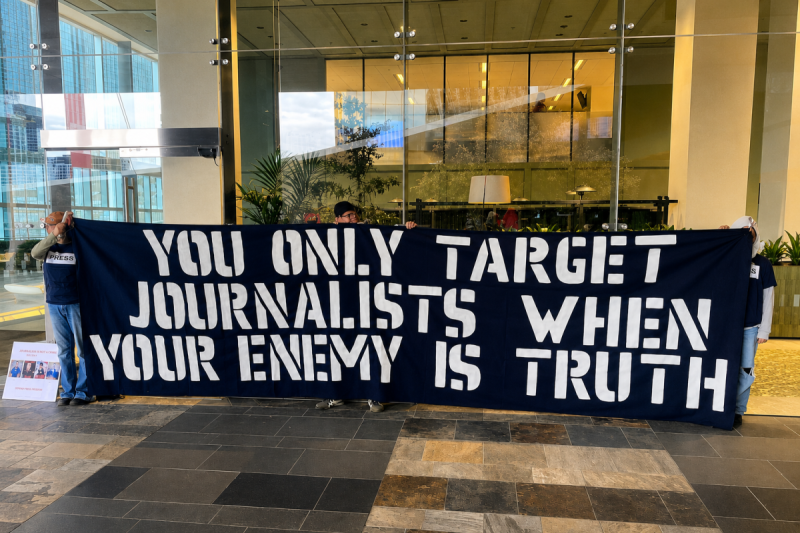
Where the truth lies

Photo by Marco Da Costa
In November 2024, I wrote an article for Canadian Dimension titled “Truth takes a side,” in which I argued that the intellectual defenders of capitalism are obligated to distort and falsify reality in order to conceal both the exploitative nature of capitalist society and its short span in human history.
At the same time, I suggested, those who defend the interests of the exploited and oppressed, especially if they promote anti-capitalist perspectives, have every reason to base themselves on an honest appraisal of unfolding events. Our side in the struggle doesn’t need to distort reality because, as Malcolm X once put it, “Truth is on the side of the oppressed today, it’s against the oppressor. You don’t need anything else.”
A year and a half has passed and I still contend that honesty is the best policy for the political left, just as lies and deception remain the weapons of choice for the right. This does not mean, however, that the truth is plain for all to see. It is often concealed in ways that are complex and confusing, and bringing it to light is no straightforward matter.
Barrage of lies
Before we can look for the truth, we have to first deal with a vast barrage of lies that blocks our way to it. This is all the more important because we are living at a time when the promotion of falsehood seems more pervasive and brazen than ever before.
Last June, Common Dreams took stock of the “wall of deception” that had been built by Israel and its enablers within the Western establishment in order to conceal the Gaza genocide or, at least, to hamper as much as possible the ability to grasp its enormity. The article justifiably pointed to “a global system complicit in sustaining Israel’s habitual lies and systematic deceit to cover up a starvation and a livestreamed genocide.”
I’m sure many of us had very few illusions about the corporate media’s commitment to truth long before the horror in Gaza began unfolding, but their dogged determination to deny a years’ long genocidal onslaught, even in the face of overwhelming evidence and a mountain of expert confirmation, has been beyond anything that could have been anticipated.
This calculated denial may break new ground but it is only part of a long-established and deeply entrenched process of falsification. Still, to watch Donald Trump and his cohorts in action is to see the brazen promotion of falsehood taken to a point where truth seems on the point of extinction. The term “post-truth” has now passed into the English language for a very good reason.
Those of us who wish to challenge the great injustices that abound at this stage in the development of global capitalism are very understandably outraged and, perhaps sometimes, disheartened by this “wall of deception.” So glaring is the web of lies, and so consistently is it woven and rewoven, that the fundamental untrustworthiness of the politicians and the media becomes obvious. Indeed, in looking for the truth, it sometimes becomes tempting to imagine that it is to be found by simply drawing the opposite conclusions to those who are being promoted by the guardians of the official discourse.
While the truth is often the inverse of what mainstream editorial boards allege, this isn’t always the case, and simply flipping the script of what the power structure would have us believe can lead to a great deal of confusion and disorientation.
First of all, not everything you read, hear or see in the capitalist media is actually untrue. As an institution, it reflects differences within the ruling establishment, as well as their shared fundamental interests. Partial and limited expressions of the truth are frequently advanced and, while we need to examine what is being put forward with a highly critical attitude, we can’t automatically reject everything that is asserted.
Rather than merely inverting the conventional discourse, we need to develop our capacity for independent investigation and develop analyses that are more than an exercise in refuting the official line. To paraphrase a popular meme, if the newspapers tell us it’s raining, rather than assume it isn’t, we need to look out the window.
Let’s take an example of how the inverted image approach can yield simplistic explanations that, in my view, lead to incorrect and harmful conclusions.
Iran protests
As I write, the United States and Israel may be poised to resume their brutal attack on Iran and no one on the left can fail to roundly condemn this attempt to obtain compliance with imperialist interests by unleashing death and destruction upon the Iranian people.
Yet we know that shortly before this assault was unleashed, Iran had been swept by a massive wave of anti-government protests, and this was but one of many such popular upsurges that have taken place throughout the country over decades. The question thus arises as to how we should relate to such developments. In answering it, we very quickly come up against the limitations of the inverted narrative approach.
If we examine what Western political leaders and the corporate media have to say, we can see that they paint a picture of the situation in Iran that is intended to serve their needs. The governing regime is presented as oppressive, and support is pledged to those who are taking to the streets in mass protests.
On March 11, the unfailingly right-wing New York Post ran an article in which “Israeli Prime Minister Benjamin Netanyahu called on the people of Iran to rebel against the oppressive Islamic regime.” Leaving no room whatsoever for misunderstanding, Netanyahu dramatically declared, “People of Iran, we are waging a historic war for liberty. This is a once-in-a-lifetime opportunity for you to remove the Ayatollah regime and gain your freedom.” I’m sure we can all agree that Netanyahu and his partner-in-crime, Donald Trump, have the most dismal credentials imaginable as freedom fighters.
We must also acknowledge that the US and Israel wish to influence internal opposition to the Iranian government and are very likely acting on this desire. Middle East Eye, for example, has pointed to evidence of Mossad involvement in the protests in Iran that it would be completely unjustified to reject out of hand.
Based on all of this, it is easy to see how someone who rightly opposes US and Israeli aggression, and is fully aware of the “wall of deception” that our enemies seek to erect to deflect scrutiny and criticism, would want to ask some serious questions about just where the truth lies. They would rightly refuse to take their lead from the State Department when it comes to assessing the nature of the governing regime in Iran and those who challenge it.
Here is where the need for independent thinking becomes critical: the assumption that “the enemy of my enemy is my friend” proves both inadequate and seriously misleading. Our opposition to imperialist aggression against Iran and the US objective of restoring the direct domination it was able to assert under the rule of the Shah should not prevent us from acknowledging the repressive and exploitative nature of the existing clerical regime.
Trump and Netanyahu very selectively draw attention to the repressive nature of the Iranian government, while ignoring that same ugly quality in regimes they support. However, their cynical exercise in deception shouldn’t prompt us to write off the vast numbers of exploited workers, oppressed minorities and women demanding their rights in the face of brutal repression as dupes of the CIA. We can’t treat the class struggle and popular resistance in Iran as an embarrassment or an inconvenience because of statements from the White House.
As a January article in Spring argues, it is a serious mistake to “disregard the working-classes of Iran while emboldening the capitalist regime to continue to commit atrocities with impunity.” There is a copious body of evidence showing that the Islamic Republic of Iran “has systematically repressed, arrested, and killed leftists since its inception” and “[t]he idea that the CIA or Mossad has simply created these protests dismisses the broader economic and political conditions driving the protests.”
An implacable hostility to the lies and distortions that are promoted by the Western establishment is essential but, at the same time, we must pay attention to the complexities and contradictions involved in a situation like the one unfolding in Iran. It is vital to oppose the present attack by the US and Israel on Iran but this should not beget an uncritical view of Iran’s governing regime and, even worse, the abandonment of the people throughout the country who are fighting back and demanding justice.
Truth is, indeed, on the side of the oppressed but, in order to discern it and act upon it, we must learn to think for ourselves and reject facile binary logic in our approach to political analysis.
John Clarke is a writer and retired organizer for the Ontario Coalition Against Poverty (OCAP). Follow his tweets at @JohnOCAP and blog at johnclarkeblog.com.