
The ‘we’ of anti-Zionism

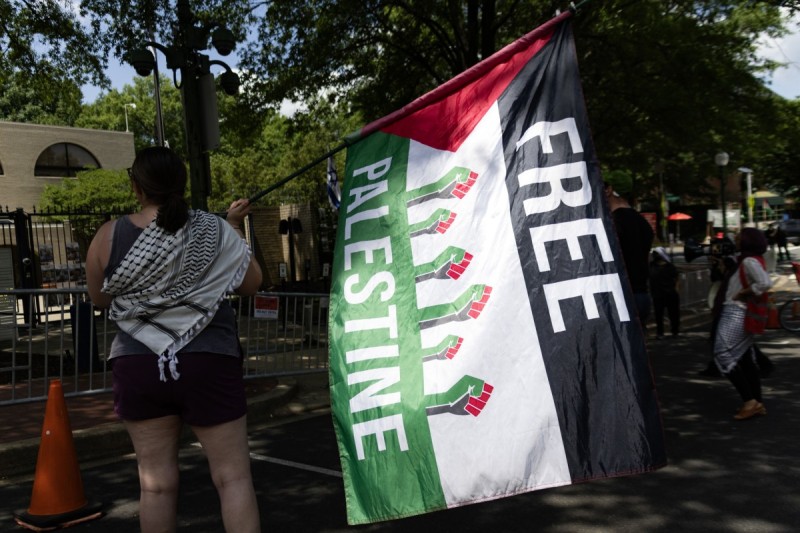
Photo by Diane Krauthamer/Flickr
The good news, at least according to Dr. Rachel Fish, is that “we” are winning. But this is precisely the problem. Speaking last month at the annual Sol and Florence Kanee Distinguished Lecture in Winnipeg—a high-profile event hosted at the Shaarey Zedek Synagogue and sponsored by both the synagogue and the Asper Foundation—Fish devoted her address to what she sees as a losing battle against antisemitism on North American campuses and in public life. Now director of the Brandeis University President’s Initiative on Antisemitism and co-founder of Boundless, which describes itself as a “non-profit think-action tank” working to “revitalize Israel education and take bold collective action against Jew-hatred,” Fish cast the struggle in stark terms: the forces advancing anti-Zionist politics are gaining ground.
In Fish’s telling, this “we” consists of a loose but influential coalition of university faculty, students, and activists who, she argues, have been fostering anti-Israel sentiment—and, by extension, Jew-hatred—since her own pro-Israel advocacy work began in the early-2000s. By the end of the evening, it became clear that “we” referred not simply to anti-Zionists, but to anyone unwilling to collapse criticism of Israel into antisemitism.
Indeed, her speech followed the same narrative as the 2004 film she produced as a member of the David Project (a now dissolved American pro-Israel campus group) called Columbia Unbecoming. This film, produced during the Second Intifada, shone a spotlight on a handful of Jewish students at Columbia University who professed to feeling bullied, censored, and silenced for their attempts to advocate for Israel by pro-Palestinian faculty in the university’s Middle East and Asian Languages and Cultures department. Fish cited this film proudly in her speech, arguing that things have only gotten worse. Her accusation that Columbia as an institution strongly supports an anti-Israel bias within its faculty may surprise those of us who remember the violent clampdown on the pro-Palestine Columbia encampment in 2024, facilitated by the university’s administration, and the post-encampment report from the university’s Task Force on Antisemitism that equated anti-Zionism with antisemitism. This is exactly the sort of conflation that sustained the logic of Fish’s recent speech. Throughout, criticism of Israel was conflated with antisemitism, even while Fish conceded that such an equation was “very hard to navigate” once you factored in all the Jewish and Israeli activists and Holocaust survivors who have spoken out against Israel’s genocidal actions since its now years-long assault on Gaza began after the events of October 7, 2023. As the evening wore on, Fish’s answer to these complications became clear: set them aside and return to the core premise underpinning the entire presentation—that anti-Zionism and antisemitism are ultimately inseparable.
Over the last year, Winnipeg has become an active battleground between the pro-Israel community and “us.” Since the ceasefire in Gaza was announced in October 2025, the push by Israel’s supporters to regain lost ground and credibility while attempting to silence pro-Palestinian voices has been felt in numerous ways. Most strikingly, in March 2026, Winnipeg City Council was poised to pass a proposal for a “Safe Access to Vulnerable Infrastructure” bylaw, which would institute harsh penalties for “nuisance” protests within 100 metres of schools, places of worship, hospitals, and other “vulnerable social” locations. In response, a massive grassroots protest managed to compel council to shelve the draconian motion. The following month saw an Israeli flag-raising on the grounds of the legislature to commemorate Yom Ha’Atzmaut, a celebration of Israel’s statehood in 1948. April also witnessed a brisk flurry of guest speakers advancing pro-Israel positions. Besides Fish’s keynote speech, the local Students Supporting Israel chapter hosted the “Triggered” tour, which featured Israeli soldiers recounting their experiences in Gaza. An event was held in the Adas Yeshurun Herzlia synagogue in Winnipeg’s River Heights neighbourhood. Two days later, Shaarey Zedek hosted a presentation, sponsored by Friends of Hebrew University, by former Israeli Ambassador Ido Aharoni Aronoff, who spoke on the subject of persuading students to feel positive about Israel again. Last week, the synagogue hosted Einat Wilf, a former member of the Knesset, who spoke about the “Palestinian right of return being a definite obstacle to peace.”
Each of these events, it should be noted, were held in synagogues, and it would have therefore been illegal under the proposed “nuisance” bylaw to protest them, including the appearance of possible war criminals from Israel.
Meanwhile, prominent Jewish institutions in the city, including the Jewish Federation of Winnipeg, have been pressuring the federal government to stop an upcoming temporary exhibit at the city’s Canadian Museum of Human Rights (CMHR) titled “Palestine Uprooted: Nakba Past and Present.” Scheduled to open in June, the exhibit has been denounced by Jewish community leaders throughout Manitoba, as well as national groups such as the Centre for Israel Jewish Affairs (CIJA) as being “one-sided” in its representation of the Nakba, which means “catastrophe” in Arabic, the violent expulsion of 750,000 Palestinians during the 1948 Arab-Israeli War. Indeed, the Jewish Heritage Centre for Western Canada—the sponsor of Fish’s keynote speech—immediately announced it would no longer consult with the CMHR because of its failure to collaborate on a “fair and balanced” approach. During the Fish lecture, the moderator and executive director of the Centre, Belle Jarniewski, lamented that the museum had been hijacked from its rightful stewards: the Asper family and the Jewish community. Hijacked, one reckons, by “us.”
Defining the “us” that has supposedly “created a fertile ground for antisemitism” on campuses across North America was the first order of business in Fish’s keynote address. The opening slide of her PowerPoint presentation, titled “Roots of Phenomena of Delegitimization of Israel,” broke down the ideologies that supposedly combine into the antisemitic “us” with surprising simplicity. The first “root” was “neo-Marxism.” Fish explained that this discipline had nothing to do with economic analysis, but was instead about seeing “power as bad and repressive.” The second factor, “post-colonialism,” was described as an ideology that condemns the actions of the Western world based on the idea that “colonialism was always bad. No good came out of it.” Incongruously, the next bullet was “Orientalism,” toward which Fish held special opprobrium, complaining that Edward Said’s groundbreaking study was assigned reading on an “obscene amount” of course syllabi. The third ideology presented was “postmodernism.” Fish described this with earnest insipidity: it’s a philosophy where “facts matter less, narratives matter more.”
Rather than directly contesting the documented claims and testimony advanced by pro-Palestinian voices, Fish instead framed “us”—especially students—as people misled by corrosive intellectual trends and outside manipulation: postmodernism, postcolonialism, “inverted morality,” recycled Soviet propaganda, Arab and Chinese funding allegedly “buying the hearts and minds of our students,” and “professional activists reliving moments of their youth.” Throughout the evening, Fish relied on the underlying premise that no reasonable person could arrive at an anti-Israel position through an assessment of material reality itself, thereby avoiding any sustained engagement with the facts of Israel’s military assaults on Gaza, Syria, Iran, and Lebanon. This, ultimately, is the defining gesture of the argument: sidestep the facts and retreat into narrative.
Denying facts on the ground, especially when they emanate from Israel itself, is the main support beam of North American Zionism at the present moment. Despite a mountain of pictures and videos posted by Israeli soldiers gleefully committing atrocities in Gaza, and even though major figures in the Netanyahu government consistently voiced their desire to exterminate Palestinians and to ethnically cleanse Gaza, much discussion remained focused on the “incendiary” chants of protestors closer to home. Fish’s presentation similarly focused entirely on the feeling and anxieties of Jewish students and, from this, argued for stronger institutional responses to campus Palestine solidarity activism, even suggesting that universities may need to “revamp their hiring processes.”
This last point, briefly raised but never fully unpacked, was the most chilling of the evening because it echoed the logic underpinning the Trump administration’s escalating attacks on post-secondary education. Without ever mentioning Trump directly, Fish aligned herself with a broader political project that invokes antisemitism less as a problem to be addressed than as a justification for increased surveillance, political interference, and disciplinary control over universities. The argument depends entirely on the conflation Fish returned to throughout the evening: anti-Zionism equals—and must equal—antisemitism. The danger of this conflation is that it ultimately becomes self-reinforcing. As criticism of Israel is increasingly framed as hatred of Jews, actual antisemitic backlash risks becoming further normalized, as recent attacks on Jewish institutions and individuals in England suggest. As historian Barnaby Raine contends in a recent interview with Equator magazine: “To use a term they have popularised, the Israeli state treats diaspora Jews as human shields. They attempt to strap us to Israel, effectively encouraging people to attack us in order to attack them, placing us in the line of fire by tethering our identity to their genocide.”
(The man who stabbed two Jewish men in the Golders Green area of London last month also stabbed a Muslim man the same day. He had been previously convicted in 2008 for stabbing two police officers and a police dog. These facts were either omitted, or buried deep in the reporting that focused on the incident as a purely antisemitic attack. As Barry Malone writes about these conspicuous elisions: “As someone who has spent my entire career in the news business, I can hear the machinery of their minds as they made those calls: it’s overcomplicated. It would ruin the headlines. It would kill the story.” In other words, “facts matter less, narratives matter more.”)
There is nothing new in this persistent conflation of Zionism with Judaism, or in the way it can be used to sideline anti-Zionist voices while allowing Zionist institutions to frame themselves primarily through the lens of rising antisemitism. Anna Lippman eloquently outlined the parameters of this conflation in these pages almost three years ago. What’s heartening about this is that “we” seem to be winning as the shopworn Zionist argumentation of someone like Fish becomes increasingly recognized as recycled and outdated; as a narrative that cannot be supported without sidestepping increasingly recognized facts.
As Israel’s aggressions against Palestinians in Gaza and the West Bank expand to attacks on all of its neighbours, support for Zionism continues to erode across North America and Europe. The danger of this conflation is that it can deepen polarization and blur the distinction between criticism of a state and hostility toward Jewish people themselves. At a moment of rising tensions and growing antisemitism in many countries, maintaining that distinction is more important than ever.
Mark Libin is a Professor in the Department of English, Theatre, Film & Media at the University of Manitoba.