
Media academics to blame in part for our news mess

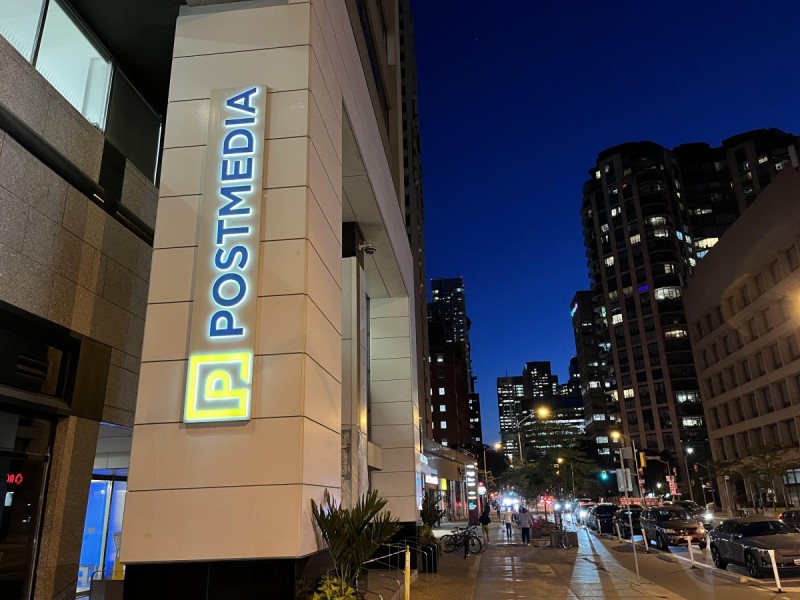
Postmedia headquarters, Bloor Street, Toronto. Photo by Harrison Samphir.
How on earth our press could fall into the clutches of private equity players and US hedge funds while our broadcasters were captured by our country’s largest telecom companies should be the subject of intense study by journalism and communications scholars at universities across Canada. Instead, too many of them have served as unwitting dupes at best and corporate lackeys at worst in the roll-up of our news media over the past few decades into one of the most tightly-controlled in the Western world. More recently, they have stood by and even cheered as the vulture capitalists shamelessly leveraged their acquired propaganda machinery to mount lobbing campaigns first for a government bailout, and then for a government shakedown of Big Tech. The resulting millions in subsidies should keep well-nourished for the foreseeable future our largest media parasite, Postmedia Network, which has taken more than $500 million out of our newspaper industry over the past 15 years. The US hedge funds that somehow own 98 percent of its shares, despite a supposed 25 percent foreign ownership limit, are laughing at us all the way to the bank for not clueing in to the long con they are working. Bell and Rogers on the broadcasting side have perfected the real money-making scam, however, as they use their government-granted market power to charge us through the nose for their services while each walks away with about $10 billion in profit every year, give or take a few hundred million. Now they want to be hooked up to the same lush subsidies that newspapers get. You will hardly hear a peep of dissent from the corridors of academe, aside from the dogged blog posts of one law professor and the occasional rantings of one communications scholar. Most media academics have no idea how business works, much less vulture capitalism, and their eyes glaze over at this admittedly arcane subject.
Unfortunately, the already thin ranks of academic media critics in Canada have just been thinned by one, as I was recently sacked by University Canada West just after I had moved from Vancouver Island to the mainland to teach three sections of Media & Society this term. From now on, I will be a media critic only as a journalist, at least as long as I can continue to find an outlet willing to publish my columns, and their numbers are growing fewer and fewer. Thank heavens for Canadian Dimension, which is literally the last publication in Canada radical enough to carry my contrarian takes. It’s even worse now that I’m without a book publisher following the recent forced retirement of my long-time enabler at New Star Books.
But I’ve got one scholarly round left in my overheated, smoking chamber, and I’m saving it to use it on my erstwhile colleagues in the academy, because before I was rendered a “former academic,” I had a paper accepted for presentation at this week’s Canadian Communication Association conference in Windsor. Titled “The Financial Engineering of Canada’s News Media,” its intent was to school scholars on the high finance wizardry being practiced by our media overlords. I was almost finished writing it when the axe came down. By then I had already paid for my flights and conference registration, so it was too late to cancel. I won’t finish writing the paper, but I will tell all assembled what they should know about money and our media in the conference equivalent of a Last Lecture. I might even get in a parting shot or two about how some in the academy have participated so enthusiastically in the sell-out of our news media.
A quick glance at the program shows that the CCA is still fixated on the same tired identity politics that have dominated academia over the past few decades and have left it discredited in the eyes of many. The keynote speech, which I probably won’t even attend, is titled “From LiveJournal to Large Language Models: Political Economy, Illiberalism, and Technocapitalist Futures,” and will be delivered by Dr. Alice Marwick of the University of North Carolina at Chapel Hill. “Two decades of platform capitalism have reshaped not only how we communicate but who gets to participate in public life, on whose terms, and to whose benefit,” reads the program description.
I am sure that many academics, especially those from UBC and Toronto Metropolitan University, will be glad to see the back of me, at least at conferences. I first threw back the curtain on corporate shenanigans at UBC in a 2004 scholarly journal article after a new school of journalism there was named after the Sing Tao newspaper chain of Hong Kong, which had built it a home on campus. Its name was unceremoniously deleted a few years later, however, after several Sing Tao executives landed in prison for fraud after inflating the chain’s circulation figures. Corporate funding was a mainstay of the Sing Tao School of Journalism, which is now part of a larger School of Journalism, Writing, and Media, including a $500,000 donation from Canwest Global Communications in 2001 to fund an Asper Visiting Professorship that continues to this day. The donation was announced shortly after the school’s director testified at Global Television’s licence renewal hearings of the joys that convergence would bring to our media after Canwest acquired the country’s largest newspaper chain, my long-time employer Southam.
“One of the things that has always disturbed me about journalism in Canada is that there were too many reporters chasing so few stories,” Donna Logan told the CRTC, which was considering limits on convergence but decided against them. “Converged journalism offers an opportunity to break out of that mould by freeing up reporters to do stories that are not being done and are vital to democratic discourse.” Instead, convergence soon bankrupted Canwest, whose debt the canny hedge funds bought up on the bond market for pennies on the dollar, using some to bid for Southam at auction. They continue to hold much of the rest today and use it to milk their renamed Postmedia of tens of millions in debt payments every year. Thus Canwest, convergence, and the Asper family crashed Canada’s media ruinously, yet their name lives on not just at UBC, but also at Western and Manitoba.
A half million was chump change compared to the $3.5 million Logan next helped wrangle out of CTV. As with the Asper donation, the money came from the CRTC’s “public benefits” program, which requires that 10 percent of the purchase price of any licensed broadcaster go to worthy causes. Bell had taken over CTV in 2000 for $2.3 billion, so $230 million had to go to public benefits. In this case it funded a Canadian Media Research Consortium across several universities, including TMU (then known as Ryerson) and Université Laval in Québec, which promised to “focus on important economic, social and cultural issues” and “produce stimulating and socially important research for public debate.” My 2013 study in the Canadian Journal of Communication showed that research produced by the CMRC instead served mostly media ownership and importantly contravened the program’s prohibition on market research.
Then there’s TMU, whose numerous media programs are housed in the sprawling Rogers Communications Centre, which took the media company’s name after a $12.5 million donation from its longtime owner. You won’t hear a peep critical of our highly-concentrated and ultra-profitable media industries coming from either its School of Journalism or School of Radio and Television Arts, which were lumped together a few years ago into something called The Creative School.
In fact, as my research has shown, its questionable research has actually been a pillar of poverty pleading by Canadian media in pursuit of ever greater subsidies. TMU loves corporate money so much it has posted a list of its donors online. One short-lived donor was Meta, which in 2018 funded five journalism startups to the tune of $100,000 each in a so-called Digital News Innovation Challenge in partnership with Ryerson’s School of Journalism. That was before the 2023 Online News Act prompted Meta to block news in Canada and withdraw from all of its funded activities. It was also in the beforetimes for TMU, which changed its name in 2021 after the discovery of a suspected mass grave of Indigenous children at a former residential school in BC because its then-namesake, Egerton Ryerson, had been one of the primary architects of the school system.
The influx of corporate money into Canadian journalism schools starting at the millennium was noted by a 2010 study, which referred to the funding as “greenmail” endowments, with the obvious imputation of influence peddling. It’s thus no wonder that critical media scholarship, of the kind I practice, has been hard to find at Canadian universities ever since. One of the last and most critical media scholars in Canada was Bob Hackett at Simon Fraser, a mentor of mine whose books and long-running News Watch Canada project shone a light on corporate power over the news. He retired in 2018, however, and no one has picked up where he left off despite the problems only growing worse. I have done what I could as a critic of Canadian media for the past quarter-century no matter where I have taught, which for the lack of an appointment in my own country (despite stellar credentials) has included Singapore (three years), Texas (five years), Fiji (two years until I was run off by its military dictatorship) and Malta, where I taught for four years before the pandemic prompted the expulsion of all foreigners.
Now I have one foot out the door, too, and there doesn’t seem to be anyone to whom I can pass this damn torch.
Marc Edge is a freelance writer who lives in Vancouver. His books and articles can be found at www.marcedge.com.