
Montréal’s working-class past revisited

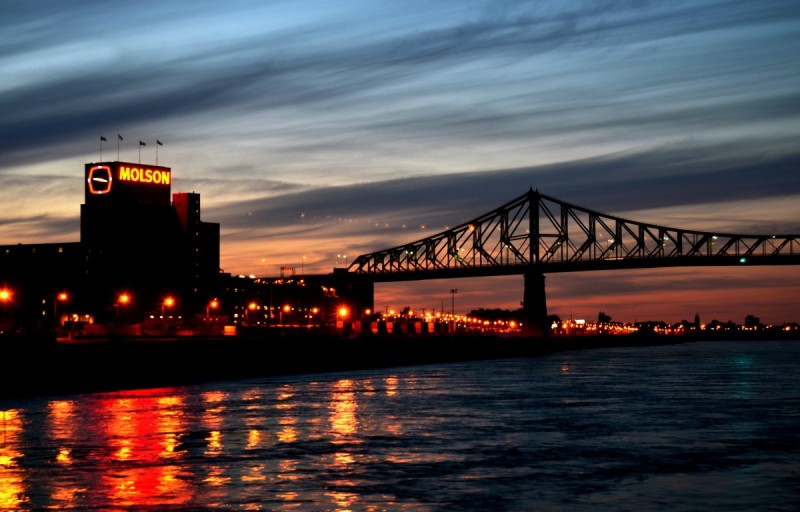
The Molson factory sign glows at dusk along the St. Lawrence in Montréal, just beside the Jacques-Cartier Bridge. Photo by Nic Redhead/Flickr.
As a young man I read Gabrielle Roy’s groundbreaking 1945 novel, Bonheur d’occasion (The Tin Flute), while living in my hometown of London, Ontario. This novel, set in the poor, working-class neighbourhood of Saint-Henri, was a life-altering book for me, resulting in my long love affair, albeit long-distance and infrequent, with the city of Montréal.
Gabrielle Roy’s sympathetic portrayal of the humble residents of Saint-Henri appealed to me, as did her underlying theme of social justice. Sixty years later, I’ve encountered a similarly remarkable book, Morel, written by award-winning Québec author, Maxime Raymond Bock, and brilliantly translated by another talented Montréal writer, Mélissa Bull.
Morel is the story of a construction worker, Jean-Claude Morel, who lived his entire life in the gritty working-class neighbourhoods situated east of downtown in the general vicinity of the Jacques-Cartier Bridge.
This beautifully crafted book traces the events of Jean-Claude’s life. From his childhood in an area once known as Faubourg à m’lasse to his old age in nearby Hochelaga, Jean-Claude sorts through his past. The reader is able to envision a man who has come to the realization that he can take a measure of pride in the work he has done and the life he has lived.
Jean-Claude knows the skills, dangers, and camaraderie of construction work. We visit taverns with him and his workmates, and we meet his lifelong friend, Nick Simatos, grandson of Greek immigrants, who eased Jean-Claude’s entry into the world of manual labour. Apart from Pietro di Donato’s Christ in Concrete (1939)—a novel about a bricklayer who struggles to provide for his family, a narrative inspired by the death of his father in a tragic workplace accident—I am not aware of another novel that describes so well the life and social milieu of a construction worker.
Several years ago, on a visit to Montréal, I took a walk through Saint-Henri. Much has changed since my first visits there, and gentrification is apparent in parts of what was once an impoverished neighbourhood. The shabby rowhouses of Rue Workman, a street Gabrielle Roy described as “frightful,” are long gone. As I turned onto Rue Beaudoin, a narrow street still dotted with adjoining homes that crowd the sidewalks, I passed a young woman and a crying child. Their belongings were stacked along the curb, waiting to be moved. It was a scene from Roy’s Bonheur d’occasion.
The neighbourhoods where Jean-Claude lived are miles east of Saint-Henri. But in so many respects, the story is the same. Residents of both districts have been forced to move, either for economic reasons, or to make way for so-called urban renewal. In Morel, Jean-Claude and others suffer through multiple traumatic moves. One move is preceded by an eviction notice announcing the planned demolition of homes to enable the building of a new highway. Even though local residents organize protests to prevent this, their efforts fail. For Morel, this move played a significant role in the breakup of his marriage and family.
Morel is not an overtly political novel. Morel himself seems indifferent to the political events of his time. Even though one of his sons is engaged in union and local protests and his friend Nick becomes a leader of the trade union Common Front, Morel remains largely outside of these movements.
I was in Montréal at a union convention in the week leading up to the 1995 sovereignty referendum. Québec’s labour movement was firmly united in support of independence. I walked the streets where Morel is set and took notice of Québec flags and “Oui” posters displayed everywhere: they were draped across balconies and duplex staircases, and posted next to countless windows. In spite of Morel’s own lack of political involvement, the cultural markers in the book—such as a plan for a mural to honour Louis-Joseph Papineau and the Patriotes at Papineau metro station, which Morel helped to build—shed light on why so many francophone workers from this neighbourhood voted “Oui” in that historic and closely contested referendum.
In a sense, Jean-Claude’s story begins and ends with the Jacques-Cartier Bridge. As a child, he learns an Indigenous origin story of the bridge that predates European arrival—a tale of Turtle and other giant beings, including an Otter whose body became the bridge. Many years later, his granddaughter shows him a sweeping view of the modern bridge, the river, and the city skyline from the eleventh floor of a government office building.
“In this panorama, the Jacques-Cartier Bridge provides the only comfort. Morel becomes aware of his own worth in front of the immutable bridge, unchanged from his earliest memories.”
Robin Philpot, Morel’s English-language publisher, has explained why he wanted to publish the English version of the book: “It’s a story that is not heard. Publishers like publishing stories about people who are down and out and in the margins of society, but rarely about workers who have dignity and a will to be respected despite very trying lives.”
Morel’s dignity and his will to be respected shines through brightly in this fine translation of Maxime Raymond Bock’s memorable novel.
Rob Rolfe, former Poet Laureate for the city of Owen Sound, is the author of seven books of poetry, including Don’t Look Back (The Ginger Press, 2023) and Beyond Mudtown (Quattro Books, 2013). He was a librarian and union leader in Toronto for many years.