
Avi Lewis isn’t breaking the NDP—he’s reclaiming it

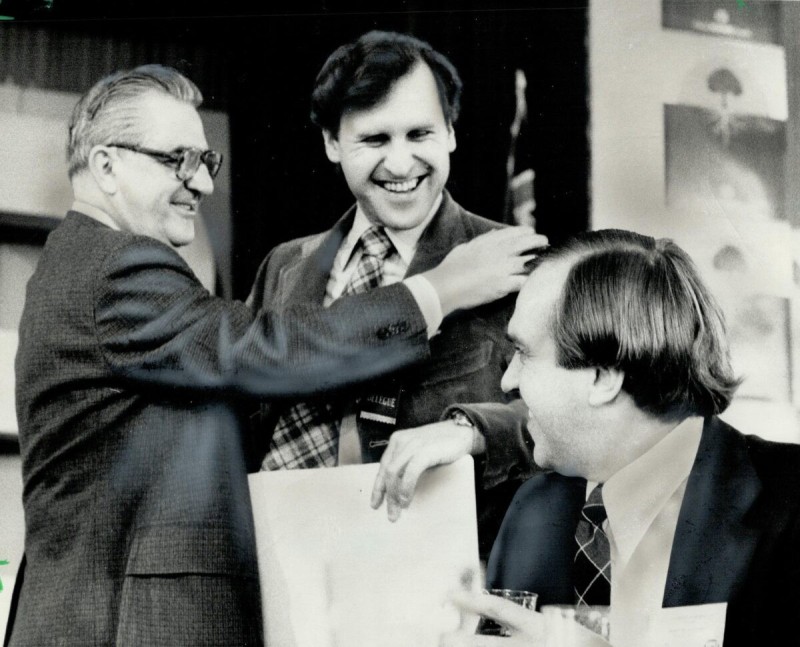
David Lewis (left) and Stephen Lewis (centre) congratulate Ed Broadbent (right) at the opening session of the 1978 NDP provincial leadership convention in Toronto. Photo courtesy Toronto Star archive.
Avi Lewis has barely taken the helm of the federal NDP, and already the reaction from mainstream punditry has been predictably overwrought. In the span of a week, right-wing commentators have cast him as both politically irrelevant and an existential threat to the country—a dangerous “communist” and an antisemite-harbourer whose rise signals something deeply sinister. The contradiction would be amusing if it weren’t so revealing.
Critics argue that Lewis represents a break from traditional NDP values, that the party’s old guard has been swept aside and replaced by a kind of “woke Marxism” that would have troubled Tommy Douglas. Even some less alarmist takes frame his victory as the culmination of a long-running internal struggle, with the party’s left finally prevailing over its establishment wing. Andrew Coyne, for instance, has suggested that this moment amounts to a delayed triumph for the Waffle faction over the party’s mainstream leadership once led, ironically, by Lewis’ own grandfather, David Lewis:
Somewhere, James Laxer is shedding a wistful tear. Along with Mel Watkins, Cy Gonick and others, Mr. Laxer led the radical Waffle faction within the federal NDP in the late 1960s and early 1970s, whose mission was to pull the party sharply to the left.
They advocated for nationalization of major industries, strict limits on foreign ownership, sharply higher taxes on the wealthy, and perhaps most controversially, withdrawal from NATO. They were organized, disciplined and uncompromising: a party within a party.
So alarming were they to the party leadership that they were eventually expelled. I believe the leader’s name was—no, don’t help me—it was… Ah yes: David Lewis.
There are, however, several problems with Coyne’s claim that Lewis represents a break from the party of his father and grandfather. It’s true that the Waffle challenged the NDP establishment and championed an unapologetically left-wing agenda. But the notion that they stood in stark opposition to a centrist party elite doesn’t hold up.
The ideological divide between the Waffle and the broader NDP, while real, has often been overstated. Even as party leaders pushed back against the faction, the mainstream NDP of the 1960s and 1970s remained firmly committed to democratic socialist principles. In fact, under leaders including Tommy Douglas, Ed Broadbent, and David Lewis, the party was in many ways more explicitly socialist than it is today—even under its new leadership.
What this means is that Avi’s version of democratic socialism is firmly rooted in an NDP history that is more radical than most pundits realize.
Much has been said about Lewis’ goal of expanding public ownership in Canada through the introduction of public options across sectors ranging from groceries to telecommunications. To be clear, Lewis is not proposing full-scale nationalization of these industries, but rather the addition of public alternatives alongside private providers. That approach was common within the mainstream NDP of the 1970s, though party leaders of the time were often more willing than Lewis to openly endorse broader nationalization and the idea of a planned economy. This perspective was evident even in Tommy Douglas, who, in his final speech as NDP leader in 1971, set out a sweeping socialist vision for Canada. Drawing on the experience of the Second World War, he argued that the country had already demonstrated its ability to organize much of the economy effectively, achieving what private enterprise had not up to that point:
The government organised over a hundred ground corporations. We manufactured things that had never been manufactured before. We gave our farmers and fishermen guaranteed prices, and they produced more food than we’d ever produced in peacetime. We built the third largest merchant navy in the world and we manned it. In order to prevent profiteering and inflation, we fixed prices, and we did it all without borrowing a single dollar from outside of Canada. My message to the people of Canada is this, that if we could mobilise the financial and the material and the human resources of this country to fight a successful war against Nazi tyranny, we can if we want to mobilise the same resources to fight a continual war against poverty, unemployment and social injustice.
In the mind of Douglas, it became clear that the NDP need not limit its policy framework to tinkering around the edges. The NDP shouldn’t even limit its horizon to adopting strong social programs which left capitalism in place. The goal must be nothing less than a planned economy:
We have in Canada the resources, the technical know-how and the industrious people who could make this a great land if we were prepared to bring these various factors together in building a planned economy dedicated to meeting human needs and responding to human wants.
So while many argue that the modern NDP would have alarmed Tommy Douglas as it moves leftward, the historical record suggests that Douglas in fact advocated a more expansive vision of public control than Avi Lewis. A similar dynamic is visible in discussions of unions and economic democracy, a theme closely associated with Ed Broadbent during his time as party leader. As I’ve argued elsewhere, Broadbent maintained that Canada could not be fully democratic without extending democratic principles into the workplace itself. Some of his policy ideas align with Lewis’, particularly around encouraging worker ownership in situations where firms are outsourcing. However, Broadbent went further than Lewis on the issue of automatic unionization. Where Lewis emphasizes making unionization easier through labour law reform, Broadbent’s position pushed the concept considerably further:
Just as a native in a modern nation is not required to decide whether or not to become a citizen of a country, so too in a place of work, men should not be required to show cause for the formation of a union. It should be an automatic right, i.e., no stipulated minimum support should be required before a union local can be formed. Unions should exist where working people exist, just as citizens exist where nations exist.
Even on the question of taxing the rich, Lewis’ approach could be described as more moderate than what his grandfather once envisioned. That’s not to say Avi Lewis is avoiding the issue. He supports higher capital gains taxes, a wealth tax, and an excess profits tax among other measures. But in the late 1970s, David Lewis was openly arguing for a more explicitly punitive approach to taxing wealth, including the idea of a maximum income. In a 1979 speech to the Ontario Federation of Labour, he made clear that taxation was not just about funding social programs, but about limiting concentrated economic power: “You can’t get much money by taking their income away from them, but you can introduce an entirely new attitude in the society of Canada by taking that away.”
In more concrete terms, David Lewis pointed to examples such as a corporate lawyer earning $336,000 (roughly $1.4 million in today’s dollars) and argued that no one should receive that level of income. He was even more critical of incomes in the $500,000 range (about $2.1 million today), asking, “By what right, by what kind of thinking does any man in this country deserve… half a million dollars of income a year?” While he acknowledged that some degree of inequality was inevitable, his tolerance for it was relatively limited: “If Ian Sinclair is that good, he can get $36,000 a year, but not $336,000 a year.” By implication, this amounted to support for an effective upper limit on incomes—something that would translate to roughly $1.5 million in today’s terms. It’s a stance that goes well beyond what Avi Lewis is currently proposing, and arguably more radical than even some Wafflers might have anticipated.
Taken together, these comparisons help clarify that Avi Lewis is not an outlier severed from the party’s roots, as some critics suggest. Rather, many of his ideas can be traced back through decades of NDP history, and in some cases all the way to the early CCF tradition. Seen in that context, Lewis can appear less like a radical departure and more like a continuation—if not, in some respects, a comparatively pragmatic one relative to earlier generations of party leaders.
This also points to a broader pattern. Figures like Tommy Douglas, Ed Broadbent, and the Lewis family are widely respected across the political spectrum, to the point that Douglas was named the “Greatest Canadian.” Yet that cross-partisan admiration often comes with a selective memory. Liberal and Conservative commentators who praise these figures as national icons tend to downplay their explicitly socialist commitments. Douglas is remembered as the father of medicare, but not for his advocacy for comprehensive economic planning. Broadbent is remembered as a principled advocate for “regular people,” rather than someone who argued for extending democracy into the workplace. And David Lewis is remembered for confronting the Waffle faction, rather than for supporting tax proposals that would have placed strict limits on very high incomes.
In that sense, claims that the NDP was once a home of “moderate” leftism rest on a somewhat sanitized reading of its history. Lewis strikes fear in the defenders of the status quo, not because he’s out of touch with NDP history, but because he’s firmly rooted in it.
Christo Aivalis is a political commentator and historian, holding a PhD in Canadian History from Queen’s University. His writing has appeared in Jacobin, The Breach, Ricochet, Maclean’s, the Globe and Mail, and the Washington Post.