
The Palestinian Nakba: Is truth and reconciliation possible?
_(cropped)_800_633_90.jpg)
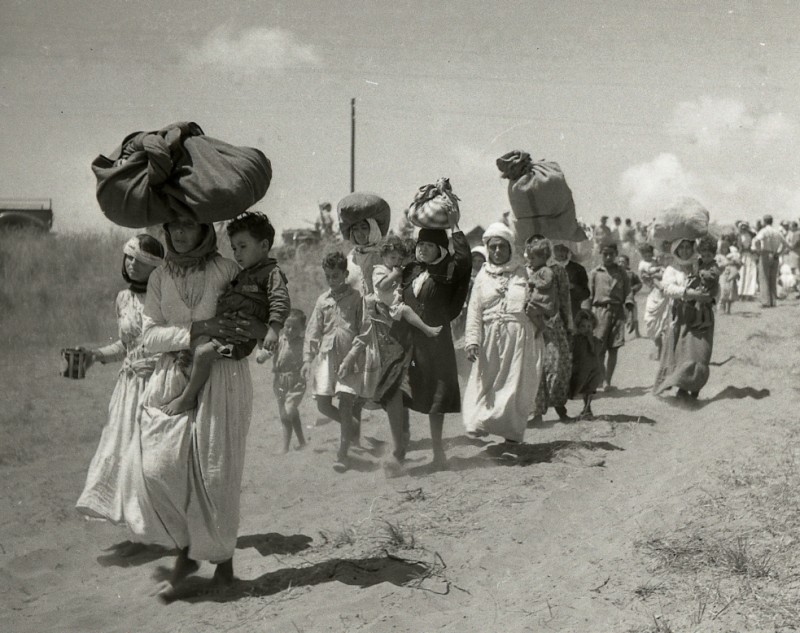
Palestinians from Tantura, a small Arab fishing village, are expelled to Jordan during the Nakba, June 1948. Photo by Benno Rothenberg/Meitar Collection/National Library of Israel/Wikimedia Commons.
_(cropped).jpg)
As a Canadian-born citizen of Palestinian origin, I learned that part of confronting my experience of intergenerational trauma and injustice includes reflecting on Canada’s Truth and Reconciliation policies towards Indigenous peoples, which in turn helps to explain how Canada shapes and advances Zionism’s aims.
Every year in May, Palestinians memorialize the Nakba (“the Catastrophe”) which refers to the process whereby Palestinians were forced out of their ancestral homelands through ethnic cleansing and political violence, driven by international collusion with Israel’s settler-colonial expansion that persists to this day. I use the word memorialize deliberately because the process that the Nakba names has been called a “memoricide”: a relentless effort to erase anything related to Palestinian identity or indigeneity and to expunge it from the world’s—and more particularly the West’s—collective historic and political imagination.
For Palestinians, preserving our stories, our teachings, our ways of being, and our identities are all part of resistance through memory. Remembering is what keeps who we are alive.
This year, I am remembering and honouring my parents, who survived being born and raised in refugee camps in Lebanon and lived through the Lebanese civil war. I am especially remembering my late father, who passed away last year, and who happened to be born on October 7, 1951—three years after the initial Nakba, and 72 years before a day that would change our world forever.
The Nakba is an ongoing process that officially began during the 1948 Arab-Israeli war, although the Zionist ideological groundwork for it was first laid in 1799 during the French colonial invasion of the region by Napoleon. Some three decades years later, British colonialists stepped in. Since the events of October 7, 2023, the Nakba and Palestinian grievances have returned to centre stage, putting to rest any risk that they will disappear down the memory hole and vanish from the hearts and minds of people of conscience worldwide.
Renewed attention to the plight of the Palestinian people has cast light on the role of myriad elements of Canadian society in the Nakba: from academia to political organizations to state and non-state actors. It has also drawn attention to Canada’s outsize historic role in advancing Zionist aims, which also helps to explain Canada’s current policies and positions. And it provides perspective on the real nature of the politics of Truth and Reconciliation with respect to Indigenous peoples.
As Véronique Sioufi observes in a 2024 article titled “If Canada wanted reconciliation, it would stand with Palestine”:
The Canadian state has tried to cultivate an image and identity as an exception among settler colonial nations—a leader in both Indigenous reconciliation and multiculturalism domestically and a neutral peacemaker on the world stage.
There’s one obvious exception to this cultivated image. Canada has made an exception of Palestine in its self-proclaimed dedication to racial equity and global human rights, supporting Israel unconditionally despite its documented apartheid, arbitrary detention and torture (including of children), forced expulsions, illegal settlements, ethnic cleansing and genocide against the indigenous Palestinian people.
The author’s parents. Photo submitted.
The Jewish Legion in Canada
In 1918, a Jewish Legion was established in Windsor, Nova Scotia. Its objective was to recruit Jewish people from across North America to fight alongside the British Empire in the First World War. Jews enlisted from all over the world. Among the volunteers was David Ben-Gurion, the first prime minister of Israel and architect of the ethnic cleansing of Palestine, and Yitzhak Ben Zvi, Israel’s second president. Their goal at the time was to support the British campaign against the Ottoman Empire in Palestine in light of the commitment set out in the 1917 Balfour Declaration to establish a “national home for the Jewish people” in Palestine. This despite the fact that the British had made conflicting promises regarding Palestine and despite the famous caveat that “nothing shall be done which may prejudice the civil and religious rights of existing non-Jewish communities in Palestine.”
In 1966, Ben-Gurion wrote a letter to the mayor of Windsor in which he expressed his fond reminiscence and appreciation of his time in Nova Scotia. In it, he also acknowledged how ‘Palestine’ was replaced with ‘Eretz Yisrael.’ “In Windsor,” he wrote, “one of the great dreams of my life—to serve as a soldier in a Jewish Unit to fight for the liberation of Israel (as we always called Palestine) became a reality, and I will never forget Windsor where I received my first training as a soldier, and where I became a corporal.”
Thus, however unwittingly at the time, Canada and its territory played a significant role in the Zionists’ pre-Nakba military preparations for campaigns to expel the Palestinians.
The genocide that has been unfolding since October 7, 2023, has revealed to the world the historical continuity between those initial expulsion campaigns and the current deliberate evacuation and expulsion plans inside what remains of the historic land of Palestine, namely the Gaza Strip and the occupied West Bank. The world has also seen how Palestinians choose to remain on the land even in the face of unrelenting persecution and genocidal violence. Many families have been wiped off the civil registry for doing so.
Zionist appeasement and the roots of Canada’s immigration system
One of the Canadian state’s longstanding points of pride has been its reputation for having an ‘enlightened’ immigration system that purportedly welcomes newcomers and makes the country a safe haven for refugees seeking a new home on humanitarian grounds. This myth is belied by the fact that immigration policies and practices in Canada stem less from any moral considerations than from an ongoing need for mass labour for the purposes of economic expansion.
What is even less well known is that the immigration system actually grew, in part, out of “field-testing” non-European mass immigration to Canada with the resettlement of Palestinians dispossessed during the Nakba. As historian Jan Raska explained in a 2015 article, the thinking in government was that, despite concerns about the reaction of the Arab states towards any plan to resettle Palestinian refugees in Canada because it might interfere with efforts to repatriate them, resettlement of part of the growing refugee population would contribute to stability in the region. Moreover, certain people in government were favourable to Palestinian refugee resettlement generally in part because they wanted Canada to be able to contribute less to Palestinian relief.
Another factor in the evolution of Canadian policy in this instance was undoubtedly the anti-Arab and anti-Palestinian racism that were rife already in the 1950s, as evidenced by statements Raska unearthed from Canadian diplomatic correspondence and newspapers from that period, Ultimately, in the wake of much deliberation and after creating an array of barriers to selection, only 98 of 905,986 registered Palestinian refugees were admitted. In his conclusion Raskin notes that Canadian immigration policy in the 1950s did not differ substantially from the view laid out by Prime Minister Mackenzie King in 1947 that Canada should “remain a predominantly white, Christian, and democratic society.”
The 39th Battalion of the Jewish Legion pose for a photo at Fort Edward, Nova Scotia on Yom Kippur, 1918. Photo courtesy Halifax Citadel/Parks Canada/Wikimedia Commons.

Raska goes on to note that this was “an important early experiment for the resettlement of non-European refugees to Canada,” yet he also points out that only a year after the very tentative acceptance of Palestinian refugees, Canada admitted over 100,000 people from the British Isles in the wake of the Suez Crisis, as well as over 30,000 Hungarians who were fleeing the Soviet invasion of 1956.
Clear echoes of Canada’s earlier, and more patently racially biased, immigration policies (which have also been informed, then and now, by support for the Zionist project) are discernible in Canada’s inhospitable response to Palestinians desperate to escape the current genocide, especially when compared with its welcoming attitude toward Ukrainians fleeing the Russian invasion. Many individual observers and organizations have commented on this blatantly unequal treatment under the widely criticized special Gaza temporary resident visa program, which was supposed to allow 5,000 relatives of Palestinian-Canadians to come to Canada temporarily. That cap was reached on paper in March 2025, but by the end of November 2025, only 950 people had arrived in Canada.
Critics point out that more restrictive criteria are being applied to Palestinians than to other refugee claimants. One Amnesty International document refers to “extraordinary administrative and security clearance barriers, all complicated by the rapid destruction of the infrastructure with Gaza.” In the case of Ukrainians, by contrast, as many commentators have emphasized, bureaucratic obstacles were minimized, and Canada approved over 930,000 applications in 2022; by February 2026 nearly 300,000 had arrived under the Canada-Ukraine Authorization for Emergency Travel, which allowed “an unlimited number of Ukrainians fleeing war to work, study, and stay in Canada for up to 3 years.”
As Kandice Pardy notes in an article for Policy Options: “Ukrainians fleeing war and persecution should be able to seek safety. But so should all refugees. Unfortunately, the existing legal infrastructure contributes to vastly unequal outcomes for people fleeing conflict, depending on factors such as skin colour, ethnicity and country of origin.”
Given all this, there is some irony in the fact that in 2023, in the midst of Israel’s current extermination drive, an Israeli intelligence ministry “concept paper” was leaked that floated a proposal to have the entire Palestinian population of the Gaza Strip forcefully transferred to other countries, with Canada highlighted as a possible final destination due to its “lenient” immigration policies.
Canada’s role in the dispossession of the Palestinians and the creation of the State of Israel
In the period leading up to the 1947 Partition Plan, which proposed dividing historic Palestine into separate Jewish and Arab states, Canada played a significant role in bringing the Zionist dream of statehood to fruition at the expense of the Palestinians. Canada was among the 11 member nations of the United Nations Special Committee on Palestine (UNSCOP), established in May 1947 shortly before Britain handed the question of Palestine over to the UN.
UNSCOP was tasked with proposing solutions to the “Question of Palestine.” Representing Canada was Supreme Court of Canada Justice Ivan C. Rand. Rand is regarded as having been so influential in the politically divided committee as to have tipped the scales in favour of the subsequent partition of Palestine and ensuing creation of a Jewish state on more than half the land. Rand’s pivotal role (as well as that of Lester Pearson) is addressed in some detail in Hassan Husseini’s “A ‘Middle Power’ in action: Canada and the partition of Palestine” (Arab Studies Quarterly, Vol. 30, No. 3). He shows that Rand was swayed by Zionist lobbying and held views that reflected dehumanizing colonial attitudes towards Indigenous populations.
Today, we are witnessing a further example of this with the creation by Donald Trump of the laughably named “Board of Peace”—yet another committee seeking to advance Zionist expansionist aims at the expense of the indigenous Palestinian people.
Arab residents being forced out of Haifa by armed Haganah militiamen during the Nakba, April 1948. Photo courtesy Bettmann Archive/Wikimedia Commons.

The Nakba and Truth and Reconciliation: What’s really happening and where do we go from here?
I am someone with a foot in two worlds: a Palestinian, with first-hand experience of the impact of the Nakba, and a native-born Canadian, who witnesses and involuntarily contributes to the ongoing dispossession of Indigenous peoples by the settler-colonial state of Canada. This gives me unique insight. My ethnic and experiential background allows me to take a constructively critical perspective that helps bring to light and educate others about hidden realities. While Nakba Day is banned in Israel and National Truth and Reconciliation Day is celebrated in Canada every year on September 30, I have to ask what is really behind our country’s Truth and Reconciliation politics given Canada’s past and current attitude towards Palestine and its Zionist appeasement and apologism.
Although the Nakba is being acknowledged on some official and national platforms in Canada, Canada continues to support Zionist objectives in distinctive ways. For example, Scotiabank, one Canada’s largest banks, was until very recently the biggest foreign investor in Elbit Systems, an Israeli arms manufacturer (it was forced to divest after strong citizen pressure). Elbit, which has subsidiaries in Canada, is known for testing newly developed weaponry and surveillance technologies on Palestinians before exporting them worldwide.
Moreover, the Canada Pension Plan invests in illegal Israeli settlements and many Zionist charitable organizations use Canadian tax dollars to fund Israeli settlements that dispossess Palestinians.
As I commemorate the Nakba as a Palestinian and honour my family and roots, I remain alert to the potential of the Truth and Reconciliation model in Canada, but I am also keenly aware of its shortcomings and pitfalls in practice. Parallels abound. Just as Israel has built national parks on lands that were former Palestinian villages (one of them is called Canada Park), national parks in Canada, as Robert Jago writes in The Walrus, are colonial crime scenes erasing historical injustices committed by the settler-colonial state. It may be possible to learn from Canada’s mistakes and, in the Palestinian context, to point in a much needed positive direction given some of the similarities with the Canadian and South African experiences.
At the same time, Truth and Reconciliation can serve as a form of pacification, a kind of Trojan Horse that brings with it the liquidation of any real sovereignty or self-determination and the subduing and eventual disappearance of the aspirations and claims of nations in the name of peace and prosperity.
Whatever path is taken by the Palestinians will not lead to justice for those dispossessed and displaced by the Nakba. For me, in the in-between space as a Canadian and a Palestinian, commemorating the Nakba becomes an act of freeing myself by charting a course that is not dictated by either identity; it means pursuing personal sovereignty and self-determination. My desire for political justice finds expression in my quest for personal justice. This too honours my ancestral lineage and my family heritage. As we learn from Indigenous teachings: “[W]hen we heal ourselves, the healing ripples out to touch not only our descendants but our ancestors as well.”
Ahmad Moussa is an international freelance writer, researcher and activist. He holds a Master of Arts in International Law and Human Rights.