
Alberta separatists think their referendum pitch is about democracy. It’s not

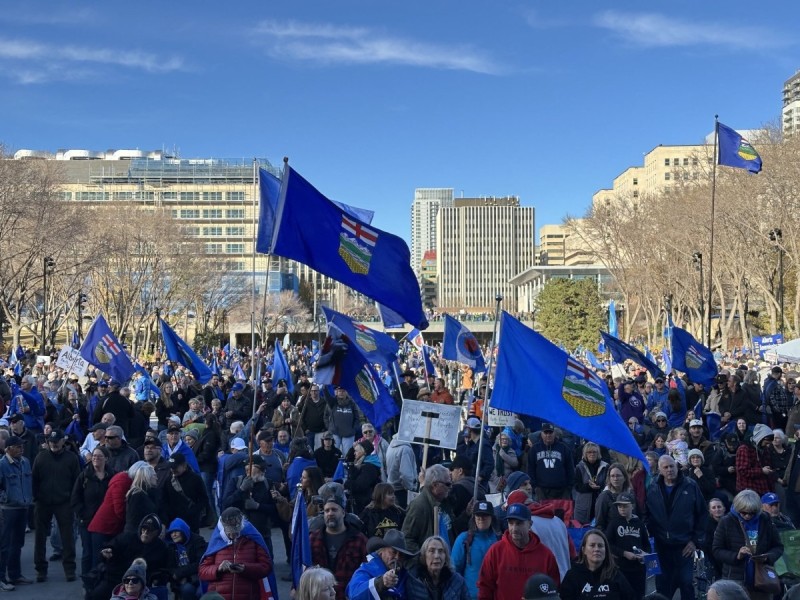
Alberta separatists have no authority to unilaterally reopen or disregard treaty relationships that predate the province itself, writes Eric Strikwerda. Photo courtesy Alberta Prosperity Project/X.
A small but loud group calling itself “Stay Free Alberta” has lately been campaigning to give Albertans the right to vote on a referendum on whether the province should separate from the rest of Canada. Their petition to get that issue on a ballot during this autumn’s provincial election has, they say, garnered the required number of petition signatures to comply with provincial referenda regulations, although questions remain as to the legitimacy of the petition and its signatures.
Recent polling, however, suggests that a consistently high majority of Alberta respondents rejects separation on its face. And dealing the separatists a potentially fatal blow last week was Alberta Court of King’s Bench Justice Shaina Leonard’s ruling quashing Elections Alberta’s earlier approval of putting the petition before the voting public in October.
Disappointed separatists, as well as some United Conservative Party MLAs, have tried to spin Leonard’s ruling as abrogating the rights of the people to make their voices heard. “We think that today’s decision by the court will deny opportunity to well over 300,000 Albertans to have their petition verified by Elections Alberta,” the premier argued last Wednesday. “We think,” she continued, “that this decision is incorrect in law and anti-democratic.”
Others, like Red Deer South MLA Jason Stephan, suggested the judge’s ruling was profoundly unfair. “All those good people put in so much work and time,” he noted on Friday, “and then basically, the rug was pulled out from under them.” For his part, Alberta Solicitor General Mickey Amery argued that the question itself is so important that Albertans must have the right to “weigh in” on the matter.
This is, and must be called out as, political spin. The issue at hand is not whether Justice Leonard’s ruling might be perceived as ‘anti-democratic.’ Neither is it about how much time and effort so many ‘good people’ put in to collect signatures for the petition. And it’s certainly not about how ‘important’ the issue might be to however many Albertans are interested in it.
The issue at hand is instead about the century and a half long legal relationship between Indigenous peoples in what is now called Alberta and the Crown. That relationship predates Alberta itself.
In 1870, the Canadian government acquired from the British Crown all of what was then called Rupert’s Land and the North-West Territories, which included present day Alberta, Saskatchewan, Manitoba, Yukon, the Northwest Territories, Nunavut, and parts of northern Ontario, Québec, and Newfoundland and Labrador. It was an enormous transfer of land. But it was no ordinary real estate deal, in large measure because the entire region was already occupied by tens of thousands of Indigenous peoples, including at least ten thousand Métis.
At the time of the transfer, John A. Macdonald’s Conservative government in Ottawa was keen to transform the region from a fur trade economy to an agricultural empire. He and others envisaged millions of acres of land opened for settlement, tens of thousands of immigrants engaged in wheat production, the rise of rural towns and industrial centres to service the wheat economy, the imposition of law and order, and a railway to transport goods and people into and out of the region.
It was an ambitious program to be sure. Complicating matters further was Indigenous title to the territory. Establishing an agricultural empire would require extinguishing that title—and Macdonald and his confreres were eager to nullify it by non-violent means. They knew full well the damage and violence and costly disorder associated with the so-called “Indian Wars” in the United States during the 1850s and 1860s, which saw the deaths of tens of thousands of Indigenous and non-Indigenous peoples alike. Macdonald did not wish for a repeat in Canada. And so, beginning in 1871, Ottawa despatched negotiators westward to meet with the various Indigenous groups that had called the region home for more than ten thousand years. Over the next four decades, Indigenous peoples and representatives of the Crown signed 11 Numbered Treaties which established an ongoing legal relationship between signatories to last “as long as the sun shines, as long as the grass grows, and as long as the rivers flow.” These treaties are constitutionally protected agreements that continue to structure political authority, land use, and governance across the Prairies today. They are not mere symbolic historical artefacts.
The idea that Alberta should separate from the rest of Canada is not a good one. And it’s not novel either. It pops up every once in a while, especially at times of geo-political, economic, or social instability. We saw it during the Great Depression of the 1930s, when disgruntled Social Crediters were angry that the courts disallowed clearly unconstitutional legislation passed by Premier William “Bible Bill” Aberhart’s government. We saw it again during the late-1970s and early-1980s at a moment of stagflation and the height of Alberta animus toward the federal Liberal government of Pierre Trudeau, who had sought to increase federal ownership of the oil industry through the failed National Energy Program.
If anything is unique about this time, it’s that during those previous periods, Albertans had elected governments that were staunchly federalist, and made no truck with the separatists.
Not so this time. In the governing UCP under Danielle Smith, Alberta separatists have found a premier and a government eager to stoke up separatist sentiment (see last year’s Alberta Next Panel and associated chicanery) by facilitating the independent Alberta crowd’s efforts at getting their separation question on a referendum ballot this autumn.
The problem, as Justice Leonard’s ruling makes clear, is that they have no legal standing on the matter. Alberta exists because Indigenous nations entered into binding agreements with the Crown—not with a future separatist movement animated in no small part by reactionary grievances. Whatever political frustrations separatists claim to represent, they cannot erase the constitutional and moral reality that these lands are governed by treaties that remain in force today.
Eric Strikwerda teaches Canadian history at Athabasca University. He is the author of The Wages of Relief: Cities and the Unemployed in Prairie Canada, 1929-1939 (AU Press, 2013). At present he is working on a history of western Canada following Canada’s acquisition of the region in 1870.