
Inside Toronto’s growing tenant revolt

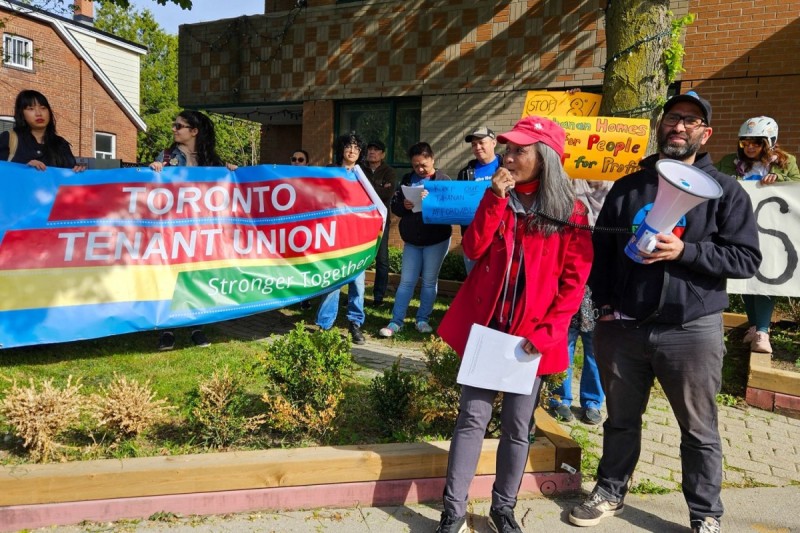
Tenants are showing a greater inclination to band together, organize, and take direct, collective action in confronting their landlords. Photo courtesy the Toronto Tenant Union/X.
On Saturday, April 18, close to 300 people crammed into a school basement for a spirited founding convention of the new citywide Toronto Tenant Union (TTU). It was a riveting all-day event, an indicator of the growing momentum in the tenant and housing-justice movement. “Time to organize!” was the theme.
“The Founding Convention of the Toronto Tenant Union marks a bold new chapter, merging our strength, and growing our collective power across the city,” read the convention call. “This isn’t just a meeting, it’s the start of a citywide movement.”
Tenant movements are emerging globally as one of the most significant social movements of our era, demonstrating an ability to unite working-class people across all divides, promote self-organization, and develop a capacity not only to fight back collectively against predatory landlords, but also to win victories.
A wave of tenant organizing and high-profile rent strikes has taken place across Toronto in the past few years. Tenants have formed a variety of unions or associations, sometimes informal, sometimes more structured. Tenants are showing a greater inclination to band together, organize, and take direct, collective action in confronting their landlords.
The grassroots organizing that sprang up during the pandemic contributed to this momentum by boosting community solidarity and social connections. In Toronto, these initiatives included the “Keep Your Rent” campaign launched by Parkdale Organize, mutual aid networks, emergency food support initiatives, peer-based community outreach, and active support for unhoused neighbours and encampments.
The rent strikes across Toronto have been dramatic, all of them occurring in working-class, heavily racialized neighbourhoods. Some lasted well over a year, with virtually all winning gains for tenants. Withholding rent is obviously risky for individual tenants. But people have taken that step believing that their collective power, and the protection of the tenant union, will carry them through.
In 2014, the City of Toronto identified 31 of its 158 neighbourhoods as Neighbourhood Improvement Areas (NIAs). Previously known as “priority neighbourhoods,” these 31 were chosen for targeted improvement based on socio-economic indicators such as low income or lack of services. The majority of these 31 NIAs were in the inner suburbs. The ward of York South-Weston overlaps or contains within it, seven of these 31 NIAs.
Over the decades, various reports, such as United Way’s Poverty by Postal Code (2004), identified Toronto’s inner suburbs as sites of growing levels of poverty, with few employment opportunities, few programs for youth, poor transit, inadequate housing, an influx of newer immigrants, refugees, and asylum seekers, and an overall lack of services to meet the needs of residents.
David Hulchanski of the University of Toronto’s Centre for Urban and Community Studies has shown how Toronto became more and more segregated by income, social status, and ethno-racial origin, with increased poverty concentration in the inner suburbs and in a handful of low-income neighbourhoods that remain in the downtown core. His 2006 report The Suburbanization of the “Non-Gentry”: The Impoverishment and Racialization of Toronto’s Inner Suburbs documented how low-income and non-white Torontonians have been squeezed into the city’s least desirable urban spaces as gentrification swept the city core.
Toronto’s much celebrated ethnic diversity is a reality largely in these neglected and under-resourced parts of the city, where a highly diverse, racialized working-class is the majority.
Financialization and unaffordability
Toronto is now the most expensive city in Canada. Home ownership is out of reach for the vast majority of working-class people, and the number of renters in the city is growing at double the rate of home purchasers. Toronto is on the verge of joining Vancouver and Montréal as cities that have a tenant majority. Across the country, 34 percent of people now live in rental accommodation.
Being a tenant in Toronto is also increasingly unaffordable. Average rents have climbed over 100 percent in just the past decade. The average monthly rent for a one-bedroom unit is now in the range of $2,300-$2,590. A 2025 survey revealed that more than a third of Toronto’s renters were spending more than half their income on rent.
Over 105,000 households are on the waiting list for subsidized housing in Toronto. Province-wide, the figure is 300,000. The waiting period for a subsidized one-bedroom apartment in Toronto is 14 years.
The share of Toronto’s housing stock which is non-market is currently at a dismal 4.5 percent and it continues to decline. Canada is losing far more affordable housing than is being built.
Many working-class and poor people are being forced to pay an exorbitant portion of their incomes on rent, often for low-quality and inadequate housing. The impact of this is hardest for low-wage and precarious workers, newcomers, and those on fixed incomes: social assistance, disability benefits, and public pensions. A shocking 44 percent of Canadians are spending more than a third of their income on rent while 15 percent are spending more than half.
Ideally, the place we call home should be an environment where we can thrive as individuals and families. Instead, for many, the unaffordability of market-supplied housing has turned “home” into a financial headache, a source of anxiety, stress, and exploitation.
The personal impact on residents is especially hard for those who have a corporate landlord. Today’s landlords are often predatory corporate entities whose singular goal is to maximize profits. Behind those often-nameless entities are REITS, speculators, asset managers, finance capital, even workers’ own pension funds. Their loyalty is to their investors, not to tenants or communities. They often care little about the proper maintenance of the buildings they own or manage.
Leilana Farha, former UN Special Rapporteur on the Right to Housing, has written extensively about the social impact of financialization: “capital investment in housing increasingly disconnects housing from its social function of providing a place to live in security and dignity and hence undermines the realization of housing as a human right.” And further, “housing and financial markets are oblivious to people and communities, and the role housing plays in their well-being.”
In the past several years, large corporate landlords have been consolidating their hold on rental housing. One study found that corporate landlords are buying up 90 percent of the rental stock for sale. They focus on buying older, cheaper buildings, often in low-income neighbourhoods, and use evictions and vacancy decontrol to displace existing tenants so they can raise the rent.
Since the end of the pandemic, eviction filings have soared because of an offensive by corporate landlords seeking to displace and remove people. These evictions are generally not personal. Many corporate landlords don’t even know their tenants. Evictions are seen as part of the cost of doing business—that is, increasing rents. Evictions in neighbourhoods such as York South-Weston heavily impact Black and racialized residents. Financial landlords have triple the eviction filing rates compared to other landlords.
Apartment blocks in Toronto’s West End. Photo by Andrew Kiss/Flickr.
Tenant mobilization and the York South-Weston Tenant Union
On May 1, 2023, over 100 tenants in a three-building complex in Thorncliffe Park began withholding their rent. Thorncliffe Park was intentionally built as one of Toronto’s first high-rise rental communities. Almost 90 percent of residents are renters, while 82 percent are racialized, mainly newcomers from South Asia, the Middle East, and the Philippines. The poverty rate is double the city average.
The landlord, Starlight Investments, had pushed for a 10 percent rent increase over the previous two years. Starlight responded to the rent strike by filing for mass evictions, but the tenants held firm. More than two years later, an agreement was finally reached between the tenants and Starlight. Commenting to the media, Philip Zigman, a tenant organizer who worked with the Thorncliffe Park residents, said the agreement “speaks to the power of working-class organizing and will encourage other tenants to fight back against unfair landlords.”
The York South-Weston Tenant Union (YSWTU) was formed in 2017. The founding co-chairs were Chiara Padovani and Sharlene Henry. It is one of the most prominent tenant organizing initiatives to have emerged in recent years. Based in the city’s northwest inner suburbs, one of the most neglected and under-resourced parts of Toronto, it started organizing building by building and eventually organized and won what has been called “the largest and longest rent strike in Toronto’s history.”
York South-Weston was once an industrial hub, home to numerous plants including Kodak and CCM. When the plants started shutting down in the 1990s, they left behind high unemployment and growing poverty. The area became a destination for many newcomers from Africa, the Caribbean, the Middle East, the Philippines, and Latin America. It also has a historic and contemporary Indigenous presence. YSW is now home to a heavily racialized working-class, with many residents living in high-rise rental buildings along Weston Road. It is fertile ground for community organizing.
The YSWTU has a strong leadership team and an engaged base. Its organizers have been effective at building alliances with neighbourhood and community groups across YSW, while also generating media attention and public support. The union has expanded steadily, engaged in political advocacy, fought Bill 60, and waged a series of successful struggles.
In 2023, tenants represented by the union in two neighbouring high-rise buildings began what became a very high-profile rent strike against the landlord, Dream Unlimited. The YSWTO successfully organized and expanded this strike, building community support and alliances including with organized labour. In October 2024, after 16 months on strike, the YSWTU reached an agreement with the landlord—an agreement that was acknowledged as a significant victory for the union. Chiara Padovani told the Toronto Star: “We got here because hundreds of tenants organized and took action together. We hope this serves as an example to tenants everywhere of how we’re stronger together.”
These actions have not only defended tenants, but also exposed the shocking lack of ethical behaviour by corporate landlords whose sole obsession is profit.
During another rent strike in 2023, at 1440-1442 Lawrence Ave. W., the landlord, Barney River Investments, launched a campaign of intimidation and harassment instead of addressing the issues raised by tenants. In mid-December 2023, during the fifth month of the rent strike, one tenant, Carmen, was illegally evicted and locked out of her unit by police and sheriffs. The union filed for an emergency LTB hearing, and then more than 100 tenants and union members conducted a four-day sit-in at the management office until her tenancy was reinstated.
“The landlord showed up at my door with the police and sheriff and told me I was evicted. It was terrifying,” Carmen said. “I had no idea what was going on because I paid my rent every month and was never told I owed them anything. If it wasn’t for my neighbours and my tenant union, I’d be on the streets.”
Carmen hadn’t received any notice because Canada Post had stopped mail deliveries to the buildings due to a bed-bug infestation. The union later filed at the LTB against Barney River for abusing tenant rights and for serious breaches of maintenance.
Another notorious Toronto landlord, Michael Klein, known as the “king of renovictions,” purchased a 53-unit building at 80 Guestville, near Weston Road and Eglinton, in 2023. Since then, he has filed at least 56 eviction notices against households that, on average, have lived there for the past 15 years. Most of the eviction notices were for “renovations.” Eleven were for “interfering with others, damage or overcrowding” because residents had installed air-conditioning units. Some tenants received multiple eviction notices. The tenant association, part of the YSWTU, has fought the notices and successfully applied for most of them to be heard together in an ongoing dispute.
The successful actions of the YSWTU received a great deal of attention, inspiring others. What followed was a series of tenant-organized rent strikes and actions across the city, many of them still ongoing. In March 2026, tenants at 75 Spencer in Parkdale began a rent strike to oppose an “above-guideline” rent increase. They had spent the previous several months trying to negotiate informally with their landlord, but were rebuffed. The landlord responded with eviction filings and also used police in an attempt to intimidate residents. The tenants have stood firm and the strike continues. Parkdale has become a hotspot for tenant organizing and rent strikes, generating strong levels of community support. Tenants have also been backed by Parkdale Organize, “a membership-based group of working-class people who organize to build neighbourhood power.”
This level of housing-focused activism is not hard to explain. The commodification and financialization of housing continue unabated, eroding housing as a basic necessity of life while increasing the dominance of corporate landlords.
Founding convention of the Toronto Tenant Union, April 18, 2026. Photo by Tim Fitzgerald Maguire.
A fruitful alliance
Three years ago, YSWTU formed an interesting partnership with Climate Justice TO (CJTO). CJTO was started in 2019 by a “scrappy” group of young people to help build an “intersectional climate movement.” They have engaged in a series of campaigns, notably organizing one of Toronto’s largest demonstrations—the #ShutDownCanada for Wet’suwet’en. They also started working with tenants and the YSWTU and developed an “orientation towards building working-class power.” As the CJTO’s Carmen Bezner Kerr pointed out, many of the core climate issues in the city are also housing issues. The CJTO ultimately merged with YSWTU to help form a new city-wide tenant movement, contributing a strong vision and a significant number of politicized and energetic youth.
In their final statement before the merger, CJTO urged leftists to “go beyond our own bubbles and talk and organize with people on the issues most pressing to them.” They declared, “It’s our belief that for the climate movement to win its demands—a complete overhaul of the current economic and political system—we need to (re)build a working-class movement capable of challenging capitalism.”
The YSWTU model is to bring together individual tenants and tenant associations under one umbrella to coordinate individual struggles in order to maximize collective power and impact. The aim is to bring this model to all parts of the GTA. This emerging housing justice movement took a historic step last month with the founding convention of the new Toronto Tenant Union.
Toronto’s new tenant union
Most of the attendees at the TTU founding convention were individual tenants, organizers, community workers, and frontline advocates. A variety of tenant associations were represented from Scarborough, Etobicoke, North York, Regent Park, Thorncliffe Park, Parkdale, Davenport, and Toronto Centre, along with people from the two founding organizations, the YSWTU and CJTO.
The Federation of Metro Tenants’ Association (FMTA), ACORN Toronto, Renovictions TO, 230 Fightback, the Toronto Underhoused and Homeless Union, and other housing-sector groups attended as observers.
The TTU defines itself as “a membership-led democratic, city-wide tenant union organized to build working-class tenant power in Toronto, led by rank-and-file members… rooted in the multi-racial working class that keeps Toronto running.”
The one-day convention adopted a structure and vision, set up neighbourhood branches, and elected a steering committee. It committed itself to fighting for full rent control and an end to evictions, which it labelled “violent acts that put our families out on the streets.”
The TTU asserts the right to organize and the right to strike as fundamental rights: “Landlords must be required to recognize and collectively bargain with tenant unions.”
It calls for “public homes, in public hands”: moving rental homes off the for-profit market, properly funding public housing, banning corporate landlords from buying up homes, and expropriating corporate landlords to return housing to public hands.
At a time when Canada is experiencing levels of mass homelessness not seen since the Depression years of the 1930s, there were discussions about the lack of affordable housing as a key driver of rising homelessness and the need to support and defend those who are unhoused.
The TTU frames its strategic goals as creating a radical alternative to the current for-profit housing market: “We aim to end the for-profit housing system, move homes into public, non-profit, and collective ownership, and build the power needed for tenants to govern the places we live.”
The discussions at the founding convention were engaged, enthusiastic, sophisticated, and inspiring, covering a wide range of issues: membership criteria, political action, and alliances with labour and climate justice movements.
Sharlene Henry, acclaimed as co-chair of the new TTU and herself a member of Unifor, credited the influence of the labour movement on the growing tenant movement. “Labour unions teach us how to organize, how to participate in collective actions, how to join a picket line, and do a rally.”
There is also a pressing need to coordinate the wide variety of housing-focused struggles. The founding YSWTU has shown that it knows how to organize, mobilize tenants and allies, and win victories. The challenge is to take this organizing model city-wide.
The biggest challenge, of course, is that corporate landlords and developers have enormous financial resources and political influence. Real estate, rental, and leasing is now the single largest contributor to Canada’s economy and has become a key source of capital accumulation during uncertain times, seen by speculators and developers as relatively low-risk and high-yield. Beginning in the mid-1990s, and accelerating during and since the pandemic, corporate profits have set records in the real-estate sector, especially in 2021–2022. These profits are extracted largely from rents, mortgages, and real-estate sales. As YSWTU co-founder Chiara Padovani reminded those assembled at the TTU founding convention: “50 percent of the rent we pay is profit.”
Extracting rental income has become so profitable that corporate landlords are extending their reach, purchasing student and senior housing, data centres, medical facilities, and self-storage facilities—anywhere they can profit from extracting rental income.
In this sector, as elsewhere, governments increasingly serve the interests of capital, assisting in the financialization of housing through tax breaks and Real Estate Investment Trusts (REITs).
Real estate, rental, and leasing accounted for 13.2 percent of Canada’s GDP in 2025. Incredibly, this is higher than manufacturing (8.7 percent), construction (7.3 percent), mining, oil, and gas (5.2 percent), wholesale trade (5.4 percent), and retail trade (5.3 percent).
Tenants are realizing that there are no policy tweaks or legislative measures coming from the state to solve problems rooted in a profit-driven market. This type of parasitic capitalism will not be defeated through minor reforms, but through collective struggle. The York South-Weston Tenant Union (YSWTU) liked to say that “no one is coming to save us.” Meanwhile, right-wing media and politicians seek to blame this housing dystopia on asylum seekers and newcomers.
The new TTU is garnering considerable attention, reflecting the urgent need for this kind of effective grassroots organizing.
The TTU also faces challenges, including collaboration with the many other organizations in the housing justice sector. All of this will be worked out in practice, and the possibilities are immense. There is a natural kinship between tenant unionism and labour unionism that can be nurtured and strengthened. Links with other social-justice movements are also crucial, especially climate action and Indigenous self-determination.
The founding convention was inspiring because it demonstrated a commitment to a militant, radical, and democratic path of struggle. The TTU joins other strong housing justice movements in British Columbia, Québec, and around the world that are increasingly on the front lines of challenging finance capital.
The ‘return of the rentier’
In his new book, The Story of Capital, social theorist David Harvey refers to “the return of the rentier” to describe the shift of neoliberal capitalism since the 1990s to the generation of wealth through rent extraction rather than investment in productive sectors. This is a return to a pre-industrial style of capitalist accumulation where those who earn wealth through the ownership of land and property, and through rent extraction, dominate the economy.
As today’s form of capitalism continues to commodify the very necessities of life, the financialization of housing has sparked resistance, across the world, north and south largely in the form of autonomous tenant unions that are increasingly taking militant action, building alliances and networks. It is a very welcome development that is helping to stir the left from its current impasse. In fighting immediate issues such as rent increases, disrepair, renovictions, they are also increasingly challenging the very nature of corporate-dominated housing.
In a 2022 article for the Canadian Centre for Policy Alternatives, Martine August, a professor at the University of Waterloo’s School of Planning, who attended the TTU founding convention as an observer, rightly affirmed that “tenant organizing in Ontario cities and beyond has to date represented the most significant challenge to the financialization of rental housing.”
Tenant unionism is challenging the narrative, the logic and practice of market-supplied housing. It is pointing to radical alternatives to the market model, such as decommodification, taking housing off the market, and having democratic, public control over all aspects of housing.
The housing justice movement and tenant organizing have landlords paying attention. The following comments are from a blog for a property management company alerting landlords to a “shift” taking place which sees tenants more inclined to organize and to take collective action. The comments were posted on the same weekend as the TTU’s founding convention under the heading: “Tenants Are Starting to Organize a Tenant Union in Toronto: What This Means for a Landlord”:
Something has been quietly building in Toronto’s rental market. Tenant groups that used to operate at the building or neighbourhood level are now coming together to form a citywide tenant union. This isn’t just a new organization. It represents a change in how tenants interact with the rental system. In the past, most rental issues were handled one-on-one. That dynamic is starting to change. Tenant groups are now organizing renters to act together, not just individually… Over the past few years, renters have been facing rising housing costs, ongoing maintenance concerns, and affordability challenges. At a certain point, many tenants realized that acting alone has limits. Today’s tenants are more aware of their rights, more connected with each other, and more willing to take action. Over time, landlords may start to notice higher communication expectations, more organized tenant responses, and increased pressure on consistency. If you have already noticed changes in tenant behaviour, it’s a sign this shift is already starting to affect you.
Ken Theobald is a community worker and anti-poverty activist based in Toronto’s northwest inner suburbs.