
Will Trump chicken out of Iran invasion?
_800_533_90.jpg)
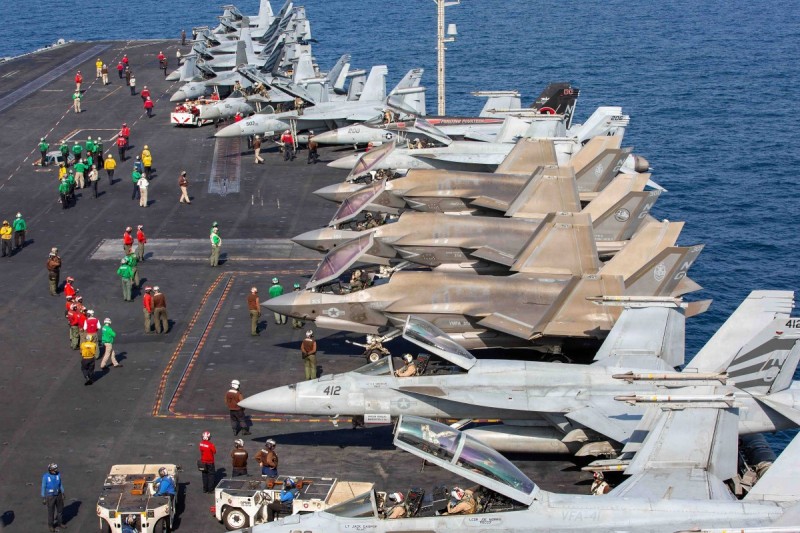
Aircraft attached sit on the flight deck of the USS Abraham Lincoln in support of Operation Epic Fury, February 28, 2026. Photo courtesy the United States Department of Defense/Wikimedia Commons.
.jpg)
“Don’t invade a revolution,” the Times newspaper warned in autumn 1980. This followed the attack on Iran by Iraq under Saddam Hussein with the encouragement of the United States.
In fact, the Islamic Republic’s regime in Iran had already buried the popular, worker-driven revolution that had overthrown the Shah’s tyranny in 1979.
But under Ayatollah Ruhollah Khomeini the Iranian state wrapped itself in the revolution’s banner. The eight-year war with Iraq permitted the regime to consolidate itself on the basis of Iranian nationalism. This founding experience of war and revolution helps explain why the assault on Iran and the assassination of Khomeini’s successor Ali Khamenei has not toppled the Islamic Republic.
It is not, says historian Mohsen Milani, “a one-man show, it’s been institutionalised, there are multiple centres of power, with multiple layers of security and intelligence institutions.” The Islamic Republic “was deliberately designed from the get-go to survive external attack.”
The most important of these institutions is probably the Islamic Revolutionary Guards Corps. It is rumoured to be close to the new supreme leader, Khamenei’s son Mojtaba. His election is a slap in the face to Donald Trump, who says he will choose Iran’s next rulers.
Trump seems to have imagined that the war on Iran would be a repeat of the US pirate raid on Venezuela in January. The kidnapping of Venezuelan President Nicolás Maduro led to his replacement by the compliant Delcy Rodriguez.
But, according to the Washington Post, “A classified report by the National Intelligence Council found that even a large-scale assault on Iran launched by the United States would be unlikely to oust the Islamic Republic’s entrenched military and clerical establishment.”
The New York Times quotes “US military officials” conceding that “Iran was more prepared for war than the Trump administration anticipated.”
The Iranian regime has so far been able to absorb the US-Israeli bombardment and keep up a steady fire of missiles and drones across the region.
The US didn’t just underestimate Iran’s resilience. Its planning doesn’t seem to have taken into account the fact that Iran sits across one of the key zones of global capitalism. This goes beyond the fact that the Gulf is the key supplier of oil and gas to both Europe and Asia.
In the past generation, Dubai has mushroomed into a world city, with a population of four million.
This is because—contrary to what the boosters of globalization claimed—geography matters. Dubai has benefitted as a hub of finance, aviation, tourism and high-end consumption thanks to its proximity to key wealth centres—the Gulf itself, Europe and East Asia.
It was predictable that, in a fight for survival, the Iranian regime would seek to disrupt the region’s economy.
More important than missile and drone strikes targeted at Gulf states is Iran’s closure of the Strait of Hormuz. Some 20 percent of the world’s liquefied natural gas and 25 percent of seaborne oil passes through it.
According to Natasha Kaneva of the JP Morgan investment bank, “In the whole written history of the Strait, it has never been closed, ever. To me, it was not just the worst-case scenario. It was an unthinkable scenario.”
What experts are calling “the biggest oil supply shock in history” is causing prices to soar.
Little wonder, then, that Financial Times newspaper columnist Gideon Rachman tweeted, “So oil at $110 a barrel and another Khamenei in charge of Iran. Operation Epic Fury is in danger of turning into Operation Epic Failure.”
So oil at 110 a barrel and another Khamenei in charge of Iran . Operation Epic Fury is in danger of turning into Operation Epic Failure
— Gideon Rachman (@gideonrachman) March 8, 2026
The critical question is how Trump reacts to this failure. He might, under pressure from his Gulf cronies, declare victory and call a halt to the attacks on Iran. This would be another case of TACO—Trump Always Chickens Out. Or, rather than face humiliation, and egged on by Israeli Prime Minister Benjamin Netanyahu, he might escalate the war.
This is an exceptionally dangerous moment for humankind. The implosion of global capitalism since the financial crash of 2007-9 is pushing the system faster in the direction of self-destruction. We have to get rid of it.
Alex Callinicos is an Emeritus Professor of European Studies at King’s College London and a leading member of the Socialist Workers Party (SWP), focusing on Marxism, political economy, and social theory.
This article originally appeared on SocialistWorker.co.uk.