
The very political ‘neutrality’ campaign to exclude equity, diversity, and social justice from higher education

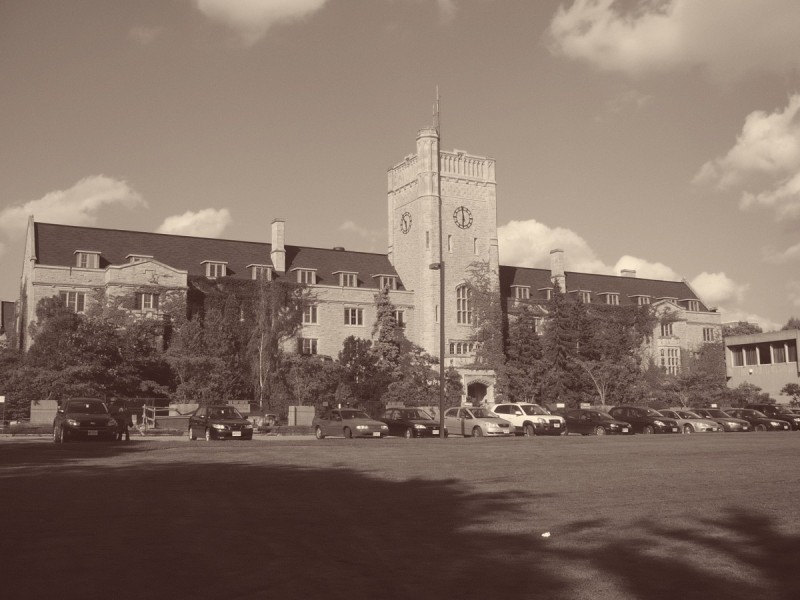
Johnston Hall, University of Guelph. Photo by Jjivkov/Wikimedia Commons.

A coterie of Canadian academics claiming to support “merit” in university hiring have sued their employers, submitted briefs to parliamentary committees, co-authored reports for conservative think tanks, and published commentaries on right-wing media platforms including The Hub and the National Post. Contrary to their claims, their aims are far from “apolitical.” From attacking equity, diversity, and inclusion (EDI) initiatives in hiring practices, they have moved to demanding the suppression of what they call “social justice” or “activist” research. The next step will be a demand—backed by right-wing media and political actors—to eliminate courses or degree programs with social justice content.
Sound familiar? It is already happening in the United States.
The so-called “culture war,” centred in universities, dates back to efforts by American conservatives in the 1980s to reverse the gains that were being made by social movements. They framed efforts to redress systemic racism and sexism as “political correctness” and “reverse discrimination.” Today, the labelling has shifted to “political wokeness,” or “wokeism,” but the objectives are the same: to halt or roll back institutional changes that challenge entrenched privileges. At stake is who gets to determine which forms of knowledge are legitimate. The claim to possess “objective” knowledge is a key weapon in the battle.
One prominent figure in the “neutral knowledge” camp is Dave Snow, associate professor of political science at Guelph University and a senior fellow at the Ottawa-based Macdonald-Laurier Institute. He was quoted in a March 5 CBC News report on developments at the University of Alberta, where he argued that EDI has “gone too far” in federal research funding policy and that grants should adopt greater “neutrality.”
In an April 2024 commentary in The Hub, Snow argued that granting agencies should fund only “objective, empirical knowledge creation” and not “activist-themed, or “social justice” research that is “utterly incompatible with the objective pursuit of truth.”
In a paper published by the Macdonald-Laurier Institute in February 2025, Snow wrote:
Higher education in Canada has reached a tenuous moment. For too long, it has focused on “equity, diversity, and inclusion” at the expense of research excellence. This has occurred alongside a growing lack of viewpoint diversity among faculty and concerns over the erosion of academic freedom in Canada… First and foremost, the agencies should commit to political and ideological neutrality. This means removing references to EDI from granting agency guidelines, eliminating EDI focused grants, and removing “equity targets” and any preferential awards.
There are multiple unsubstantiated empirical and causal claims in this statement. Indeed, one could argue that the reality is quite the opposite of what is being asserted here. “Lack of viewpoint diversity” is the right’s coded way of saying “the professors are all leftists.” In reality, Marxist scholarship is almost completely shut out of social science departments in Canadian universities, and always has been. The feminist and anti-racist scholarship that found institutional niches in higher education beginning in the late-1980s has been permanently under siege and only tenuously funded.
Those who hold such scholarship in contempt have typically never made the effort to study it themselves, let alone defend its right to a place in the academy on grounds of pluralism or academic freedom. The biggest threat to academic freedom today is clearly coming from the right, as it attempts to purge universities of critical, dissident voices. The claim that hiring scholars from diverse backgrounds has undermined research excellence has been roundly refuted and is frankly offensive.
Are there reasons to be critical of the limitations of EDI policies in higher education institutions? Absolutely. Marxist, feminist, and anti-racist scholars have noted for years that altering the racial and gender composition of university faculty and administrators does not necessarily result in different institutional priorities or shift governance regimes in progressive directions.
The worldviews of these individuals and the principles they are willing to defend matter, too. Moreover, the systemic barriers to access to higher education cannot be dismantled by universities alone. The governments that are privatizing our universities are effectively excluding working-class youth. Notably, it is the very academics vilified for their alleged lack of ‘political and ideological neutrality’ who are defending universal, public post-secondary education—not the anti-EDI crowd.
Against this backdrop, I want to examine the ‘objectivity’ and ‘neutrality’ mask that anti-EDI academics are deploying to legitimize their positions.
It is revealing that criticism of EDI initiatives has already been extended to encompass what Snow calls “the political agenda of social justice activism,” which, he asserts, “undermines the search for truth.” Academics like Snow are claiming, in essence, that they are uniquely competent to distinguish “truth” from a “political agenda,” that social justice-oriented research cannot be a “search for truth,” and that their own research is valueless and free of any kind of political bias (that is, “objective”).
Whole courses are taught in humanities and social sciences demonstrating the falsity of such claims, but here are some basic points to consider.
Research questions do not arise in a vacuum. Scholars decide which problems to investigate based on their intellectual frameworks, values, and experiences. These orientations are shaped by socialization, educational opportunities, and the researcher’s own position within social hierarchies of race, gender, and class. Institutional factors also influence research agendas. Funding priorities, academic incentives, and the political economy in which universities operate all shape which topics receive attention and resources.
Scientists rarely have complete autonomy over research directions; such independence would require unlimited and unfettered funding and institutional support. In practice, much university research follows the priorities of external funders (government agencies, private sector partners, philanthropists). Put simply, knowledge production is embedded in social and institutional contexts. Scholars who acknowledge these influences and critically reflect on their own assumptions may in fact produce more rigorous scholarship than those who claim complete neutrality.
Simply put, there are no scholars without values or assumptions—only scholars who recognize them and those who deny them.
Social justice-oriented research explicitly addresses issues that concern groups whose interests and perspectives have been marginalized historically in both scholarship and society. By raising questions previously neglected or dismissed, it generates new empirical knowledge and theoretical insight.
Politically, the opponents of EDI and social justice-oriented research frequently frame their arguments as warnings about declining “public trust” in universities. In his September 2025 testimony before the House of Commons Standing Committee on Science and Research, Snow argued that “activist” EDI threatens the “legitimacy” of granting agencies and the broader post-secondary sector. “If these agencies are seen as rewarding political projects,” he warned, Canadians and politicians will “start to ask whether the roughly $4 billion spent annually by these agencies could be better spent elsewhere.”
A similar argument appears in a report by Brad Epperly and Geoffrey Sigalet that was published by the Macdonald-Laurier Institute and is widely cited by right-wing influencers. Epperly, notably, is one of the academics who sued the University of British Columbia for taking such stances as Indigenous land acknowledgements. The authors claim that diversity initiatives face “widespread public resistance” and risk “eroding trust in higher education” along with funding for universities.
That a segment of the public (mainly, the base of the conservative parties) sees universities as hotbeds of “wokeism” is indeed an achievement of the very actors who are issuing the “warnings.” The message that the chorus of anti-EDI academics—along with right-wing columnists, think tanks, and conservative political organizations—is conveying to policy makers is: “Get rid of these EDI initiatives and ‘social justice’ research, or we will continue to mobilize public opinion against funding for higher education.”
Sure, the threat is masked as concern, but everyone knows what lies behind it.
The opposition to social justice research is profoundly anti-pluralist, seeking to devalue or exclude research that this group of academics considers illegitimate. Snow, for example, opposes the Social Sciences and Humanities Research Council’s “Race, Diversity, and Gender” funding envelope.
Is anyone trying to shut down his research? Where does this animus come from?
The same scholars are, notably, not interested in investigating alternative explanations for public perceptions of higher education, including the rising cost of university education, the anti-intellectual discourse of right-wing populists, or the failures of university administrators to educate the public about the aims of EDI and to defend academic freedom.
If one wished to identify the causes of declining public support for universities, the first step would be to identify multiple plausible explanations and test their relative influence through rigorous empirical analysis. The Epperly-Sigalet study does not utilize any such methodology. It simply shows that if you give selected, partial information to respondents who are not well-informed about a question, the prompts will influence their answers (nor do they provide a description of the demographic profiles of the groups that received the different information “treatments,” so we cannot assess a whole set of possible explanations for the responses).
If, in addition, one imposes researcher-created binary choices on respondents, one can manufacture evidence for pet hypotheses.[1] As most social scientists recognize, the use of quantitative methods does not guarantee unbiased results.
The study makes factual statements for which there is little evidence, generating the impression that there is a big problem when there may be none. Respondents were told: “Sometimes university administrators lacking subject-specific expertise override departmental hiring decisions for demographic-based reasons” (my emphasis added).[2] They repeatedly imply that “diversity” candidates are being hired despite being less qualified than white male candidates. There is no evidence for this claim, which effectively maligns the reputations of academics who are not white, cisgender men.
Their use of the term “demographic-based hiring” (referring to what I would call strong affirmative action measures) misrepresents the range of EDI policies that have been adopted by universities and other institutions. The claim that strong affirmative action measures are “common practices” across these institutions is inaccurate. But such generalizations are convenient, enabling right-wing pundits to claim that widespread “race-ethnic-and gender-based hiring” or “race-centric hiring” is shutting qualified white men out of employment of opportunities.
In fact, few programs employ strong affirmative action, and these were implemented to reverse decades of persistent discrimination. When the Canada Excellence Research Chairs (CERC) were created in 2008, 19 went to men, and none to women. Between 2010 and 2018, only two women held CERCs. Affirmative action measures were implemented in 2019, finally resulting in an improvement in the representation of women among CERC holders. The Canada Research Chairs Program has further adopted equity targets for 2021-2029 chair appointments, aiming to “address systemic barriers to participation in the program for individuals from the four designated groups: racialized individuals, Indigenous Peoples, persons with disabilities, and women and gender equity-seeking groups.”
It is to be expected that there are supporters and opponents of EDI initiatives, mapping onto the left-right spectrum of values and beliefs. What stands out in this debate, however, is that the opponents of EDI position themselves as “neutral” and “objective” defenders of academic standards while depicting EDI supporters as uniquely ideological. At best, the neutrality claim exhibits a striking lack of self-awareness and epistemological sophistication on the part of the academics who make it. At worst, it is being deployed disingenuously as a weapon to discredit EDI criteria in hiring as well as social-justice-oriented research.
The claim to possess “objective” or “neutral” knowledge has long been employed by dominant groups to attack every progressive movement in academia. Far from being “objective,” the anti-EDI campaign is thoroughly political in its motivation, design, and dissemination.
Laurie E. Adkin is a professor emerita in the Department of Political Science at the University of Alberta.
References
1. One survey question forces respondents to choose between “a ‘best candidate’ that was a white male” and “a job candidate who contributed to diversity,” but is less qualified for the job. This reproduces an old canard of the “merit only” contingent, that is, the false claim that the “diversity” candidates being hired are not fully or best-qualified for their positions.↩
2. I have sat on hiring committees where administrators who were not subject area experts overrode the committee’s short-list, but it was not for EDI reasons.↩