
A dangerous retreat: Where does Canada stand on the use of banned landmines?

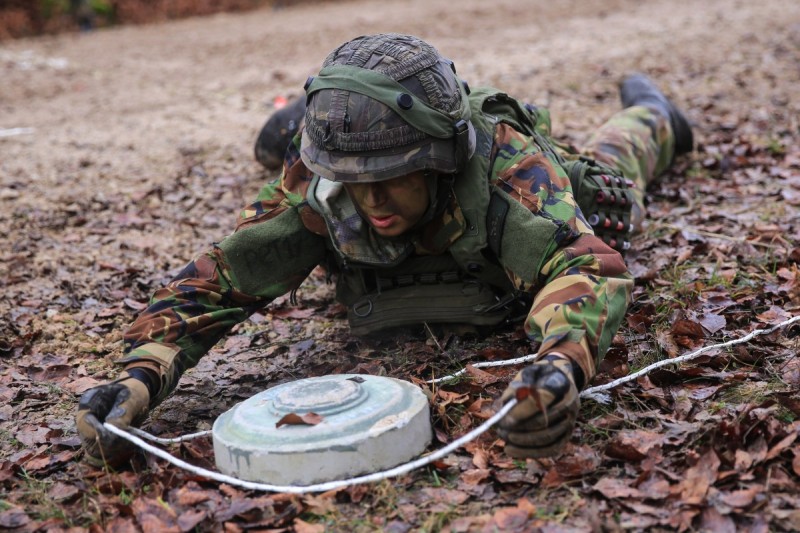
A Dutch soldier lassos a land mine before removing it from a road during a training exercise in Germany in 2015. Photo by Justin De Hoyos/Wikimedia Commons.

“Breaching under fire is one of the most dangerous tasks combat engineers undertake,” said Gary Toombs. From Ukraine to Gaza, Toombs dismantled explosives for over 30 years and now works at Humanity and Inclusion, an independent aid organization focused on disability in regions affected by conflict and disaster. Having worked with the British Army, as well as on humanitarian missions, he is concerned about anti-personnel mines starting to “re-enter mainstream defence planning” in production, procurement, training, and doctrine.
Over the past year, Estonia, Finland, Latvia, Lithuania, and Poland have withdrawn from the Anti-Personnel Mine Ban Convention, sometimes known as the Ottawa Treaty. In February, Polish Prime Minister Donald Tusk said the country aimed to be able to mine its borders within 48 hours of a threat. While India, Myanmar, Russia, and South Korea have long produced landmines, reports suggest that Ukraine is now also actively producing and developing anti-personnel mines, and Finnish and Polish companies signalled readiness to produce last year. Ukraine recently suspended its obligations under the Treaty, which prohibits withdrawal during active conflict.
Anti-personnel mines are indiscriminate weapons, killing soldiers and civilians without distinction. The Treaty, signed by 161 countries, prohibits their production, procurement, and use on humanitarian grounds. None of the major mine-producing countries signed on. Still, countries overwhelmingly agreed that the proliferation of these weapons contributes to humanitarian crises and that humanitarian norms should trump military utility. Humanitarian disarmament and civil society organizations have repeatedly condemned countries that have reneged on their commitments.
Certain types of mines, such as command-detonated Claymore mines and anti-tank mines that require greater force for detonation, are not prohibited by the Ottawa Treaty, as the presence of a “human in the loop” is meant to reduce indiscriminate harm. As a preventative measure, mines are also evolving to include so-called “smart” features, such as automatic deactivation after a set period. Since withdrawals from the Treaty, the private sector has moved quickly on emerging landmine technologies. As part of Poland’s East Shield, for example, Warsaw-based company MBF Group is spearheading a consortium developing fields of automated landmines along the borders with Russia and Belarus. These systems will rely on mesh networks of “distributed sensors and controlled activation,” according to the company.
But even so-called smart mines can fail, remaining active beyond their intended lifespan—something that also occurs with cluster munitions, Toombs noted. He is not convinced anti-personnel mines improve military utility either. “Once you lay mines, you’re also restricting your own freedom of manoeuvre,” he said. What appears efficient in planning can look very different on the ground. Plans shift. Offensives pivot. Withdrawals happen. Flanks collapse. Maps are lost. Personnel change. Terrain shifts with the climate. “And suddenly you’re breaching your own obstacles, often under pressure and under fire.”
There are “smarter options,” he added, including “visible obstacles, surveillance, and controlled defensive measures” that do not rely on indiscriminate weapons. In Ukraine, “drones have proven highly effective at destroying hardware, gathering intelligence, and disrupting manoeuvres.”
Some security scholars also question the military utility argument. Instead, they argue that the normalization of landmines creates a “false sense of security, exploitable by opponents,” pointing to historic failures to halt offensives and the heavy civilian toll.
“The commitment to ban APMs is unconditional; it does not matter if the state party is at risk or not,” wrote Henrique Garbino and Priscyll Anctil Avoine of the Swedish Defence University. Legal alternatives like Claymore mines are sufficient, they suggest—so why withdraw from a humanitarian treaty? “What follows, then, in the name of self-defence? Will states return to using chemical or biological weapons or withdraw from the Geneva Convention altogether?”
The Ottawa Treaty “carried real moral and political weight,” Toombs reflected, but the erosion of humanitarian principles within NATO risks undermining credibility and trust. “Within alliances, it can create friction when some partners remain committed and others step away.”
“The Ottawa Convention wasn’t created in comfortable circumstances; it was born out of the real, visible suffering caused by landmines,” he added. “And once that door is opened, even slightly, it becomes harder to close.”
Breaking the shackles
“The honourable thing to do was to withdraw from the Convention,” said Walter Dorn, a military expert and professor at the Royal Military College of Canada. Ukraine has faced heavy criticism for using anti-personnel mines during the war. But “Ukraine found that landmines were essential to prevent Russia from pushing further into Ukrainian territory,” Dorn argued, calling the decision “legally correct.” Otherwise, Ukraine would have violated the Treaty; “it’s better not to be a party than to violate it.”
“Over ten years of aggression and over three years of full-scale invasion by a non-member against a member is a situation that the authors of the Ottawa Convention did not foresee, and the governing bodies failed to address,” wrote Lieutenant Colonel Inna Zavorotko and Oleksii Plotnikov of Ukraine’s Ministry of Defense. Ukraine’s suspension, they argued, is not equivalent to withdrawal: “[Ukraine] remains a member and wishes to resume compliance when the situation allows.” For other countries, the imbalance creates “an unfair advantage” if Russia can use landmines while they cannot.
As long as the war is going on in Ukraine and we have Putin in charge of Russia, I doubt that it’s feasible or even wise to try to convince those five countries to re-sign,” added Dorn.
Mine clearance at Jaffna Fort, Sri Lanka. Photo by Rehman Abubakr.
The European exodus from the Treaty also reflects a broader trend toward military deregulation and stronger private-sector influence. Legal experts have lobbied to ease “burdensome” mine regulations to attract investment, while NATO has embraced private-sector partnerships to “make our societies more resilient.” Such developments sit uneasily alongside treaties banning indiscriminate weapons, yet are gaining traction as global conflict intensifies. “Today, the role of politicians is to break the shackles that have been imposed on the military, and that is what we are doing,” Polish Defence Minister Władysław Kosiniak-Kamysz told Radio France Internationale.
Deregulation, private-sector investment, and escalating conflict are particularly concerning in combination with the rise of artificial intelligence. Its growing role in warfare is rapidly reshaping the battlefield. “Landmines are a form of lethal autonomous weapons systems,” Dorn said. While drones and AI are used in mine clearance, they can also function as anti-personnel weapons. Automated sensors and targeting systems are becoming more sophisticated, and loitering munitions that wait for a target have been likened to landmines. As these systems are increasingly deployed against humans, the line between “human in the loop” and full automation continues to blur, raising the prospect of entirely removing human control.
The recent Anthropic controversy has intensified long-standing concerns about the lack of regulation governing fully autonomous weapons systems and states’ preparedness for failure. The California-based AI company was labelled a “supply-chain risk” by US Defence Secretary Pete Hegseth after refusing to remove safeguards on its tools. Anthropic has argued that fully autonomous weapons “cannot be relied upon to exercise the critical judgment” of trained personnel, and is challenging its blacklisting in court. As autonomous systems become normalized, Dorn argues that urgent arms control is needed. “Now is the time to prevent them from causing havoc.” Yet prevention is likely to remain an uphill battle as the principles underpinning arms control regimes such as the Ottawa Treaty continue to erode.
Canada a Treaty role model?
As countries withdraw from treaties and expand weapons production, militaries are navigating increasingly complex and unpredictable conditions. Rather than working to stabilize the international anti-personnel regime, Canada has remained largely silent.
“You would expect Canada to champion the Ottawa Convention,” Dorn said. “Unfortunately, Canada seems to be missing in action on that front.”
Canada’s record on anti-mine principles has not been spotless. In 2013, Canada ratified the Convention on Cluster Munitions by drafting and tabling federal legislation: the Act to Implement the Convention on Cluster Munitions. The Convention bans the use of cluster munitions—missiles that release smaller explosive submunitions. When these fail to detonate (with historical failure rates estimated between 10 and 30 percent), they effectively become de facto landmines.
The Harper government’s legislation was criticized for undermining the Convention by permitting Canadian participation in joint operations involving cluster munitions. The United States and coalition forces used cluster bombs, including Israeli-made munitions, during the invaions of Iraq and Afghanistan. While Canada formally supported the ban, former general Walter Natynczyk defended a controversial position on interoperability with allied militaries, citing uncertainty over whether Canadian forces had facilitated their use in earlier conflicts.
When Canada ratified the Convention in 2015, former Senator Suzanne Fortin Duplessis stated that “Canadian commanders will never have the right to order the use of cluster munitions,” even in joint operations. However, Canadians were shielded from legal liability for past violations because they were not deemed to have provided “active assistance.” “We can’t actively ask Canadian soldiers to plant landmines or cluster munitions, or drop them, or fire them from artillery,” Dorn explained.
Canadian investment in cluster munitions producers was also deemed illegal under the Convention. Yet a loophole in Bill C-6 allowed Canadians to facilitate the acquisition, transport, or request for use of such weapons by non-signatories. This, Dorn argued at the time, was justified on interoperability grounds, given uncertainty about whether such munitions were present in joint operations. While Canada maintains that its forces have never used cluster munitions, the clause effectively softened its stance and created space for indirect involvement.
Cambodia Landmine Museum in Siem Reap, founded in 1997 by former Khmer Rouge child soldier Aki Ra. Photo by James Stewart/Flickr.
With allied militaries now withdrawing from the anti-personnel mine ban, and given Canada’s record on cluster munitions, concerns about renewed proliferation have resurfaced. Canadian forces are participating in NATO’s Security Assistance and Training for Ukraine (NSATU) mission, raising potential legal and operational challenges. “It would become a legal issue if Canadian forces were involved in laying landmines or even training Ukrainian personnel to do so,” Dorn said. As with cluster munitions, Canadian forces are prohibited from providing “active assistance” in operations involving non-signatories to the Treaty.
A defence source said that while understanding how anti-personnel mines are deployed forms part of training, Canadian personnel will not instruct allied forces in their offensive use.
A Department of National Defence spokesperson said the Canadian Armed Forces are required to “refrain” from “assisting, encouraging, or inducing anyone” in activities prohibited by the Ottawa Treaty, citing both the Code of Conduct for Canadian Forces Personnel and the Code of Service Discipline, which is part of the Canadian military justice system.
Despite repeated calls from civil society, Canada’s Foreign Affairs Committee has barely addressed these complicity gaps ahead of the European withdrawals. “Minister Anand had discussions with her peers,” including Polish Deputy Prime Minister Radosław Sikorski, said Stéphane Lessard of Global Affairs Canada.
A Global Affairs Canada spokesperson stated in an email that the Ottawa Treaty “remains a core priority for Canada,” describing it as “one of the most successful humanitarian disarmament treaties.”
Citing “real and credible threats posed by Russia and Belarus along NATO’s Eastern Flank,” the department said Canada has maintained dialogue with allies, while confirming that Canadian forces in joint operations “will operate under orders to ensure that Canada continues to meet its own obligations.”
Strength of the taboo
“We’ll sign the treaty, and then we’ll un-sign it when we need it—what is that?” asked Robin Collins, a long-time arms control activist with the Canadian Pugwash Group and the Rideau Institute, a policy think tank. “What’s the strength of the norm? What’s the strength of the taboo? What good are treaties if you can always violate them or exit them?”
Amid the conflicts and displacement crises of the 1990s, anti-personnel mines became a focal point of debate within Canadian civil society, particularly among disability justice activists.
The mine ban created divisions between the Department of National Defence and what was then the Department of Foreign Affairs, Collins recalled. While Defence Minister David Collenette took a more cautious approach, Foreign Affairs Minister Lloyd Axworthy pushed the process forward, fast-tracking the Treaty. By 1999, it was implemented through the Ottawa Process—a model that incorporated civil society and survivors into policymaking.
“There was a normative impact even on non-signatories,” Collins said. Initially, the United States, which widely resisted arms controls—not just on nuclear weapons, but on biochemical and blinding laser weapons that were banned for the severe harm they caused combatants—was influenced by the Treaty. The Clinton administration was set on joining the Ottawa Treaty, restricting the US army’s use of anti-personnel mines beyond the Korean Peninsula. This restriction was reversed by George W. Bush amid the wars in the Middle East, and has since deteriorated altogether with the new American defence strategy’s removal of “human rights and civilian harm mitigation as explicit considerations in defense policy.”
NATO, meanwhile, has not exerted significant pressure on member states to uphold humanitarian norms. “If you want to change NATO policy for the good, let’s say eliminate its nuclear deterrence policy, you have to be fairly bold,” Collins said.
Withdrawal from the Ottawa Treaty risks pushing countries toward a deterrence model similar to nuclear doctrine. “It’s not just the weapons you use—it’s the kind of security you pursue,” Collins said. “Is it competitive security or common security? The common security approach is under attack right now.”
“These all start to feel like a kind of witchcraft,” he added. “We’re talking about morality in the act of killing.”
Lital Khaikin is a freelance journalist and author based in Montréal, and regularly contributes features on humanitarian and environmental issues related to underreported regions and conflict zones.