
Why Ric Esther Bienstock’s ‘Speechless’ left me speechless

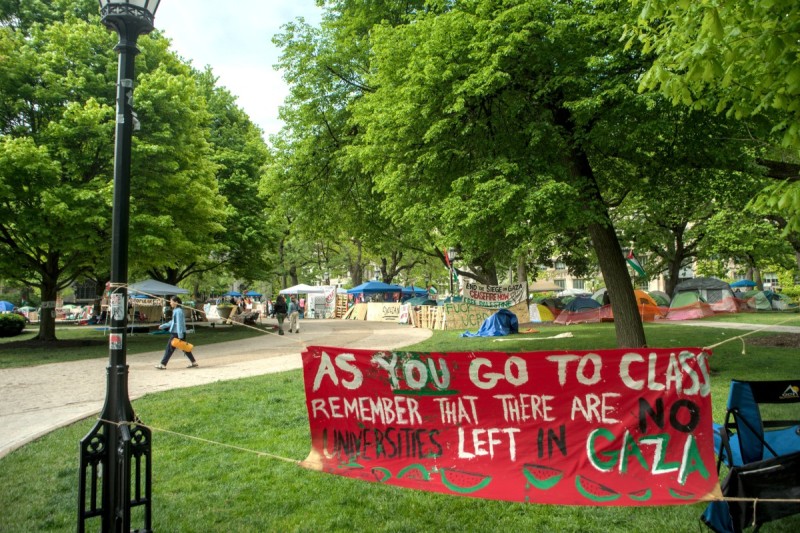
A protest encampment at the University of Chicago’s Main Quadrangle, featuring a sign reading: “As you go to class, remember that there are no universities left in Gaza.” Photo by wabisabi2015/Flickr.
I’m invested. I was left speechless. Emmy Award-winning filmmaker Ric Esther Bienstock’s two-part documentary essay Speechless claims to be concerned with the narrowing of free speech on campuses, particularly in the United States. Bienstock tells us that as her children headed to college, she became alerted to the culture wars raging on campuses and needed to investigate further. She heads directly to Evergreen State, a public liberal arts college in Olympia, Washington, to document young students seeking change. The story of Speechless unfolds from Evergreen with a trajectory that anyone paying attention to the contemporary university would recognize as inevitable.
In 2010, Macleans published an article claiming that many Canadian universities were becoming “too Asian,” casting the increasing number of Asian students as a threat to campus life. The article’s conceit was that this apparent demographic increase was changing the atmosphere at universities. The article was greeted with disgust, rightfully, and its explicit anti-Asian racism challenged, debated, and ultimately proven to be unfounded. Four years later, the Black Lives Matter movement arrived, largely outside universities, but quickly also found a foothold in political organizing among Black students and their allies on campuses. Taking the changed demographic shifts in the classroom and other parts of the university, alongside students’ demands for a more just world (and universities’ implication in helping to uphold an unjust world), debate over the role the contemporary university plays in wider society has been commonplace since at least 2010.
We should have seen it coming. By “we,” I mean those of us who have a critique of the university—who believe it can, if it wanted, be a shining example of what is possible for a just social formation—and those of us who see clearly its inadequacies and its insistence on the status quo. Those of us who want another university now take seriously William Haver’s insistence that the university, as an institution, is founded on inequity and cannot be made equitable. Contestations over how to make the conservative university better, which is all we can really do, are therefore fraught with significant pitfalls. Only another, different university can produce the just context for knowledge production and dissemination that many of us dream of. It is this struggle to produce another university now that Speechless plunges into, with a significant sideways glance at those of us who believe the university can do better than it has so far.
Speechless spans a period from 2017 to 2024 and intersperses that period with history lessons from the 1960s (though I believe the events that came to a head in 2017 were shaped by developments already underway between 2010 and 2016). If the film gets anything right, it is that the meagre gains of the ‘60s have been the object of sustained conservative and right-wing resistance from that time to the present. Bienstock, however, shows little interest in why such forces have mounted that resistance. Instead, she characterizes the ‘60s as the foundational problem to be reckoned with—presenting the decade as an infecting contagion. In her telling, the ‘60s mark the beginning of a left-wing takeover of the university. It is an early signal to any viewer invested in the university as an institution that Bienstock has not spent much time in them if she believes the left runs them.
The ongoing canard that universities have been taken over by the left has been useful to deploy so that the conservative institution of the university can continue, with minimal changes, its ongoing sorting, ranking, and ordering of peoples in service of dominant forces. Bienstock gives viewers a quick graphic crash course of the faulty claim that the arrival of critical theory, critical pedagogy, critical social justice, Black liberation, and, most important, a discourse that centres power—who has it and who does not—did not just change the university but took it over and indoctrinated students. If you are invested in the university, you would have heard this story before and will also know that it overstates the case tremendously. But you must be invested to know that it is a lie that the left runs the university, and that equity, diversity, and inclusion (EDI)—commonly referred to as DEI in the US—reigns supreme is an untrue claim. Bienstock sets up the ‘60s as the source of all that went wrong not just in the university, but, by inference, in North American society and beyond. By doing so, Bienstock makes clear where she stands in the debate. It is clearly not on the side of those of us who would desire a world more just than the one we currently have.
Before I say more about Bienstock’s sleight-of-hand documentary essay, I would be remiss not to note that a British-Canadian production that excises Canadian campus free speech and academic freedom debates is one that begins from a place of obfuscation (the film hardly mentions Canada beyond the use of stock footage of pro-Palestine protests and encampments in Montréal). And yet Canada plays a central role in how this latest iteration of campus battles over free speech and academic freedom has unfolded. You cannot honestly account for these conflicts without reckoning with the rise and viral proliferation of Jordan Peterson while he was a professor at the University of Toronto. As early as 2016, Peterson was circulating as a budding guru railing against the so-called left takeover of the university, with his attacks on trans students cloaked in claims about violations of his free speech. By 2017—the year Bienstock’s documentary essay begins—Peterson had emerged as a major figure who not only opposed the use of preferred pronouns for trans students, but also stood against programs such as ethnic studies, women and gender studies, Black Studies, and critical pedagogy.
As I said, I am invested. In 2017, I was the director of the Women and Gender Studies Institute at the University of Toronto, where we received word that Peterson was planning to create a name-and-shame website targeting departments and faculty associated with the kinds of topics and themes he opposed. It is truly suspect that Bienstock’s documentary sidesteps Peterson in its account of the period. One wonders why. My investment makes this silence in the film all the more striking. I want to assert that Peterson is a foundational figure in all of it. His claim that his free speech and academic freedom were being violated if he had to use the chosen names and pronouns of trans students was one of the most incendiary shots fired across a North American campus in that period, and he quickly emerged as a guru of the movement well beyond Canada. In 2018, I found myself debating young white men in a Cape Town bar about his work. It was a friendly exchange, and I interrupted their journey toward becoming acolytes. That Bienstock does not mention Peterson at all raises serious questions about the documentary’s bias and its blind spots.
The Peterson controversy at UofT gave me a first-hand view of how the university actually responds to the kinds of disruption invoked by figures like him. It was not a response that suggested the university was run by left-wing EDI. On the contrary, in my view, the administration did everything it could to protect Peterson and to dismiss the legitimate concerns of faculty, staff, and students who felt unsafe in the months and years following his rise to global prominence. Filmmakers make choices; the genre is time-based, but what makes it into the narrative matters. Bienstock and her crew’s decisions about what to include—and what to leave out—expose a profound weakness in the documentary as its argument unfolds.
Millennials participating in a Black Lives Matter protest. Photo by Johnny Silvercloud/Flickr.
The film begins with the righteous anger of young people at Evergreen College, where changes to a long-standing anti-racism exercise and a professor’s objections led to campus demonstrations and national media attention. It is clear to me that these young people are trying to work out how to understand and produce justice at their college. Bienstock and her crew, however, seek out the most vocal, the most articulate, and the most doctrinaire, alongside the Black, queer, disabled, loudly dressed, coloured-hair figures—you can picture them—and train their cameras on them to skillfully mark them as unreasonable, as out of control. The camera lingers on those who take up space, who are most vocal, who are testing out their growing political awareness, and the editing renders them dogmatic, unreasonable, and spewing prepackaged left cant. No generosity is extended to these passionate young people. A particular kind of framing—one might simply call it editing—pervades the documentary essay, signalling to viewers when Bienstock disagrees without her having to say so outright. There is no attempt to understand how or why these students arrived at the positions they hold. Instead, viewers are led to believe it all stems from the radical ‘60s being absorbed into education and unthinkingly reproduced by students. Speechless offers a shallow account of young people becoming political actors—making mistakes, finding their voice, and rendering their beliefs visible and actionable. Bienstock instead holds them up to ridicule, reducing them to caricatures. When interviewees’ views and grievances align with her own, no such ridicule is applied. Filmmakers—along with their executive producers, producers, and editors—make decisions in the post-production process, and the choices made by Bienstock and her crew are clearly geared toward shaping viewer sympathies, and they are not with the students.
Bienstock’s camera, however, lingers affectionately on the protagonists (I am deliberately not naming them) of EDI, anti-racism, and trans antagonism. It finds articulate white and Black former professors whose fraught positions in the campus wars Bienstock invites viewers to identify with and support. These figures recount their experiences of abuse at the hands of EDI experts and policies, with some claiming that students, in an anti-free speech furor, drove them out of the academy. They are followed to depositions, filmed speaking with legal counsel, and shown in the intimacy of their homes—edited as reasonable, even vulnerable, figures who have been harmed and displaced by EDI policy run amok and hysterical student demands. The contrast with the student protesters is so stark as to render one cartoonish and the other saintly.
At least one of those interviewed sympathetically by Bienstock is a well-known figure in the anti-trans movement, or a critical gender feminist; the others might be described as classical liberals who, as one suggests, simply want to renovate the house or add another room. The idea of revolution is anathema and not worth discussing. What is striking is that Bienstock’s documentary stages disagreement between students and these professors as one between vile unreason and calm reflection. A more nuanced account of what is actually happening in the contemporary university is missing, in favour of the angry, loud fight. There is nothing nuanced in Bienstock’s rendition of the current troubles roiling the academy. The reality, however, is far more complex than her film would have you believe. Free speech battles are only a symptom, not the entire disease that ails the university.
It is always interesting to me that people are more worried about being named or called racist or transphobic, for example, than dealing with the fact that those words are the proper names for practices and behaviour—names that should prompt reflection on why they are being applied. Those words—racist, sexist, transphobic, homophobic—name a set of practices that cause harm, and since we have no other words for naming those practices, we might as well continue to use them. When named by one of those words, it would be useful to immediately assess why one was named that way, rather than reflexively treating the word itself as vile. To do the latter is to step away from the immediate need for reflection. Reflection might still lead to a different understanding of the claim being made, but reflection is precisely what the proper name demands of those being named. The idea that naming the practice is itself horrific, and should therefore be resisted without reflection, is an obfuscating deflection that sidesteps any engagement with practices, behaviour, and actions. To mark actions as racist, sexist, ableist, homophobic, or transphobic is not to violate the person accused of bad behaviour; it is to name the phenomenon. The attempt to render these words so taboo that they can no longer be used to name behaviour is a dangerous move, one that seeks to erase the necessary social regulation and opprobrium they carry and to undermine legitimate analysis of behaviour that causes real harm. Bienstock’s documentary essay is filled with this ideological move, almost unquestioningly, as a norm of its argumentation. For those of us who know full well that universities produce knowledge that does real harm—from eugenics, to crime and policing, to social policy, to international relations, justifying multiple forms of violence and poverty as legitimate—we know it is false to imagine the university as a neutral place, or that it ever was one. That is a fantasy, and a dangerous one.
I am a Black person. I know full well that universities are places where, for hundreds of years, scholarship across disciplines has produced deliberate knowledge and misinformation about Black people. I am also a Black professor, and I know that a central element of my work in the university is to produce a different account of Black life against those other, quite literally deadly accounts that have circulated and been skillfully updated for at least a century. Bienstock’s documentary essay does not rise to the occasion where the truth of the university as an institution that impacts lives unevenly can be seriously grappled with. Instead, she goes in search of feral students who refuse a vaunted liberal tradition of education, a fictional civility, unrestrained free speech, and administrators who use EDI to institute and mandate anti-oppression forms of speech. In Speechless, no one is actually speechless; it is just that the speech they desire is not the speech they feel has been authorized as legitimate. But this paradox lies at the heart of the battles over knowledge in the post-1960s university. Knowledge is contested because it literally sorts who gets to live and who gets to die. Universities continually obscure their intimate involvement in the roughest economics of life, even though they are one of the pillars that organize all of our lives. The old canard that nothing important happens in universities, except perhaps in the hard sciences, has long served as deep cover for their ongoing complicity in ordering social life. Once we acknowledge the work the university actually does, we can better understand why it is such a significant battlefield. Bienstock’s documentary essay prefers to obfuscate rather than reveal this brutal truth. Not once does it ask the question: why are calls for social justice in the university so destabilizing?
The slip between free speech and academic freedom is constant in the film. Very little time is given to clarifying the distinction or the different stakes between the two. Suffice it to say that academic freedom is not without constraints and responsibilities, ethics even. Free speech is an entirely different terrain. Bienstock’s singular focus on speech violations, DEI overreach, and the portrayal of anyone seeking to make the university better is laser-focused on presenting those positions as outlandish, unreasonable, and the true source of discontent in the university. The editing of the documentary reinforces the very specific narrative Bienstock wants viewers to take away: that any calls for change are radical, left, unreasonable demands. By the time it arrives in Florida and turns to Critical Race Theory, her position is firmly established and the trajectory of her intervention entirely predictable.
Florida Governor Ron DeSantis used Hillsdale College—a private, conservative Christian institution in Michigan—as a blueprint for remaking the public New College of Florida, installing loyalist trustees, dismantling EDI initiatives, and pushing a “classical” curriculum. Photo by Brother Atticus/Wikimedia Commons.

In what can only be described as an extremely sympathetic portrayal of the New College takeover—following the 2023 intervention by Florida Governor Ron DeSantis and his allies, who installed a new conservative board, ousted the college’s leadership, and moved to reshape its curriculum and governance along ideological lines—Bienstock and her crew reproduce the cartoonish students-versus-the-calm, principled “dissident” dynamic once again. There is much that could be said about how the documentary unfolds—the tensions and outcomes of conflict—but it is enough to note that viewers are led, or perhaps manipulated, into experiencing one side as reasonable and the other as wildly radical and detached from reality, with student politics framed as unreasonable demands. Once again, young students are offered up for the pyre and skillfully, cinematically dismissed as misguided, angry, and unreasonable. But after the first hour and 29 minutes (the series consists of two parts, “The New Campus Revolution” and “The Pendulum,” each running approximately 90 minutes), and by 54 minutes into the second half, any viewer invested in the contemporary university and its troubles can only conclude that Bienstock is not interested in the truth. Instead, her camera captures disagreements between students and their “betters” as a kind of filmic shaming, continually restating that the ‘60s is to blame—critical theory, critical pedagogy, critical social justice, Black liberation, women’s studies, gender studies, ethnic studies, Black studies, and so on. These post-60s fields have given students languages and ideas that are framed as rendering them unreasonable antagonists. But the truth is that these fields have helped make universities more diverse and have reshaped the institution itself—particularly for white women, many of whom have moved into administrative positions of power, regardless of whether they identify as feminist or are affiliated with women’s studies. The same opportunities have been far more limited for non-white people. These fields opened possibilities that did not exist before, and that is precisely why forces opposed to progressive change seek to dismantle them. This struggle is about how we live together in an evolving social context, where people seek to live authentically without being punished for their difference.
In the section addressing the fallout from the deliberate distortion and proliferation of attacks on Critical Race Theory, the documentary falters significantly, revealing its sympathies even more clearly. CRT is positioned within the lineage of critical theory and Black liberation, yet no practitioners are interviewed; instead, critics are given space without being meaningfully challenged. As someone invested in these debates, I know that opponents of CRT have successfully mobilized campaigns that have cost people their jobs and driven some into exile. These critics have been highly effective in limiting the speech of those they oppose. Yet Bienstock does not engage this reality. Indeed, by writing this review, I may invite similar targeting—a familiar risk for Black and other non-white scholars. But Speechless offers no sense of this. Its treatment of CRT demands its own critique, particularly as it intersects with illiberal policy changes in Florida, the New College takeover, and the rise of state actors committed to dismantling EDI and expunging post-60s fields from the university. Once again, the film’s choices reveal as much in what they omit as in what they include.
Finally, we arrive at the documentary’s trajectory: Palestine. As suggested earlier, this turn is entirely predictable. But here, the project’s solipsism is laid bare. Bienstock and her crew spend considerable time on events at Cornell. Interviews—such as with a UK African student leader forced to flee the US—reproduce the same cartoon-versus-reasonable dynamic, now framed as Zionist versus anti-Zionist. It is here that Bienstock foregrounds her Jewishness, and the documentary’s ideological commitments come sharply into focus.
In this section, Bienstock suddenly expresses concern about speech—about whether professors influence students’ views, about the phrase “from the river to the sea,” about language that might incite violence. She entertains limits on speech, posing questions about the rhetoric used by Palestinian supporters and allies. Suddenly, there is skepticism about speech acts. At this point, it becomes clear that Bienstock does not understand the long struggle over knowledge in the post-1960s university. Like many who only notice the university at moments of crisis—whether “too Asian,” Peterson, CRT, or Palestine—her three-hour documentary, while appearing comprehensive, is in fact shallow. It misses a crucial point: since the 1960s, the university has functioned as a laboratory for social transformation, absorbing and neutralizing revolutionary movements by bringing them within its walls. What emerges is a paradox, where these movements exist both within and against the institution. Policies like EDI are attempts to manage that paradox, not resolve it. When management is smooth, the institution maintains the status quo; when it falters, marginalized groups use these intellectual spaces to expose the violences the university perpetuates. This complexity cannot be captured through a narrow focus on free speech. A fuller story could be told—but not by a documentary invested in spectacle.
All films must end, but where one ends matters. Bienstock concludes with a montage of Trump’s second term and his crackdown on student protesters—many already targeted by the Biden administration and university leadership. Yet the film says little about this broader illiberal moment. Instead, it returns to free speech, refusing to grapple with the fact that speech is always entangled with power, violence, and authority—who wields it, and to what ends. The students’ concerns remain clear, but the framing ensures they are easily missed.
Ultimately, at the heart of Speechless is a profoundly disingenuous project. Bienstock fails to engage anyone who critiques DEI while still striving for a more just university. Such people exist. Had she included them, the story would have been far more complex and nuanced than the stark, binary narrative she presents. The intellectual dishonesty left me speechless—but no less invested in the fight it refuses to name.
Rinaldo Walcott is a writer and critic. He is professor and chair of Africana and American Studies at the University of Buffalo (SUNY).