
Ontario faces high cost and high-risk nuclear future

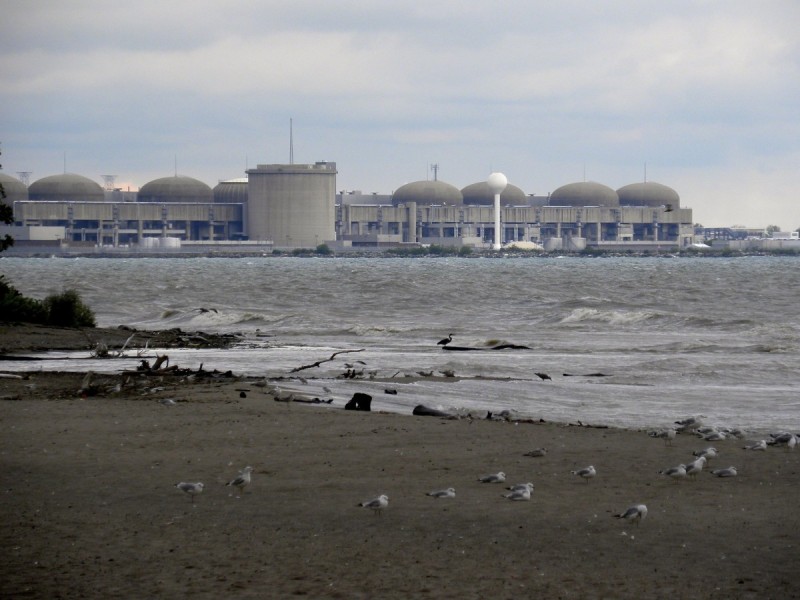
Pickering Nuclear Generating Station seen from Rouge Beach Park in Scarborough. Photo by JasonParis/Flickr.
Carefully buried on the Friday of Halloween, and overshadowed by the build-up for the Toronto Blue Jays World Series games over that weekend, was an announcement by the Ontario Energy Board that the electricity generation costs charged to consumers would increase by 29 percent on November 1.
Sensitive to the politics of electricity rates, the issue on which Premier Doug Ford’s government won its first mandate in 2018, the announcement was accompanied by a near doubling, from 13.1 to 23.5 percent, of the Ontario Electricity Rebate program. The move seems designed to hide the cost increase from consumers by increasing the subsidization of electricity rates through general revenues.
The additional annual cost of the subsidy increase has been estimated in the range of $2 billion, bringing the total expenditure to approximately $8.5 billion per year. These are tax revenues that otherwise could be spent on core public services. The total cost of the province’s electricity subsidies are now the equivalent of nearly two-thirds of its $13.5 billion deficit—exceeding total expenditures on the justice sector—and are almost double its capital expenditures on health care and education for the coming year.
Beyond their immediate costs, these subsidies have the perverse effect of providing the largest payouts to the biggest consumers of electricity—typically higher income households. A more targeted strategy could deliver relief to the lower income and rural households least able to pay additional energy costs, with a much lower hit to the provincial treasury.
The increase in electricity prices is largely attributed to higher nuclear generation costs, along with unexpectedly higher spending on energy conservation. The latter may be explained by the greater uptake of provincial home energy retrofit programs following the expiry of federal funding for home energy efficiency renovations under the Canada Greener Homes program.
The increase in nuclear generation costs represents a much more serious long-term problem for Ontario taxpayers and electricity ratepayers. The province has embarked on a massive nuclear expansion and refurbishment program, with the intention of increasing the portion of nuclear generation in Ontario from 50 to 70 percent of electricity output.
In addition to the refurbishment of existing reactors at the Bruce, Darlington and, potentially, the Pickering B sites, the province is proposing a 10,000 megawatt new build nuclear project near Wesleyville, between Coburg and Kingston, as well as a new 4,800 megawatt facility at the Bruce Nuclear site. There is also a plan to build four 300 megawatt small modular reactors (SMRs) at Darlington. Construction of the first unit is already underway.
Independent estimates of the costs of this program, based on past results—as well as recent experiences and assessments in the United States, Europe and the United Kingdom—are in the range of $400 billion.
The federal and Ontario governments’ recent announcement of $3 billion in additional, taxpayer-funded supports for the SMR project at Darlington represents only a small portion of the anticipated $21-26 billion for that initiative overall. Given the lack of any other investors, it remains far from clear how, other than through electricity ratepayers, the province and Ontario Power Generation propose to cover its remaining costs. The same questions apply to the other projects that are to make up the planned program of nuclear expansion.
The Darlington reactor project itself carries with it a host of problems that make it an exceptionally high-risk undertaking. The current cost projections are approximately double those of the last new build reactor proposal in Ontario, which amounted to $22-26 billion for two 1,200 megawatt reactors in 2009 (accounting for inflation that would come out at between $33-39 billion today). In the face of such estimates, the project was promptly abandoned by the Liberal government of Kathleen Wynne.
The Darlington project is based on a reactor design that has never actually been built or operated before anywhere in the world. The project has never been subject to a meaningful environmental assessment, and its construction was approved on the basis of an incomplete design. Serious questions over its technical and economic viability continue. The project is intended to be the leading example of the SMR concept. Yet other utilities, governments and private investors around the world have already walked away from these designs as too costly and risky.
More broadly, it is important to recognize that Ontario’s electricity system, and the choices made around it, are governed by political directives. There is no review and oversight process concerning the cost and economic, environmental, climate, technological and safety risks, that may flow from those directives.
Ontario is in the unique situation of having been the subject of more efforts to develop and model alternative pathways for its electricity system, and the broader decarbonization of its energy system, than any other province in Canada. But there is no process to assess whether the direction set by the provincial government represent the best option for the province in economic and environmental terms—especially relative to the alternative pathways that have been identified.
The focus of the province’s plans instead is on large, centralized, high-cost, high-risk, and high-impact options like new nuclear power plants, as well as carbon-intensive gas-fired generation. The output and emissions from the latter have quadrupled since 2017, and the province is looking to add new gas plants to the system.
In contrast, independent studies, and even work done by the province’s own Independent Electricity System Operator, point in other directions. They have emphasized energy efficiency and productivity, renewable energy resources coupled with new energy storage technologies, and distributed energy resources (such as networks of household and facility-scale rooftop solar and energy storage assets), as offering cheaper, lower-risk and more flexible and adaptive pathways to decarbonization and energy sustainability. These are increasingly imperative in an environment of turbocharged economic and geopolitical uncertainty.
With the basic costs for renewables, particularly wind and solar, falling to well below 10 cents per kilowatt hour, this is the direction in which other jurisdictions around the world, with the exception of Donald Trump’s US, are accelerating. In contrast, electricity costs for new build nuclear facilities remain in at least the mid to high 20 cents per kilowatt hour range, with some estimates exceeding 40 cents per kilowatt hour.
In addition to their impacts on energy affordability, the higher electricity costs flowing from the province’s nuclear-centric strategy will also undermine efforts at decarbonization through the electrification of space heating, industrial processes and transportation. Higher electricity prices will make electrification pathways more expensive, and therefore less attractive relative to existing fossil fuel-based processes.
In economic terms, the Ford government’s nuclear-heavy strategy appears to be premised on an assumption that a massive nuclear expansion program will turn Ontario into an electricity production and export “superpower.”
The fundamental problem with that strategy is that Ontario has no comparative advantage in electricity production. Comparative advantage in energy tends to be a product of accidents of geography. Ontario did have such an advantage through the first half of the 20th century, when hydroelectricity, principally from Niagara Falls, provided the foundation of the industrial base that was built through the Golden Horseshoe around the western end of Lake Ontario, from Niagara to Oshawa.
But that advantage was lost from the early 1960s onwards when the province ceased to be a hydro-dominated system, turning first to the construction of coal-fired plants, and then to a massive nuclear construction program from the 1960s to the 1990s, ending in the effective bankruptcy of Ontario Hydro.
Ontario turned out to be no better at building and operating these types of plants than anyone else in North America. The province therefore lost its comparative advantage in electricity production. The recent experience with attempts at constructing new nuclear facilities in the US and Europe suggest that such advantage cannot be restored through a nuclear expansion program.
Renewable energy sources, combined with energy storage, present much more cost-effective, lower-impact and lower-risk options. When it comes to energy, any economic strategy for Ontario has to focus on controlling energy costs and improving energy efficiency and productivity, not energy production.
So far, Ford has shown no interest in these options. Ontario needs to have a serious debate about the future of its energy systems, finding pathways to meet future electricity needs while decarbonizing the province without risking economic meltdown in the process.
The Ford government seems more inclined to use taxpayer money to hide the consequences of its energy choices instead. Ontario electricity ratepayers and taxpayers should be very worried about where that pathway will lead.
Mark Winfield is a professor of environmental and urban change at York University. He has written extensively on energy, climate and electricity issues in Ontario. He is co-editor of Sustainable Energy Transitions in Canada (UBC Press, 2023).