
Extrajudicial killing in the age of spectacle

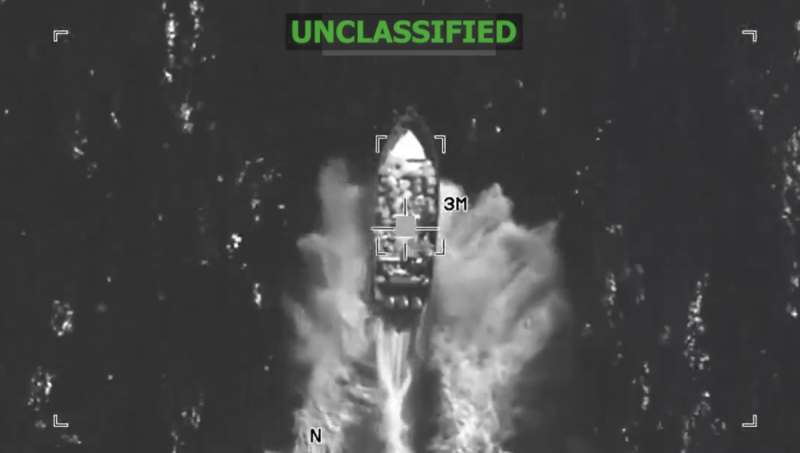
A screengrab from a video posted by the US government of a “kinetic strike” on a boat allegedly carrying drugs in the Caribbean. Photo courtesy US Southern Command/X.
Designating major drug cartels as global terrorist organizations and declaring a national emergency, the Trump administration has launched the largest US military deployment in Latin America since the Cuban Missile Crisis. Under Operation Southern Spear, US forces have carried out targeted strikes on suspected drug-smuggling vessels, killing couriers and small-boat crews in actions that human rights groups warn resemble a “murder spree” more than law enforcement. These killings are not incidental. They are staged as spectacles of retribution: highly visible demonstrations of force aimed at projecting resolve and deterrence.
Aside from the legal and ethical issues with a policy of extra-judicial executions, the strategic rationale for staging these costly spectacles is dubious at best. First, it diverts critical resources from major criminal networks sourcing narcotics. The Drug Enforcement Agency’s 2025 National Drug Threat Assessment and the Office of the Director of National Intelligence’s 2025 Annual Threat Assessment identify the Sinaloa and Jalisco New Generation Cartel groups as the major suppliers to the US of fentanyl and other illicit drugs—Venezuelan traffickers are minor players. Second, destroying the vessels and assassinating couriers eliminates the material evidence and critical intelligence on networks that could be gathered from arrests and interrogations.
In a paper from 2016, lawyer Kevin Lerman points out that drug mules are “pawns of the drug conspiracies” representing the lowest rung of the narcotics trade. Couriers are the “most powerless and most exploited in the international drug trade,” he writes, typically snared into the web of the cartels by poverty, debt or coerced into collusion. If caught, cartel bosses will vigorously disown them and not waste a penny on their legal defence. These readily replaceable mules now fill US prisons while narco lords and their financial kingpins, with few exceptions, have faced little or no repercussions. The fragmented evidence on the profiles of the mules now being blown apart by US military power largely echoes this depiction: fisherman and migrants from coastal regions of Venezuela struggling in poverty with few alternatives to provide for their families.
These pawns of the drug industry now face the full weight of lethal US military power bereft of any due process. Extrajudicial and extraterritorial killings, once viewed as a weapon for criminal non-state actors—anarchists, terrorists or death squads—has become a weapon more widely deployed by an array of state actors including Russia, Iran, and Israel, among others. That normalization did not begin with Trump. Under the Bush and Obama administrations, the US asserted the executive authority to place individuals on secret kill lists and order their execution without charge, trial, or judicial oversight, relying on classified legal opinions to shield those decisions from public scrutiny. Obama refined this power, institutionalized it, and embedded it within a durable legal architecture designed to survive presidential transitions.
Trump’s current killing spree at sea is not an aberration but the logical culmination of that bipartisan project, now stripped of even the pretense of restraint. Given the scale of violence inflicted by cartel leadership, one could plausibly argue that narrowly targeted operations against the upper echelons might disrupt criminal enterprises. Why, then, is this inherited power being wielded not against kingpins, but against expendable foot soldiers—fishermen, migrants, and couriers whose deaths serve spectacle rather than strategy?
While narco elites have not been targeted for assassination, some have been caught in the net of the law. In 2002, Honduran President Juan Orlando Hernández was charged with operating a “narco-state” that enabled “a corrupt and violent drug-trafficking conspiracy to facilitate the importation of tons of cocaine into the United States.” He was convicted to serve 45 years in prison for deploying his political power “to support one of the largest and most violent drug trafficking conspiracies in the world.” On December 1, 2025, years of investigative and legal work were swept aside and Hernández was granted a full and unconditional presidential pardon. Ross Ulbricht, the billionaire founder of the Silk Road marketplace, was arrested for his role in enabling a vast Bitcoin laundering network on the darknet that facilitated the global trade in narcotics. In 2015, he was convicted on an array of charges—distributing narcotics by means of the Internet, money laundering, and traffic in fraudulent identity documents—and sentenced to double life in prison plus 40 years without the possibility of parole. On January 21, 2025 Ulbricht similarly received a full and unconditional presidential pardon. In justifying pardons for these wheelers and dealers in the global drug trade, there was no reference to the facts supporting these convictions, only vague presidential laments they had been treated “very harshly and unfairly.” It unveils, yet again, that soft, mushy spot in Trump’s heart for the plight of authoritarian elites and billionaires of all stripes.
On another front, undocumented immigrants, most without any criminal record, are being seized from homes, shops, and streets, shackled and imprisoned, without any hint of due process, all designed to create the public spectacle of a regime that is “tough on crime.” Elites flex their economic and political power with impunity, while the full force of state disciplinary force is unleashed on expendables. Alessandro Manzoni’s novel, The Beloved, offers a powerful meditation on the plight of those caught in the crosshairs of such as system: “the law was like a net spread to catch the little birds, while the great ones broke through it and flew away… the poor were punished for trifles, while the rich committed crimes with impunity.” His words still resonate in our time.
The world Manzoni depicts was haunted with religion, but so too is ours—much as some wish it weren’t so. As this war on narco-terrorism presses on, with its weekly public witch-burnings, Secretary of War Pete Hegseth has been staging performances of faith before his military personnel, including a ritual recitation of the Lord’s Prayer, as images of American military power—tanks, warplanes, bombs—flash across the screen. Manzoni challenged the collusions of religion and power. Hegseth’s particular brand of Christianity is marked by a fervent embrace of this brew. It is part of a wider Christian landscape littered with an array of troubling political theologies—Christian Reconstructionism, Dominionism, and the New Apostolic Reformation—that have been reshaping US religious culture. Their impact on American politics has only grown over the generations and their adherents now occupy the halls of power.
Like witch-burnings, the killing of drug mules is designed to be a dramatic spectacle, a theatre of punishment, for public consumption. But this costly spectacle is getting muddier and messier with more murdered mules and pardoned narco elites cluttering the stage, while cartels continue to hum along in full production. Adding to this muddle is the forced marriage of Christianity to state power with the secretary of war commandeering Christian faith to adorn his chest-thumping displays of military power. Countering these trends will require major conjunctions of political and spiritual intelligence to chart paths through this swollen tangle of power, populism, and politicized religion.
Daniel Cere is Associate Professor of Religion, Ethics and Public Policy in the School of Religious Studies at McGill University.