
Recognition is not power: the battle for the soul of McGill

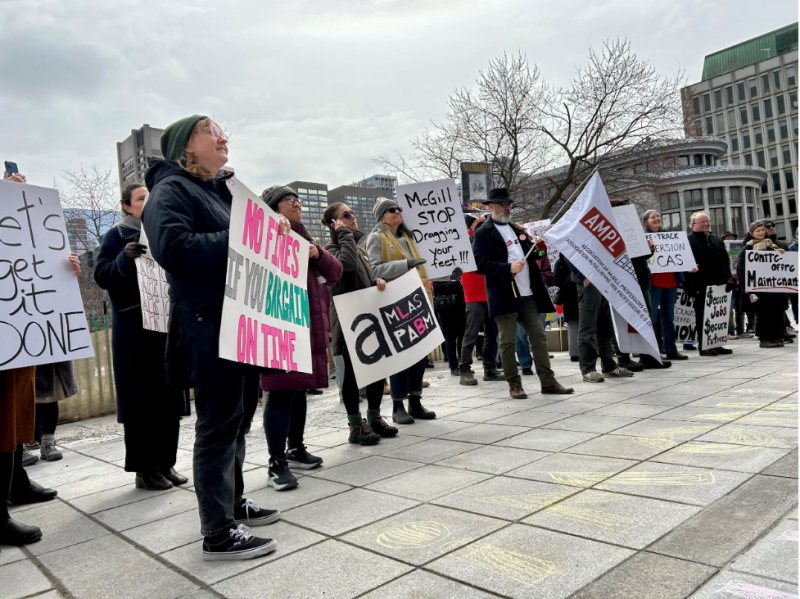
Faculty and supporters gather at McGill University, calling for a full counter-offer after months of stalled contract negotiations. Photo by Gavin Sewell.
On a cold, grey April afternoon, faculty from across McGill departments gathered on the steps of the Arts Building to issue an ultimatum. Under the banner of the Confederation of Faculty Associations of McGill (COFAM)—an alliance uniting the university’s newly unionized faculty associations—they set a deadline: after nine months of stalled first-contract negotiations, they wanted a full counter-offer by April 10, rather than the incremental, article by article responses which have left bargaining at a standstill.
The deadline passed and McGill’s administration, for its part, is still holding the line.
Only a few years ago, McGill distinguished itself in having no faculty unions—whereas, according to the Canadian Labour Economics Forum, 90 percent of academic staff at other universities are covered by collective agreements. Since 2022, the faculties of law, education, and arts have unionized after a prolonged and costly battle with the administration—one that included legal challenges and more than $1 million in anti-union spending, according to previous reporting in The Rover. Recognition, however, is only the opening battle. What follows is the harder question of power: who governs the university, and in whose interests.
For many of those involved, the answer goes beyond wages or working conditions. “The big appeal of unionizing profs is a question of power within the university,” said one organizer at the rally. “Profs should have more power… the big one for me is having our say within the institution.”
At issue is not only the content of a first collective agreement, but the extent to which faculty can exercise meaningful control over the institution of which they are the heart.
According to those at the table, the university has responded in fragments to proposals ranging from contract faculty conversions and improved working conditions to academic freedom and equity protections—returning a slow drip of individual clauses without presenting a coherent, comprehensive counter-offer.
“It’s really difficult to bargain like that,” explains Edward Dunsworth of the COFAM mobilization team. “We need a full picture to properly negotiate—to make advances in one area and compromises in another.”
Without a complete counter-proposal, the process risks becoming a war of attrition, stretching indefinitely with no clear horizon for a deal.
That dynamic is felt acutely by the university’s more precarious instructors. A primary battlefield in these talks is the status of contract academic staff (CAS), who carry a significant share of the teaching load while often lacking the job security, benefits, and institutional voice of their tenure-track colleagues. Union negotiators are pushing not only for improved wages and benefits, but for “conversions”—clear pathways for long-serving contract faculty to move into stable, permanent positions. As one speaker at the rally put it: “We don’t just want the ability to apply… we want those conversions now.”
An AMFA (Association of McGill Professors of the Faculty of Arts) member attends the rally, part of a broader coalition of faculty unions organizing across the university. Photo by Gavin Sewell.
Beyond the paycheque, the confederated unions are seeking to codify the very values of the institution in a more democratic, worker-controlled direction. Non-monetary demands currently on the table include reinforced protections of academic freedom and concrete measures to address systemic inequity and discrimination. By pulling these issues into a collective agreement, the unions are attempting to move university policy out of the opaque, “case-by-case” discretion of the administration and into a framework of transparent, enforceable rights. In this sense, the current round of bargaining is less about a distribution of resources and more about a redistribution of authority.
For those directly involved in negotiations, the limits of the bargaining table are well understood. Speaking to the crowd before the march toward the James Administration Building, a member of the COFAM negotiating team described the process in stark, spatial terms. The formal discussions, she noted, take place on “the literal 15th floor” of a downtown office building—where proposals are exchanged and language is debated in isolation. But that boardroom reflects rather than determines the outcome. “The reality,” she told the assembled faculty and supporters, “is that everything happens here—when we are together, united, and we demonstrate pressure against the university.” At the table, she added, negotiators can only “transmit” the power that is actually generated by the base.
That distinction—between the formal ritual of negotiation and the informal power that shapes it—explains the persistence of the current impasse. As bargaining alone has produced limited movement, the strategy has shifted toward institutional coordination and a more militant tone. The formation of COFAM represents a departure from McGill’s long-standing position, where departments operated as siloes. Today, professors in law, arts, and education are beginning to act as a unified bloc, attempting to convert their collective weight into the kind of leverage that can’t be ignored in a corner office in downtown Montréal.
For Barry Eidlin, a sociology professor and labour scholar, the administration’s approach is neither surprising nor accidental. “From a managerial perspective, the university’s $1.1 million spent on legal challenges and its reliance on external counsel are rational investments. Employers place a very high economic price on retaining control of their workplace,” Eidlin argues. In this view, the “article by article” stalling is not a sign of administrative dysfunction, but a predictable strategic response to a perceived loss of authority. The administration appears to view a million-dollar legal bill not as an expense, but as a premium paid to insure their continued unilateral control over the institution.
Perhaps the most significant shift, however, is internal. Traditionally accustomed to professional autonomy and “collegial” respect, many professors are new to the combative logic of collective action. Organizing, as Eidlin puts it, requires a fundamental shift in mindset: away from the academic conviction that better data or superior arguments will carry the day, and toward the recognition that outcomes are shaped by power. “It’s not about having the best arguments,” he says—a realization he notes is often “anathema” to the way professors are trained to think. The current struggle has required building something less familiar than a research paper: a collective identity rooted in shared working conditions and common leverage.
Whether this shift in consciousness will be enough to break the deadlock remains an open question. What is clear is that the struggle at McGill has moved beyond the initial victories of recognition into a more uncertain, higher-stakes phase. If the first stage was about establishing the legal right to organize, the second is about determining what that right can actually achieve—and how much of the university’s future will be shaped by the people who do the work.
Gavin Sewell is writer, organizer, and contemporary artist known for his intricate mixed-media pieces and wall sculptures. A cofounder of the SATTAQ freelancers union, Gavin is deeply involved in labor and social justice issues.