
Can the new Toronto Tenant Union change the tired housing debate?

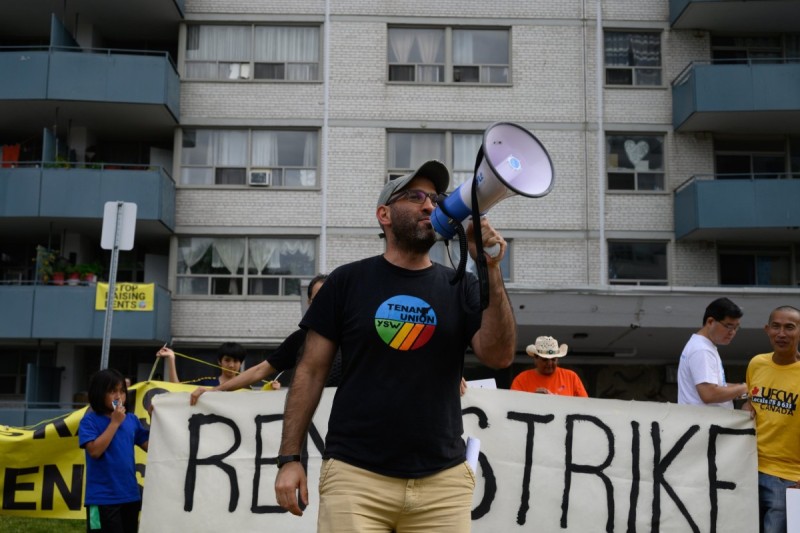
Toronto Tenant Union Co-chair Bruno Dobrusin at a rent strike at 1440 and 1442 Lawrence Ave. W. in Toronto in 2023. Photo courtesy Toronto Tenant Union/X.
On April 18, more than 300 tenants from across the Greater Toronto Area gathered at the founding convention of the Toronto Tenant Union (TTU), whose mission is to “fight rent hikes, win housing justice, and protect our homes.”
Given the track record of its two largest founding groups—the York South-Weston Tenant Union and Climate Justice Toronto—the TTU is poised to fight landlords fiercely and win often.
It could do even more.
This new, city-wide tenant union could inject a much-needed dose of political honesty into housing debates.
The distribution of housing is a quintessential political-economic question, not simply an economic one. Land and the homes we build on it are not like the proverbial widgets of economic textbooks. We can’t produce housing in whatever amounts, given the limited amount of desirable land on which to build it. And people can’t simply forgo housing if the price isn’t right.
The controlled supply and inelastic demand for housing lead to enviable profit margins for those who sell or rent it. They wouldn’t have it any other way. In turn, those who pay too much in rent want price controls and the removal of profit from the equation.
There is no “win-win policy solution” that will please both sides. Politicians must pick a side.
Mark Carney and Doug Ford could have worked together to curb predatory financial landlords through a combination of tax policies and strong rent controls. Instead, they are spending $2.2 billion on a HST rebate for houses priced under $1 million.
The winners: developers who built too many condos and investors who can now buy them in bulk at discounted prices. As Jeremy Withers exposed in detail, the tax rebate is simply a bailout.
Prime minister and premier get together to rescue developers and prop up investors while doing nothing for tenants. The politics of housing is that blatant. Yet, mainstream housing debates in Canada consistently ignore power and class interests. Most housing pundits focus exclusively on problems with housing production, fuelling the fantasy that quantity, not distribution, is the core issue. By treating housing as a widget, they push conflict under the rug.
Toronto offers no shortage of examples of what that “apolitical” framing obscures. In the Downtown East, vacant lots that could be used for affordable housing have sat idle for years while communities push for expropriation, only to be outbid by private equity firms seeking to build luxury condominiums.
In neighbourhoods like Regent Park and along the Dundas East corridor, redevelopment has driven up land values, invited speculation, and displaced low-income residents, even as governments continue to partner with the very firms profiting from that transformation.
Who benefits from policy debates that circumvent the raw power politics behind these redevelopment deals? Not tenants.
Research knowledge plays an important role in nuancing political claims and in shaping policy and programs. But expertise shouldn’t sideline or silence the politics of housing, and that’s what happens when researchers take up all the airtime. Too often, we think we’re adding to the debate when we’re simply diluting it.
As a quiet observer at the Toronto Tenant Union’s founding convention, I was thrilled to hear the housing question discussed in its fullness. Members debated motions and amendments incisively, delving into questions of political power, conflicting economic interests, regulatory capture, and state coercion.
There was one lengthy discussion about who can join the tenant union. The original draft stated that members should live in the GTA, agree with the union’s vision statements and not be landlords. But what about homeowners? Do the benefits of tapping the political support of homeowners outweigh the risk of losing focus on tenant issues?
Members decided that homeowners may join as non-voting members. They also agreed that people living with their homeowning parents and people who are unhoused can join as voting members, as they share the same political interests as tenants.
Many other similar debates followed. Then, members elected a team to coordinate political action, which is what the union is really about.
Québec has two province-wide tenant coalitions—the Front d’action populaire en réaménagement urbain (FRAPRU) and the Regroupement des comités logement et associations de locataires du Québec (RCLALQ)—both formed in the late-1970s in a manner very similar to that of the Toronto Tenant Union. Notably, the Québec media treats these groups as the primary political interlocutors for tenants, much as it treats labour unions in economic development and employment matters.
While a common fear among the left is that recognition as a legitimate political interlocutor leads to co-optation by the liberal political apparatus, FRAPRU and RCLALQ demonstrate that this is not always the case. Both coalitions remain genuine social movements and show no interest in becoming polite civil society organizations. Their interventions in public debate are uncompromising in tone and content and are backed by internal democratic processes. In practice, the spokespeople for these coalitions take airtime away from researcher types like myself, offering an unmediated and accountable tenant perspective in most housing stories—which is a great thing.
In Toronto, the Federation of Metro Tenants Associations (FMTA) and ACORN are sometimes asked to weigh in on specific tenant issues. Coverage of rent strikes, like the one at 75 Spencer Avenue, often focuses on tenants.
Still, in a city where almost 50 percent of the population rents their home, tenant groups get very few opportunities to weigh in on housing-related developments. And too often, tenants are asked to share personal experiences rather than articulate their collective political stances.
Sappy stories of poor tenants and apolitical policy debates are tiresome and unhelpful. We are much better served by honest political discussions about the inherently conflictual nature of land and the housing built on it.
The TTU is a new, democratic, and unapologetically political voice in housing debates. If given the airtime it deserves, the union can elevate clear-eyed, grounded stances that cut through the fog of wonky debates.
Ricardo Tranjan is Ontario Research Director at the Canadian Centre for Policy Alternatives and author of The Tenant Class.