
How the Canadian military is fueling the climate crisis

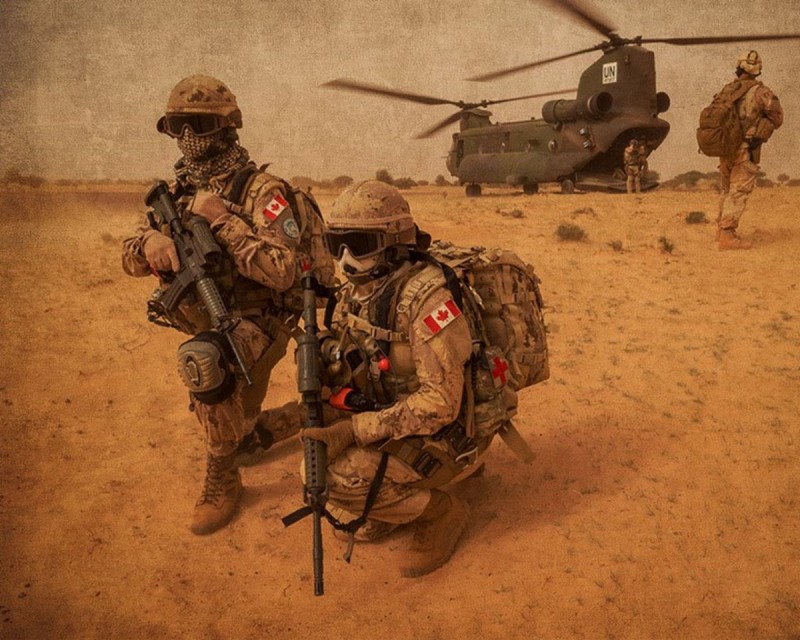
Members of the Canadian Armed Forces during an operation in Afghanistan. The photo has been digitally altered for operational security reasons. Photo courtesy the Canadian Armed Forces website.
The following is an excerpt from Yves Engler’s new book, Stand on Guard for Whom? A People’s History of the Canadian Military, released this year by Black Rose Books.
Though it receives relatively little attention, the Canadian Forces’
ecological footprint is immense. It ranges from decimating
animal life to releasing substantial greenhouse gases (GHG) into the
atmosphere. In fact, DND emits far more carbon than any other
institution. According to the government’s 2017 defence policy review,
DND “represents more than half of the Government of Canada’s
greenhouse gas emissions.” Despite this, CF operations are exempt
from the government’s emission reduction targets.
Military vehicles, planes, and warships consume significant
fossil fuels. But even before becoming CF property war tools emit a
great deal of carbon and other pollutants. Manufacturing guns, tanks,
submarines, naval frigates, and fighter jets consumes significant energy
and produces many waste products. Bullet and small arm production
generate hazardous wastes such as ozone-depleting substances, volatile
organic compounds and heavy metals.
The CF operates a few hundred planes and naval vessels and has
30,000 land vehicles. Once built, planes, vessels and tanks all guzzle
petrol even if rarely used outside of drills. A Forbes headline aptly
referred to “Fuel-Sucking Military Vehicles.” A Humvee consumes
around a litre of gas every five kilometers it travels while naval frigates
carry 665,000 litres of fuel.
Fighter jets are incredibly fuel intensive. During six months of
bombing Libya in 2011 a half dozen RCAF jets consumed 14.5 million
pounds (8.5 million litres) of fuel. An hour of flying a CF-18 consumes
hundreds of litres of fuel and in a usual year RCAF planes log thousands
of training hours. For their part, the Snowbird performance aircraft
participate in dozens of airshows in multiple locations each year. Nine
CT-114 Tutors usually perform for about 35 minutes at these events.
Since 1992 the RCAF has had five mid-air refuelling aircraft that
can each carry 24,000 pounds of jet fuel. According to a 2018 Skies Mag
article, the CC-130HT aerial refuelling aircraft “has been extensively
used since its operational introduction in 1993.” Two Canadian air-to-air refuelling tankers supported the bombing of Libya in 2011 and
between late 2014 and 2018 they distributed 65 million pounds of fuel
for the (mostly US) bombing of Syria and Iraq.
Flying is fuel intensive and its climatic impact is generally about
twice the CO2 emitted alone. The release point of the carbon enhances
its warming impact and other flying “outputs” produce additional
climatic impacts. Fighter jets burn an especially toxic fuel, which allows
them to fly higher and faster than commercial aircraft.
A century later the ecological toll of the First World War lingers in eastern
France. The traces of trench networks and blast holes remain visible
while huge amounts of ordnance are collected each year. Near Verdun,
France, a 700 square kilometre no-go Red Zone has over 10 million
explosives. The soil has elevated concentrations of copper, lead, zinc,
mercury and tin. Arsenic levels in parts of the Red Zone continue to
rise, meaning the chemicals are acting up.
Seven decades after the war unexploded ordnance and debris
litter central Korea. Deforestation in the north is partly due to fires
caused by bombings, which destroyed dams and thousands of acres of
farmland.

The first Gulf War resulted in a “toxic battlefield.” While the
Iraqis fouled the air by burning oil wells, coalition forces destroyed
pipelines, refineries and sewers, spilling sewage and oil. The US
also fired shells with depleted uranium, which probably increased the
incidence of cancer and congenital disease for those nearby. During
the war the CF disposed of plastics, batteries, medicine, dead animals, and
unexploded ordnance in burn pits. A large CF base abroad can
burn tens of thousands of kilograms of waste daily.
During the 1999 bombing of Serbia NATO jets dropped
bombs containing depleted uranium. NATO’s effort, the author of
“Environmental impact of the war in Yugoslavia on south-east Europe” notes, “to destroy industrial sites and infrastructure caused dangerous
substances to pollute the air, water and soil.” The deliberate destruction
of chemical plants caused significant environmental damage.
Environmental protection wasn’t part of the agreement between
the NATO-led International Security Assistance Force and the UN
or Afghan government. US bombing in Afghanistan disrupted
important migratory passageways for birds. To destroy crops during
the 2000s war Canadian and US forces employed incendiary white
phosphorus munitions, which are linked to ailments in animals. The
CF also littered the landscape with tens of millions of bullets and
shells. Leftover Canadian mortars reportedly killed three children in
February 2009, prompting a demonstration calling for “death to the
Canadians.”
The Kandahar airfield, which housed tens of thousands of
Canadian troops, was responsible for significant waste. A “poo pond”
of human waste fouled the air while large quantities of hazardous
waste material accumulated. These included oils, lubricants, solvents,
pesticides, detergents, compressed gas cylinders, bulbs and batteries,
nickel-cadmium and lithium as well as waste containing asbestos and
contaminated soils. A leaked US Army memo stated that the
burn pit at its largest Afghan base posed “long-term adverse health
conditions” to those breathing the air.
NATO severely damaged Libya’s Great Manmade River aquifer
system. On July 22, 2011, NATO planes bombed and destroyed much
of its pipe-making facilities at Brega. Without providing evidence,
NATO claimed Gaddafi’s forces stored weapons at the facility and fired
rockets from the site. Attacking the source of 70 percent of the population’s
water may have been a war crime. Human Rights Investigations wrote,
“even if rockets were being fired from within the location (for which no
evidence has been produced) or this facility was being used for military
storage by Gadaffi forces, or housed armoured vehicles, attacking the
pipe-making factory in a way that leaves it severely damaged is illegal
as this facility is important to the water supplies of Libyan civilians.” Since the 2011 war millions of Libyans have faced a chronic water
crisis.
Impacting large sea life, naval frigates use the ocean as their trash
can. Ships dump food waste in the Arctic sea and navy guidelines permit
Canadian submarines to dump oily bilge water into the sea. Anecdotes
in various military histories suggest RCN vessels have discharged a great
deal of oil during war. More recently, HMCS Calgary spilled 10,000-
20,000 litres of F-76 fuel into the Georgia Strait in February 2018 while
HMCS Halifax spilled “an unspecified quantity of oil” into the Halifax
harbour in July 2019. HMCS Athabaskan dumped 800 litres of fuel
into the same waterway in January 2016. Earlier in the decade HMCS St. John’s spilled 9,000 litres of diesel fuel into the Halifax harbour and
HMCS Preserver spilled another 14,000 litres there.
Even after they are no longer operational, naval vessels pollute
the seas. Many RCN vessels have been sunk to the ocean floor. In
2007 US and Canadian gunboats, as well as fighter jets, disposed
of HMCS Huron 100 kilometres off of Vancouver Island. Officially,
the method of disposal was listed as “firing by naval sea sparrow
missiles, aircraft machine guns, and naval gunnery (including MK48
torpedoes).” HMCS Huron was sunk two kilometres down to
the ocean floor. In response Jennifer Lash, from the group Living
Oceans, complained that the military was “treating the ocean like a
garbage dump … No one even knows what kind of marine life there
is down there.”
Huge amounts of toxic material have been released at naval
testing sites. According to an internal assessment of CF Maritime
and Experimental Test Ranges (CFMETR), 93,000 kilometres of
copper wire and 2,200 tons of lead, lithium batteries and other toxic
materials were dumped at Nanoose Bay between 1965 and 1995.
While they refuse to allow independent scientists to investigate the
torpedo-testing site, the RCN insists its soft mud bottom can absorb
these toxins.
On the east side of Vancouver Island, CFMETR is largely used
by US nuclear-powered and nuclear weapons-capable submarines. In
the 1990s US submarines fired thousands of torpedoes at the facility
(the soft seabed allows them to retrieve expensive torpedoes).
DND suspects dozens of lakes or underwater spots are laden with
unexploded ordnance. For nearly half a century, the CF pounded Lac
Saint-Pierre, near Trois-Rivières, with shells as big as 155 millimeters
(the size of a large fire extinguisher). DND admits that more than
300,000 projectiles were tested in Lac Saint-Pierre and they maintain
a year round ‘caution zone’ at a lake that had 8,000 live shells on its
bottom five years after shelling ended in 2000. Lead and mercury
from the weaponry can harm animal and human health.
US Air Force fighters during the 1991 Gulf War. Photo by Everett Historical/Shutterstock.
There are over one thousand known munitions dumpsites off the
east coast. After the Second World War 180,000 tons of munitions was dumped just
offshore of Sydney, Nova Scotia.
In 2010 DND reported that chemical and biological munitions
were disposed in over 100 sites across the country. CBC interviewed
a former military officer who said in the late spring of 1985 he was
ordered to escort a flatbed truck along an empty road to a freshly dug
pit at CFB Gagetown. Over 40 full or semi-full barrels—some dented
or in various states of decay—were dumped in the spongy soil. Most
of them were wrapped with an orange stripe with the words “Agent
Orange”.
From the end of the Second World War until the 1970s the CF dumped chemical
weapons into the ocean. After the Great War the military disposed some
chemical weapons in the Atlantic. On a larger scale the Directorate of
Chemical Warfare and Smoke dumped many containers full of mustard
and nerve gas munitions into the sea in 1945.
A large quantity of chemical munitions were dumped 8,200 feet
below sea level one hundred kilometers from Tofino, on Vancouver
Island. In 1946 the RCN sunk 30,000 drums of mustard gas near
Sable Island, 160 kilometres east of Halifax. In total 2,800 tons of mustard
gas was dumped around the canyons in the eastern Scotian Shelf, a 700
kilometre long and 100 kilometre wide area. According to the CF, chemical or
biological weapons were dumped in at least 28 sites off the east coast.
Exposure to these chemicals causes cancers and depresses
immune systems in sea life. They also pose a potential threat to fishers
and oil exploration teams (oil interests pushed the government to map
the chemical weapons dumps in the Atlantic).
After the Second World War the Canada-Britain-US tripartite Advisory Committee
on the Effectiveness of Gas Warfare Materiel in the Tropics shared
data from a number of test sites. Between 1945 and 1947 the US and
Canada exploded more than 30,000 chemical arms on the Panamanian
island of San Jose. Uninhabited by humans and relatively isolated
(though not too far to get supplies from the mainland), the island was used to conduct “chemical warfare tests under existing jungle
conditions.”
In 2001 Ottawa refused Panama’s request for help to clean up
3,000 unexploded Canadian-made mustard-gas shells and at least eight
unexploded 500 and 1,000-pound bombs containing phosgene and
cyanogen chloride. A large amount of munitions were also dropped into
the sea around the island. Across Canada there is unexploded ordnance
at “several hundred” sites, according to a government analysis. In
2011, Wellers Bay near Trenton, Ontario, was closed to the public after
DND personnel found hundreds of kilograms of weapons fragments.
They believed “500-pound bombs” may still be buried underground in
a popular beach area where bombers trained during the war.
Toxins from remnants of explosives and unexploded ordnance
seep into local ecosystems and drinking water. “Unexploded or
deflagrated RDX [a common explosive] does not degrade in soil and,
because of its solubility in water, migrates easily to groundwater and
off military property,” a 2011 DND report says. “This may trigger a
serious environmental problem and becomes a public health concern
if the groundwater is used for drinking.”
Shooting ranges also pose a threat to local water sources. The
lead in bullets can seep into local ecosystems. A potent neurotoxin,
lead alters the formation of the brain and is an important cause of
intellectual disability and behavioural problems (the steep decline
in violent crime over the past four decades has been linked to the
elimination of leaded gasoline).
Bases are also full of pesticides and herbicides. An internal report
(made public in 1997) described CFB Shearwater and CFB Greenwood
as a “cocktail of toxic chemicals.” It found 542 CF sites contaminated
across the country requiring cleanup. Philip J. Anido points out that
since the French constructed Québec City’s Citadel in the late 1600s,
colonial military installations have left contaminated waste.90
Beyond the toxins at military sites, CF training has damaged
robust and rare fauna. To dig trenches soldiers often rip out prairie grasses while trucks drive over flora and ground-bird nesting areas.92
Destruction in the north was particularly stark. In “The Cold War
on Canadian Soil: Militarizing a Northern Environment” Whitney
Lackenbauer writes, “military mega-projects radically transformed
the human and physical geography of the North. Bulldozers tore
permafrost off the ground, disrupting ecosystems and creating
impassable quagmires.”
The Distant Early Warning (DEW) Line, a network of 63 radar
and communication stations in the Arctic Circle, was an ecological
calamity. Built in the early 1950s to counter the purported Russian
menace, the 4,500-kilometre line from the northwest coast of Alaska to
the eastern shore of Baffin Island required 460,000 tons of material to
be transported north. Alongside maritime and land transport, 45,000
commercial flights delivered goods as many as 5,000 kilometres. And 9.6
million cubic yards of gravel was produced on site.
The off-road vehicles brought to the north damaged vegetation
and melted permafrost. Activities associated with the DEW line were
linked to depleted fish stocks and agitating caribou and other game
Indigenous peoples subsisted on.
When the DEW line was abandoned a few years after being
completed an incredible amount of material was left behind. There
were rotted vehicles in lakes, containers full of hazardous materials
and dumps leaking arsenic and PCBs. When the cleanup began three
decades after the sites were abandoned, over 200,000 cubic metres of
soil contaminated by diesel fuel was placed in nearby “land farms”
where it was tossed and turned until the hydrocarbon evaporated to
more acceptable levels. Additionally, 35,000 cubic metres of waste—mostly soil contaminated with PCBs and lead—was shipped south to
be incinerated or buried.
About 1,000 kilometres south of the DEW line, the 98 radar sites of
the “Mid Canada Line” spilled PCB’s and other toxic substances
for decades. For years the Mushkegowuk Council, which represents
seven Indigenous communities in northern Ontario, campaigned for the government to clean up the heavy metals, DDT, asbestos, PCBs
and petroleum hydrocarbon from the abandoned radar sites that
contaminated their soils, groundwater, animals and foods. Nearly a
half-century after the line was abandoned Ontario and Ottawa put up
$100 million to clean up Mid-Canada Line contamination.
In the 1980s low level training flights by US, British and German
fighter jets in Labrador scared wildlife and damaged the Innu’s way
of life. As a result of supersonic jets skimming the ground, ducks laid
eggs a month early, caribou changed migration patterns and beavers all
but vanished.
For some reason there has been little political scrutiny of the
military’s ecological footprint or the fact its GHG emissions are
exempted from reductions targets. In 2017 Tamara Lorincz, author of
a report titled “Demilitarization for Deep Decarbonization,” pointed
out that not a single MP publicly questioned the climate impacts of
new fighter jets or the CF in general.
Ironically, Googling the topic mainly turns up articles about the
CF protecting the environment. Military statements, for example,
describe the RCN’s role in defending offshore energy platforms from
possible attack and resulting ecological damage. The 1971 White Paper
on defence called for the RCAF to survey Canadian waters to detect
pollution from foreign vessels and arrest ships that breached Canadian
environmental regulations. A few years after the DEW and Mid
Canada Lines caused extensive ecological damage, the White Paper
asserted that the CF would ensure “a harmonious natural environment”
in the north.
The military can ‘greenwash’ its operations partly because the
environmental movement largely ignores the CF and warfare. But
regardless of this blind spot from many environmentalists, militarism is
inherently anti-ecological.
Yves Engler has been dubbed “one of the most important voices on the Canadian Left today” (Briarpatch), “in the mould of I.F. Stone” (Globe and Mail), and “part of that rare but growing group of social critics unafraid to confront Canada’s self-satisfied myths” (Quill & Quire). He has published nine books.