
Trump’s war on Venezuela is a war on Latin America

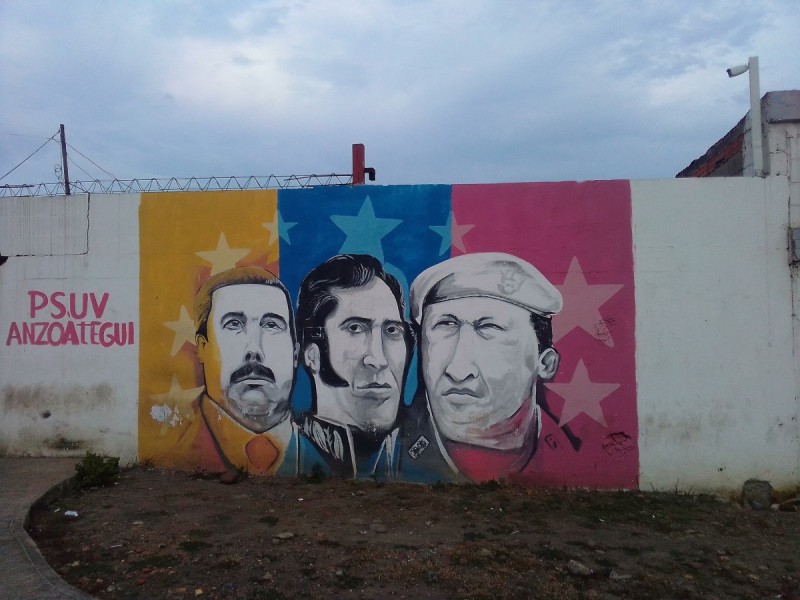
Street art depicting Nicolás Maduro, Simón Bolívar, and Hugo Chávez. Photo by Guaiquerí/Wikimedia Commons.

After more than two decades of coup attempts and destabilization efforts against Venezuela, the United States has escalated its campaign with direct, illegal, and unprovoked military strikes on the South American country. Explosions rocked Caracas in the early hours of January 3—by daylight, plumes of smoke rose over the capital. US bombing also targeted the states of Miranda, Aragua, and La Guaira, striking airports, residential areas, ports, military bases, and surveillance antennae. According to Venezuelan officials, the attacks have caused dozens of casualties.
Compounding the assault, the US military invaded Venezuela and kidnapped sitting president Nicolás Maduro and his wife, Cilia Flores, in an operation involving “a joint force of over 150 aircraft and special operations teams.” The Trump administration now plans to try Maduro and Flores in New York on long-discredited narcotrafficking charges.
According to one report: “Data from the United Nations Office on Drugs and Crime shows that Venezuela is not a cocaine-producing country, and last year’s U.S. Drug Enforcement Administration report on drug trafficking focuses on Ecuador, Central America and Mexico, with little emphasis on Venezuela.”
Nevertheless, Trump has claimed that “the illegitimate dictator Maduro was the kingpin of a vast criminal network… responsible for the deaths of countless Americans. Maduro and his wife will soon face the full might of American justice and stand trial on American soil.”
France, Spain, Russia, China, and the European Commission have all stated that the US military’s operation against Venezuela broke international law. Regional leaders have also condemned the illegal bombing of Venezuela and the kidnapping of Maduro.
Colombia’s President Gustavo Petro said, “The Colombian government rejects this aggression to Venezuela’s and Latin America’s sovereignty.” Mexico’s Claudia Sheinbaum issued an “urgent call to respect international law…and to cease any act of aggression against the Venezuelan government and people.”
Cuba condemned the US attack on Venezuela as “state terrorism,” while warning that the Latin American “zone of peace” is being “brutally assaulted.” Brazil’s Lula asserted that the US had crossed an “unacceptable line.” Chile’s Gabriel Boric offered “condemnation” of the US operation, while Uruguay noted its rejection of “military intervention by one country in the territory of another.”
In Latin America, only the right-wing, Trump-aligned governments backed the operation—namely, Ecuador, Argentina, Panama, and Bolivia.
The US attacks on Venezuela are a flagrant violation of international law. Article 1 of the UN Charter calls for “respect for the principle of equal rights and self-determination of peoples,” while Article 2 says that “all Members shall refrain in their international relations from the threat or use of force against the territorial integrity or political independence of any state.”
The war on Venezuela is not over. Trump has already threatened a second, larger strike if the Venezuelan government does not submit to his demands for a total economic and political remaking of the country. At the same time, he has proclaimed that the US government is “going to run” Venezuela and openly signalled Washington’s intentions to seize control of its resources. Trump has declared that US oil companies are preparing to move into a post-Maduro Venezuela. “We have the greatest oil companies in the world,” he said, “the biggest, the greatest, and we’re going to be very much involved in it.” Vice President JD Vance reinforced this message by declaring that “the stolen oil must be returned to the United States,” invoking Trump’s stated goal of reversing Venezuela’s 1976 oil nationalization, a policy later strengthened under the presidency of Hugo Chávez.
There is no ambiguity here. The Trump administration is openly telling the world why it bombed Venezuela and kidnapped Maduro: the US aims to occupy the country, either directly or through proxies. Trump has said that he is “not afraid of boots on the ground,” making clear that direct military occupation remains on the table, all in service of exploiting and profiting from Venezuelan resources. The geopolitical motive must also be stressed. Advocates of Maduro’s overthrow frequently point to Venezuela’s close relationships with China, Russia, and Iran, as well as Caracas’s support for Palestinian liberation. Opposition leader María Corina Machado has gone so far as to claim that Venezuela has “already been invaded” by Russia, Iran, Hezbollah, and Hamas.
Canada’s government has refused to join the global outcry against the war. In fact, Foreign Affairs Minister Anita Anand tacitly endorsed the kidnapping of Maduro by immediately affirming that Ottawa has “refused to recognize any legitimacy of the Maduro regime.” Anand called on “all parties” to abide by international law—ignoring the fact that one party, the US government, has openly and consistently shredded international law through decades of unprovoked aggression against Venezuela. This includes years of crushing sanctions, CIA operations, and Trump’s “total naval blockade” of the country.
Please see my statement on the situation in Venezuela: pic.twitter.com/bILuKbHQsk
— Anita Anand (@AnitaAnandMP) January 3, 2026
Anand’s unwillingness to condemn the US war on Venezuela comes as no shock. The minister has previously refused to describe the US military’s extrajudicial executions in the Caribbean as illegal. Even less surprising is Conservative leader Pierre Poilievre’s shameless praise for Washington’s criminal aggression. “Congratulations to President Trump on successfully arresting narco-terrorist and socialist dictator Nicolás Maduro,” he wrote in a social media post. “Down with socialism. Long live freedom.”
For his part, interim NDP leader Don Davies said that Trump’s attack on Venezuela “is neither an act of self defence nor does it have UN Security Council authorization. It is therefore totally illegal and a breach of the UN covenants the US has agreed to uphold as a Member State… The U.S. can have no credibility upholding international law and the rights of nations when it blatantly violates those principles itself.”
Missing from these statements is one unavoidable fact: Trump’s war on Venezuela is also a war on Latin America. It is part of his administration’s reassertion of the Monroe Doctrine, as codified in the National Security Strategy of November 2025, which explicitly commits the US to restoring “American preeminence” in the Western Hemisphere.
This revival of gunboat diplomacy is driven not only by hostility to leftist governments, but by Washington’s anxiety over China’s growing economic and diplomatic influence, its obsession with migration and drug trafficking, and a naked hunger for resources and strategic control. The result is an increasingly forceful and erratic US posture toward the region—marked by election interference, sanctions, military threats, and open coercion—that treats Latin America as a domain to be disciplined rather than a collection of sovereign societies. Trump has already interfered in elections in Argentina and Honduras, and he is openly threatening Mexico, Colombia, and Cuba.
Amid these escalating US aggressions, the Liberal government remains silent and refuses to stand up for the sovereignty of the region’s peoples. This is unacceptable. Canadians who oppose Washington’s barefaced imperial violence—and Ottawa’s complicity in it—must mobilize and raise our voices for change. It is our responsibility to the hemisphere, and to the planet, on which we live.
Owen Schalk is the author of Targeting Libya: How Canada went from building public works to bombing an oil-rich country and creating chaos for its citizens, an exploration of Canada’s pivotal yet little-known role in Libya’s history, now available from Lorimer Books.