
First, they came for Venezuela

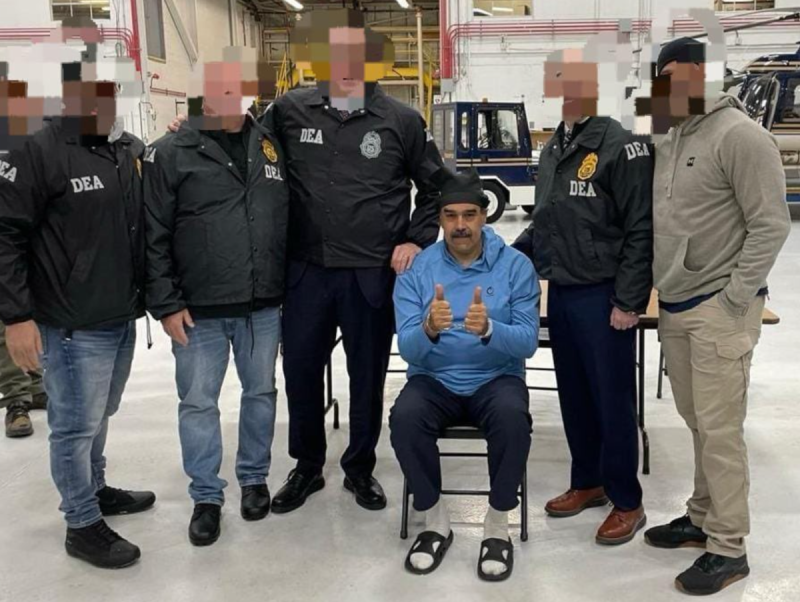
Nicolás Maduro posing with DEA agents following his capture by the United States. Photo from Wikimedia Commons.
After four months of US President Donald Trump’s sabre-rattling, set against the backdrop of the most menacing and massive buildup of American military might since its 1989 invasion of Panama, US helicopter-borne troops finally swooped into Caracas in the middle of the night on Saturday, January 3, 2026. They scooped up Venezuelan President Nicolás Maduro and his wife Cilia Flores and disappeared back into the darkness. By the end of the day, both were in jail in New York, facing criminal charges including “narco-terrorism conspiracy, cocaine-importation conspiracy and weapons charges.”
Trump, who had previously justified US intervention in Venezuela by trumpeting a variety of legally dubious claims, including that he was protecting the US against the threat of Maduro’s “narco-terrorist organization,” finally abandoned all pretence.
The United States, he declared, will now “run” Venezuela for an indefinite period and will take “a tremendous amount of [oil] wealth out of the ground… in the form of reimbursement for the damages caused us by that country.”
That is the truth—and the challenge for the rest of the world. Including Canada.
International reaction was swift. Venezuela’s ideological supporters (China and Russia) condemned US military actions. Latin America is divided, with right-wing governments (Argentina’s Milei and Ecuador’s Noboa) supporting the operation, while others (Mexico’s Sheinbaum and Brazil’s Lula) condemned the raid.
For much of the rest of the world, however, especially Canada’s European allies, the response has been more complex and nuanced.
That’s because there have long been questions about Maduro’s electoral legitimacy. He was first elected Venezuelan president in 2013, winning by just 1.6 percentage points. By 2018, with his country’s economy in freefall and many of his opponents in jail or in exile, Maduro’s claim to have won re-election with more than two-thirds of the vote rang hollow. More than 50 countries, including Canada, anointed Juan Guaidó, the little-known leader of the National Assembly, as the country’s rightful leader. Maduro outlasted Guaidó. In 2024, Maduro once again claimed electoral victory, despite even louder questions about the vote’s legitimacy.
So, while the European Union rightly noted Saturday that the Maduro government “lacks legitimacy,” its statement about the US capture of Maduro emphasized that “under all circumstances, the principles of law and the UN Charter must be respected.”
A spokesman for United Nations Secretary-General António Guterres expressed concern at the “dangerous precedent” of the United States’ action, adding that Guterres was “deeply concerned that the rules of international law have not been respected.”
What does international law say? Article 2 of the UN Charter lays out clearly the rights and obligations of all members. Section 4 notes that “all Members shall refrain in their international relations from the threat or use of force against the territorial integrity or political independence of any state.”
Article 2 is the bedrock international covenant that allows us to criticize Russia’s invasion of Ukraine or China’s threats to absorb Taiwan.
Which brings us back to Canada. Canada’s response to what happened in Venezuela was neither complex nor nuanced. It was supine.
In a mealy-mouthed, three-paragraph, 190-word post on X, Prime Minister Mark Carney danced and dodged, avoiding any direct criticism of what most experts consider the United States’ flagrant violation of that international law.
It’s worth parsing Carney’s posting. It begins with its own expansive version of virtue-signalling:
One of the first actions taken by Canada’s new government in March 2025 was to impose additional sanctions on Nicolás Maduro’s brutally oppressive and criminal regime—unequivocally condemning his grave breaches of international peace and security, gross and systematic human rights violations, and corruption. Canada has not recognised the illegitimate regime of Maduro since it stole the 2018 election. The Canadian government therefore welcomes the opportunity for freedom, democracy, peace, and prosperity for the Venezuelan people.
OK, but what about the US attack that very day on a sovereign nation in clear violation of international law?
Canada has long supported a peaceful, negotiated, and Venezuelan-led transition process that respects the democratic will of the Venezuelan people. In keeping with our long-standing commitment to upholding the rule of law, sovereignty, and human rights, Canada calls on all parties to respect international law.
So, finally, 112 words into his self-justifying, self-satisfied statement, Carney finally offered nine words that actually, sort of responded to what was happening. Canada calls on all parties to respect international law. And that was it. Moving on.
We stand by the Venezuelan people’s sovereign right to decide and build their own future in a peaceful and democratic society…
But Carney never once called out the United States for its failure to respect that international law.
The Canadian government, cowed by an erratic and often vindictive Trump, has seemingly adopted what it believes is the pragmatic position, placing trade concerns with Washington (and the need to renegotiate the Canada-Mexico-US trade deal) above international law—and self-respect.
By contrast, our other partner in that trilateral trade arrangement, Mexico, did not shy away from the crux of the situation: “The Mexican government strongly condemns and rejects the military actions unilaterally,” it said, specifically describing Washington’s actions as a “clear violation of Article 2 of the Charter of the United Nations.”
We need to remember who we are dealing with. Donald Trump is a president who has already unilaterally renamed the Gulf of Mexico the Gulf of America, who claims the right to seize control of Greenland by force, who has threatened to dispatch US troops to Mexico, and, of course, who has expressed a lust to make Canada the 51st US state.
Venezuela may be—probably is—just the opening gambit in implementing Trump’s grand vision of a radically expanded, expansive version of the Monroe Doctrine, which sees the entire Western Hemisphere as Washington’s plaything. That aspiration was made explicit policy in the recently released US “National Security Strategy.”
In light of all that, can we really afford to be so quiescent and cowardly?
The words of German pastor Martin Niemoller about complicity in the face of Nazi brutality may well be pertinent: “First they came for the socialists, and I did not speak out […] Then they came for the trade unionists […] Then they came for the Jews […] Then they came for me.”
First, they came for Venezuela.
John Kirk is Professor Emeritus of Latin American Studies at Dalhousie University and the author/co-editor of 21 books about Latin America.
Stephen Kimber is an Inglis Professor in the School of Journalism, Writing & Publishing at the University of King’s College and the award-winning author of 14 books, including What Lies Across the Water: The Real Story of the Cuban Five.