
Critical education in an age of authoritarianism

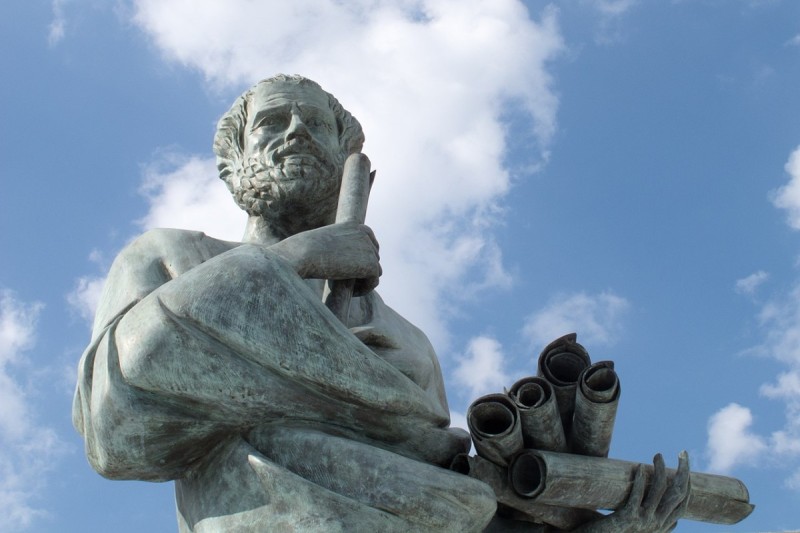
Statue of Aristotle at the Aristotle University of Thessaloniki, Greece. Photo by salut_rai/Wikimedia Commons

The Trump regime moves through the Western Hemisphere as a reckless force of destruction. Its swagger, rooted in bluster and brutality, resembles that of an inebriated thug let loose to destroy anyone in its path. On January 7, Minneapolis mother Renée Nicole Good tried to drive away from federal ICE agents who had come to arrest and harass fellow residents of her city. She was promptly shot in the head and killed. Homeland Security Secretary Kristi Noem then declared, without a shred of proof, that Ms. Good was a domestic terrorist.
International rules no longer apply. This regime bombs civilian vessels with impunity in the Caribbean Sea and Pacific Ocean because it claims, always without evidence, that they are carrying drugs. It kidnaps Venezuelan President Nicolás Maduro and his wife, Cilia Flores, on fabricated drug charges. Venezuela now faces the prospect of being handed over to American oil interests in a payback scheme that Donald Trump says will be financed by Venezuelan oil itself. Newly appointed Secretary of War Pete Hegseth has celebrated the “flawless execution” of a joint military raid involving more than 150 aircraft to seize Maduro and Flores. At least 100 people were killed. His message is unmistakable and grotesque: Maduro “effed around and he found out.” Who comes next? Follow the ideology. Follow the resources—Iran, Cuba, Colombia, Mexico, Panama, Greenland. Canada?
Hegseth’s fascist co-conspirators act the same way, developing a snitch line for Americans to report “domestic terrorism” like “opposition to immigration enforcement” or “radical gender ideology.” Trump, just under a year into a job he got by lying about so-called criminal immigrants, strokes his misogynistic impulses by insulting female reporters who dare to ask him questions, calling them, among other things, “piggy” and “ugly.” His personal Gestapo rounds up and disappears both legal and undocumented immigrants from courthouses, schools, Home Depots, and the like. Ever the proud racist, he attacks Somali immigrants, calling them “garbage” from a country that “stinks” and says he wants to strip away their citizenship. Joseph Goebbels’ intellectual offspring, Karoline Leavitt, calls this an “epic moment.” America has become a fascist state, unmoored from any concept of truth, its laws perverted to the purposes of its elite.
Things are better in Canada, but the tracks in the snow lead in a similar direction. We’ve recently elected a conservative prime minister in the guise of Liberal Mark Carney, who is pressing ahead with Bill 5, the One Canadian Economy Act—legislation designed to weaken environmental protections, Indigenous rights, and local democracy by allowing the federal government to bypass rules that obstruct major profit-making projects. In recent years, provinces have increasingly chosen to avoid court challenges when breaking strikes or overriding the rights of transgender people and Québécois who wish to observe religious rites in public. To do so, governments are turning to the infamous “notwithstanding clause” to suspend fundamental civil rights guaranteed by Canada’s Charter of Rights and Freedoms.
In Ontario, the Greenbelt scandal and Skills Development Fund debacle underscore the central role of cronyism in the Doug Ford government. It has shown little hesitation in curtailing local democracy—stripping elected representatives of their powers or suspending them altogether, as it did with six school boards in the past year. Meaningful accountability is unlikely: despite winning less than half of the popular vote cast, and in an election with turnout below 50 percent, the government now wields 100 percent of the power through a majority in the legislature.
This is a sample of what is increasingly becoming normal for governments and those with the power, influence and money to lie, misdirect, break or ignore laws. Naked authoritarianism is dressed up as order. Indeed, fascism relies on culture and pedagogy being pressed into service to erase or distort memory. In this process, it becomes extremely difficult to discern what is true, what actually happened, and what is even meaningful. This is inevitable in a political culture that applauds blatant lying and obfuscation.
But what about young people who are left to flounder in this morass? How can they begin to make sense of the swirling mess of venomous absurdity that vies for their attention in a stream of social media that is detached from civic duty? What responsibility do educators have toward their students?
One of the most urgent challenges confronting educators, students, and cultural workers today is not merely how to teach, but what role education must assume at a historical moment when democracy is slipping into the dark night of fascism. How, in light of this challenge, does education do the pedagogical work of both enabling and defending democracy—teaching young people how to think critically, act courageously, and hold power accountable?
The central question is no longer technical or instrumental; it is profoundly moral and political. What pedagogical labour is required to create the economic, political, and ethical conditions that enable young people and the wider public to question authority, to dwell in doubt, and to imagine what dominant power insists cannot be imagined? At stake is whether education can be reclaimed as a democratic force capable of cultivating informed, courageous, and socially responsible agents who can defend education itself as indispensable to sustaining a vibrant and robust democracy.
Educators face the enormous task of restoring critical education as a vital force in democratic life. This comes at a time when Ontario’s minister of education, frustrated by students’ slow progress on provincial math tests, has established a commission of inquiry to tell teachers how to accelerate learning to meet his ministry’s specifications. For his and other governments, education is a commodity, something to supply job-ready workers for corporations with no interest in public goods beyond their ability to support an ideology of consumption and acquiescence. Florida and 22 other states banned 6,870 books in 2024-25—it’s happening in Canada, too. All of this serves to diminish inquiry and prepare students to be obedient and passive workers, not critical and engaged citizens.
Under current conditions, it is crucial that critical pedagogy cultivates historical consciousness, enabling students to grasp history not as a static record of the past but as an indispensable lens through which to read the present. Through the critical labour of remembrance, fascism is revealed not as a closed chapter but as an ever-present danger, a formation whose dormant traces can be reactivated even within the most seemingly secure democracies. In this sense, history must retain its subversive pedagogical function, drawing upon archives, silenced histories, and marginalized narratives to disrupt common sense, unsettle dominant ideologies, and expose the fragile foundations of democratic life.
Educators as public intellectuals
Apart from families, educators at all levels have the most sustained and intimate contact with
young people. We offer their first sustained encounter with the public sphere, shaping how they come to understand what exists beyond the private world, how culture works, and how power moves through its subtle rituals, silences, and politics of interaction. We need not utter a single word; the very spaces we create, the relationships we model, and the values we embody function as pedagogy in their own right.
As Paulo Freire so powerfully insisted, education is never neutral. It either serves to reproduce the existing order or becomes a practice of freedom. There is no safe middle ground, only the demanding ethical labour of aligning education with a moral, political, and civic project capable of keeping the democratic imagination alive and of sustaining the conditions under which justice, dignity, and freedom can be made possible. Education has a responsibility of writing young people into rather than out of the script of democracy and the future.
We have power. But how do we use it to counter the authoritarianism that destroys our work?
As educators, we must embrace our role as public intellectuals. Despite the inevitable pitfalls of our own education, we have taken some steps on the intellectual journey that accompanies engagement in the world. We maintain and pass on culture. There is a huge variety in the ways we might accomplish this with students of widely different ages and backgrounds. But this is our fundamental task.
Tragically, our work is increasingly framed by politicians and others who peddle baseless and malignant narratives—blaming immigration, local oversight, or diversity, equity, and inclusion for social and economic crises. They insist that youth can be taught more “efficiently” online or in overcrowded classrooms, and that governments require extraordinary powers to override local decision-making, suspend rights, and break collective resistance in the name of economic urgency. The attacks on personal autonomy and democratic life accelerate week by week.
In the current moment of organized irresponsibility and resurgent fascist politics, educators are compelled to confront a set of urgent and inescapable questions. What does it mean to teach under conditions of tyranny in a society saturated by inequality, disposability, and repression? How should educators understand their relationship to democracy when democratic institutions are under sustained assault? What does it require to reclaim education as a political project in which learning is inseparable from the formation of critical, informed citizens capable of imagining and enacting social change? And how might educators join with others, both within and beyond the academic world, to build a broad social movement in defence of public goods, while situating their work within a larger international struggle for justice and democratic renewal?
There is no neutrality here. To do nothing is to abet authoritarianism. It is to retreat from the responsibility of helping young people engage in a world that is becoming increasing hostile to their lives and futures. Educators occupy positions of trust that can either reproduce silence or open spaces for questioning, enabling students to interrogate how power operates, whose voices matter, and whose are erased. This requires preserving historical memory and rescuing it from the myths that sustain domination and legitimize control. As both of us have long argued, the task is not simply to help students master the technical skills of reading texts, but to help them understand how to read the world itself. Such a pedagogy insists on asking the most fundamental questions: Who benefits? How are identities being shaped? In whose interests does knowledge circulate? What values are being normalized, and what futures are they designed to secure?
As we help young people engage to be active citizens, we have to be engaged ourselves. It’s essential that we become involved in defining conditions of work and how this relates to the broader issues of the communities in which that takes place: poverty, food insecurity, environmental breakdown, racism, contempt for those who are different and, of course, government irresponsibility. Governments, supported by wealthy individuals, systems of patronage and electoral processes that inhibit representation, have far more power than the small groups of citizens demanding a restored democracy. We need to find common cause with them and other activists in unions, social, and environmental movements. This applies to local communities with their school councils, special education action groups and others all needing allies with whom to identify and organize. Teachers in Ontario, Alberta, and Québec have upped the ante over the past years by holding provincial governments accountable for discriminatory laws. The Chicago Teachers Union keeps its community in the loop about Trump’s cuts to SNAP benefits while United Teachers of Los Angeles explains who benefits from the dismantling of the US Department of Education. We will not eliminate authoritarianism anywhere without broad alliances of likeminded people fighting for similar changes.
Graffiti depicting Donald Trump and Kim Jong-un in Vienna, Austria. Photo by C. Stadler/Wikimedia Commons.

Educators and civic engagement
In the face of an escalating fascist threat, education must be reclaimed as a profoundly moral and political project, one devoted to cultivating the knowledge, critical capacities, ethical commitments, and civic courage required to confront injustice and envision futures beyond the horizons imposed by domination. Grounded in critical pedagogy, education becomes a practice of freedom, enabling students to speak, write, and act from positions of agency, dignity, and collective responsibility rather than fear and acquiescence.
Schools and other places where young people learn are full of opportunities to test theories of reality for magical thinking. If you are a teacher walking down a school hallway, the disputes you hear circling around who did what, why they did it and so on, are normal. The discourse is not unlike the claims used to justify yet another Israeli raid on Gaza during a so-called “ceasefire”—crossing the yellow line, throwing stones; Hamas won’t give up its weapons. Yet schools offer a safer space for broader discussion. Educators can challenge such claims with insight and contextual knowledge, practicing critical education in its most basic form: asking, What happened?
This is the essential question that we, as educators, face every day. We know that there is no response unmodified by perspective, memory, and calculation. To be sure, answering that question is a search and not an end. But it is our job to ask it, not just in the hallways of our schools, but in our classrooms, lecture halls, and wherever else young people gather to make sense of what is going on around them.
It is the first step out of the pit of civic illiteracy, a condition marked by historical amnesia, the erosion of critical thought, and immersion in a culture of immediacy that severs private troubles from the larger political, economic, and social forces that shape them. In such a landscape, power thrives on confusion and distraction. To invite young people to step back from the urgencies of everyday life and engage critically with a world structured by uncertainty, contradiction, and domination is a humbling and necessary pedagogical task. It is one that asks them not for easy answers, but for the courage to think historically, ethically, and collectively in the face of bewilderment.
Teachers often relate their experiences and their concerns about the direction their work is taking. Some worry that they might be judged as being too political—particularly since the onset of the genocide in Gaza. Ontario Premier Doug Ford claimed, despite facts to the contrary, that Toronto teachers were indoctrinating students when they took them to a rally in support of Indigenous people attended by pro-Palestinian demonstrators.
But we can’t ignore what is blatantly obvious in our students’ world. They are intimately aware of the conditions of their lives and communities, and they seek out engagement and protest; it is often their friends and families who are directly affected by injustice, racism, and inequality, to name but a few.
Engaged students bring issues to class often, these days, related to what they hear about Gaza and the West Bank. Teachers don’t get into arguments, and they don’t push their own ideas—they guide students towards methods for getting closer to truth. What information supports an argument, considering points of reference and the historical and cultural context? How can you identify a trustworthy source in an environment where the loudest voices dominate?
Teachers might use tools like lateral reading to verify claims, checking an author’s background or consulting other online sources to see what holds up, while also exploring alternative perspectives and counter-narratives. They introduce issues such as power imbalances and how these might shape what students hear or read. One teacher uses the acronym CRAAP (Currency, Relevance, Authority, Accuracy, Purpose) as a tool to critically evaluate these issues. Another uses texts like Robin Wall Kimmerer’s award-winning Braiding Sweetgrass to consider Indigenous philosophies like the gift economy as a contrast to capitalism. The same teacher also assigned a Toronto Star op-ed by Grassy Narrows Chief Rudy Turtle on the community’s unmet demands for clean water.
As one secondary teacher explained, the pursuit of truth arises from discussion and the questions posed by both teachers and students.
Educators must foster a culture of inquiry in which students, rather than prescribed authorities, become the disruptors—agents rather than passive recipients of misinformation or propaganda.
In his January 3, 2026 press conference announcing the US invasion of Venezuela, Donald Trump offered useful material for such inquiry. Justifying this military action, he claimed that “We’ve knocked out 97 percent of the drugs coming in by sea. Each boat kills on average 25,000 people. We knocked out 97 percent. And those drugs mostly come from a place called Venezuela.”
This statement cries out for fact checking and further discussion with students: What support is there for his claims that the US has knocked out 97 percent of drugs coming to the US by sea and that each boat kills 25,000 people? What data is there about the quantity of drugs exported from Venezuela? Why hasn’t his government answered questions about whether or not drugs are found on the boats they have blown up?
At its best, education refuses to accept the world as presented by the powerful, the financial elite, or the enablers of fascism. It is a practice of critical interruption, a moral and political endeavor that equips young people to connect personal troubles to systemic forces, understand how power operates through culture and language, and imagine futures not dictated by fear, violence, or disposability. This is why authoritarian regimes relentlessly target teachers, universities, books, and critical inquiry itself: an educated public capable of thinking historically, acting collectively, and holding power accountable is the greatest threat to tyranny. Social change is impossible without an emancipatory form of critical pedagogy.
There is no refuge in neutrality. Silence is never innocent; it is pedagogical. To retreat from public life, avoid controversy, or reduce education to mere technique is to surrender cultural terrain to those who weaponize ignorance and cruelty. The task before educators is demanding and often risky, but unavoidable. To teach today is to choose sides: between memory and amnesia, democracy and authoritarianism, justice and organized forgetting. The future will be shaped not only by those who wield power, but by those who decide whether education remains a force for critical consciousness, civic courage, and democratic possibility. The question is not whether education is political; it is whether it will serve domination, or become a practice of freedom.
Henry A. Giroux currently holds the McMaster University Chair for Scholarship in the Public Interest in the English and Cultural Studies Department and is the Paulo Freire Distinguished Scholar in Critical Pedagogy.
William Paul is a retired principal and editor of School Magazine.