
The trades remain a danger zone—especially for women workers
_800_533_90.jpg)
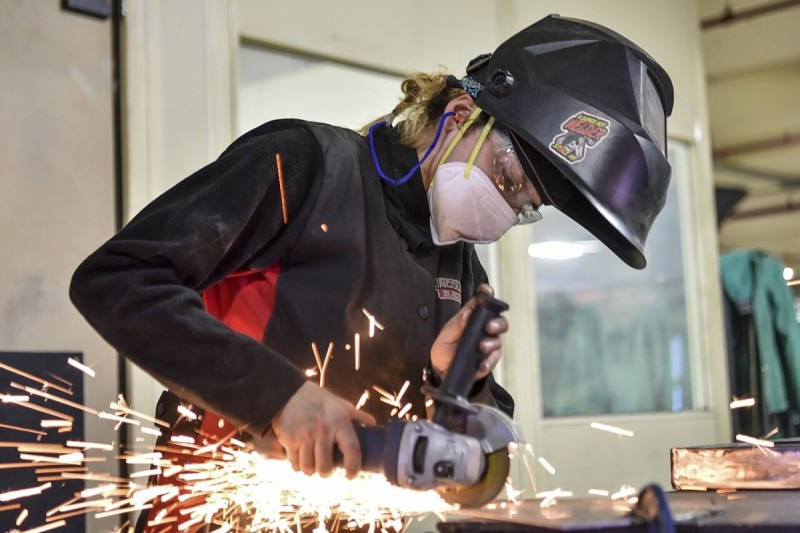
Photo by Scott M. Allen/Wikimedia Commons
.jpg)
This year opened with the murder of a Minnesota woman by ICE agents. Last year closed with a workplace murder of an American woman tradesworker, also in Minnesota. This is not mere coincidence. The same forces that devalue women’s lives and organize to attack us in our neighbourhoods are at play in both the killing of Renee Good and the life and death dramas that women are prey to in our construction workplaces.
Amber Czech, a young American welder, was murdered at work in November 2025 by a coworker: struck in the head with a sledgehammer in a premeditated act of violence. For those of us women who work in the trades, that incident hits very close to home. A case of clear, unrepentant murder like that of Czech or Outi Hicks is only the tip of the iceberg of physical and sexual violence at work. In dangerous trades, a less impulsive misogynist would make the death look like an accident.
Most of us have dealt with harassment, and many of us have faced death threats or actual assaults from our fellow workers, and often have to leave sites or make career detours in order to keep ourselves safe.
I met a tradeswoman who was intentionally burned by an older man who gave her a wet rag and then told her to touch electrically live machine parts with it. I met a woman who was imprisoned under the floorboards by hazing coworkers, another who was locked in a closet, and a friend of a friend who was shocked, likely on purpose, by a coworker who hated her and flipped a breaker while she was up in a lift. One woman I met had a coworker, supposedly a union brother, who repeatedly tried to run her over with a pickup truck. Most, if not all, were working on unionized sites, which suggests that unions are not effectively protecting their female workers or taking their safety seriously as a workplace issue.
Make no mistake, a murder like this is an act of political violence, no less so than the Polytechnique Montréal massacre. There is still a concerted effort to keep women out of the fields of construction and engineering, and especially the skilled trades. The fact that Czech was, by all accounts, very successful as a welder, was teaching at her old high school, and, from photos, looked confident and strong—this is all salt in the wound for a certain type of misogynist male worker, and they will do whatever they can to crush such women, up to and including murder.
And the toxic men are succeeding at nearly shutting women out. In Canada, those employed in the construction sector are primarily white, cisgender, heterosexual men. Women leave apprenticeships at twice the rate of men. McMaster University labour studies professor Suzanne Mills says that the number of women in the various trades has barely changed since the 1970s.
A pay-gap data analysis by the Social Research and Demonstration Corporation (SRDC) shows that heterosexual women make 15 percent less than men over the course of the average year, with queer women earning 22 percent less. This is especially significant since roughly half of women in trades identify as lesbian, and another 25 percent as bi, pan, or queer.
I personally remember being warned by other workers to stay away from a certain young worker who was driving a forklift—he had told them he was going to try to kill me with it. If Amber Czech had received such a warning from her fellow workers, maybe she would still be alive. Allies are important, and male tradespeople can keep an ear out for talk that a woman worker might never hear. They can also be careful not to assign someone to work in a remote area with a coworker known to be problematic.
Both Amber Czech and Outi Hicks were killed while working alone in somewhat isolated areas, and not by direct coworkers but by random workers on the site, so both of these situations are something to watch out for. Part of the problem in the trades is that there are always deadly weapons at hand, so people with very obvious anger issues should be identified before things reach a boiling point.
Wherever there is physical violence, coercion, and hazing, we can assume there is also sexual and domestic violence occurring at those workplaces. It is well known that whenever the extractive industry of big construction projects comes to a remote area, there is an increase in sexual violence and trafficking, especially affecting Indigenous women. Factory towns often also have increased rates of domestic violence. The (often very few) women working in frontline jobs on such projects are also vulnerable, both to workplace violence and domestic violence if they end up dating men within the industry.
This is a women’s issue, but not just a women’s issue. In many skilled trades, women represent less than two percent of workers, and in other extremely male-dominated areas, such as the military, it has been documented that men are actually the majority of victims of sexual violence—especially younger men; men who may be perceived as queer regardless of their actual sexual orientation; trans people; and gender-nonbinary people. Sometimes this kind of violence is part of hazing rituals or pranks and may not even be recognized as violence. With up to 50 percent of women in the trades identifying as lesbian and another 25 percent as bi, pan, or some other queer identity, women’s workplace issues in the trades are also LGBTQI+ issues, and vice versa. Construction trades remain extremely homophobic and transphobic.
Most construction sites have no HR representative at all to complain to—sometimes there is no HR department, either. Unions do not always take women’s issues seriously, with many union stewards and safety personnel having no specific training in gender issues.
The continued struggle for access to all-access bathrooms in Ontario indicates that even very obvious accommodations are not being implemented. If women are denied something as fundamental as a place to use the washroom—often barred from men’s bathrooms even when no alternative exists—there is little reason to believe employers or unions will meaningfully address subtler but far more serious forms of inter-worker violence and harassment. Bathrooms and properly fitting personal protective equipment are not perks; they are the bare minimum. Providing them is not about inclusion rhetoric, but about establishing whether women are even tolerated on the job. Despite endless talk of women being “welcome” in the trades, the reality is that many worksites still lack the basic infrastructure required for women to function safely and with dignity at work.
Amber Czech, a skilled welder, was murdered at her workplace in November 2025. Photo from GoFundMe.
Message to my sisters (and other siblings) in the trades
Take it from someone who’s been there: I’ve faced death threats, sexual assault, and coercion at work. And I’ve lived to work another day, though not undamaged.
Skilled trades work is exciting. It’s a challenge and there are obstacles, but it feels so great to learn skills, to be able to fix things and build things, and to overcome all the bullshit to make it happen. One of the important lessons in skilled trades—for any worker—is knowing when and how to refuse unsafe work. You will be asked in your career to do dangerous stuff that you will have to push back on. As a woman worker, one of the things you are going to be asked to do is work with or near people who are unsafe for you to be around. Male coworkers are often very bad at recognizing when someone is dangerous to you. You have to develop a ‘Spidey sense,’ which is difficult because you also know you need to develop a thick skin.
It takes such guts and such determination to succeed in extremely male-dominated workplaces, but it also takes the savvy to know when to walk away. This means making a judgement call if your life is being threatened or if your mental health is degrading in a way that makes you vulnerable to suicidal thoughts, addiction, or other dangerous coping mechanisms.
Many tradeswomen deal with these issues by putting on blinders, by pushing through, by not recognizing when they are being mistreated or put in a bad position, or by rationalizing it with thoughts like, “Maybe it was just a random layoff and I didn’t lose my job because I’m the only woman out of 300 guys here.” Some of this type of thinking is honestly necessary to survive day-to-day in a hostile environment, but you need to try to let a sliver of awareness in so you can make the right career and life decisions and protect yourself if necessary.
One danger sign is if the harasser or the angry person is either the foreman or in a close relationship with them. Another is if you have no allies on your crew: people don’t talk to you, they don’t tell you when they are having lunch, and so on. That, by itself, is not necessarily a sign to walk away, but if there is a hostile person on site and you have no support network, it raises the danger level. Look to make unexpected allies. One of my own mentors was a very conservative Christian dude; he would never identify as a feminist, but he is a good person who respects women. Sometimes the threat is so serious that it’s not time to call the Ministry of Labour or your union steward first. If we are talking about attempted murder or death threats, it may be time to call 911.
An abusive worksite can be like an abusive relationship: it seems like you don’t have any other options and can’t get out, but ultimately you can and you have to. If you can’t get justice, then you need to preserve yourself, and that may well mean finding another job. There are other jobs out there. Men in construction walk away from fucked up jobs all the time. There is always another crew, another part of the trade, another worksite. Protect yourself, both from physical violence and attacks on your mental health, and live to work another day.
Megan Kinch is a union electrician and freelance writer living in Toronto. You can find her on X at @meganysta.