
Cancelling billionaires

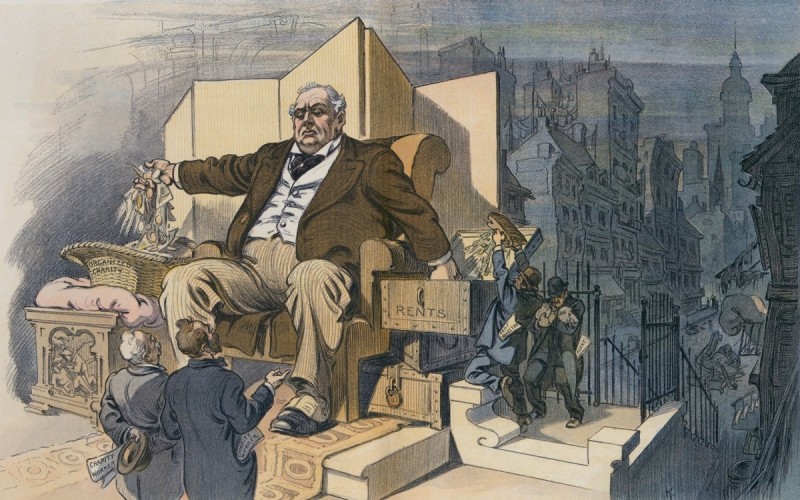
“A phase of our tax system – the greater the service, the heavier the tax,” a 1911 political cartoon by Udo Keppler, published in Puck magazine. Image courtesy the Library of Congress.
Five years ago, we wrote an article for Canadian Dimension titled “The urgent need to tax billionaires out of existence.” That article was the genesis of a book we’ve just published called Cancelling Billionaires Before They Cancel Us: The Urgent Case for a Wealth Tax. In the book, we make the case for a wealth tax aimed exclusively at the super-rich, by which we mean those with fortunes of $25 million or more.
The issue of extreme wealth inequality gets little attention in mainstream media or politics, even though the relentless rise of the super-rich is the most profound change in our society in recent decades. And it’s a change with dangerous consequences. The unprecedented concentration of wealth at the top today poses an extreme threat to the environment, to democratic governance, and to the standard of living of ordinary people. A wealth tax would be the most effective way to address the problem of extreme wealth inequality, enabling us to fund public programs that could benefit millions of Canadians while also reining in the power of the ultra-rich.
Some insist that a wealth tax could never happen. Certainly, the forces arrayed against it would be formidable. But there’s also evidence that the masses are increasingly dissatisfied as billionaires siphon off an ever-larger share of the world’s wealth. Polls show a high level of support globally for a wealth tax—with an astonishing 90 percent of Canadians backing the idea. Indeed, as billionaires wreak havoc in the US with the encouragement of Donald Trump, there are signs of a shifting political landscape and a rising backlash against their dominance. In California, there’s a serious push for a state wealth tax aimed at billionaires, while plans for strong new wealth taxes are being developed in Europe and inside influential international organizations.
In the following excerpt from our book, we lay out some reasons for our optimistic view that a wealth tax is an idea whose time is coming—and sooner than one might think.
Billionaires—triumphant with the return of Donald Trump—act like they own the world these days, which they pretty much do.
So, it’s perhaps heartening to note that, about 150 years ago, in a period known as the “Gilded Age” in the United States, the ultra-wealthy were similarly ascendant and seemingly untouchable, and yet that changed dramatically in the course of just a few years. In the early 1900s, leading nations abruptly adopted progressive taxation, forcing the ultra-wealthy to pay taxes, essentially for the first time. This greatly diminished their dominance while adding huge revenues to government coffers, enabling the rise of the social welfare state and creating what had never really existed before: the middle class (that’s the class anyone reading this likely belongs to. Before its creation, only the wealthy could read).
The sudden emergence of progressive taxation and the accompanying rise of the middle class were pivotal developments in humanity’s long, precarious march towards greater equality—and clearly sources of inspiration for more than two hundred economists, legal experts, and policy makers who came from around the world in April 2025 to a conference at the Paris School of Economics called “Taxing Billionaires.” The goal of this committed group was clear: to keep the momentum going towards the development and implementation of a wealth tax aimed at the super-rich, even in the face of the second inauguration of Trump months earlier. With Trump’s return making billionaires apparently more invincible than ever, it certainly seemed far-fetched to imagine countries imposing a tax that would compel these moguls to share some of their massive fortunes. So, it was good to know something similarly unimaginable had happened before.
Undoubtedly, if a wealth tax does find its way onto the world agenda, it will be because of a decade of hard slogging by that team gathered in Paris, led by the brilliant French economists Thomas Piketty and Gabriel Zucman. Their crusade for a new wealth tax—unlike the notoriously ineffective wealth taxes implemented by many European countries—has made considerable progress, despite the headwinds against it.
Piketty’s passionate dedication to greater equality led him to delve deeply into the history of wealth disparities. After more than a decade studying the history of wealth throughout Europe, he produced a massive treatise that, to everyone’s shock, quickly became a huge international bestseller.
The 2014 publication of Capital in the Twenty-First Century turned Piketty overnight into something of a global celebrity. The dense 753-page tome, which has sold three million copies worldwide, opened up a long-dormant debate about extreme inequality and kick-started the push for a new wealth tax. Crucially, Piketty noted that there’s nothing inevitable about the increasing concentration of wealth at the top. It can be blocked through political action. “Human progress exists; the movement toward equality is a battle that can be won.”

Piketty points to the dramatic increase in life expectancy worldwide over the past two hundred years, from an average lifespan of merely thirty-two years in 1820 to 73 years in 2020. And he notes that the most important step in this evolution came in the 20th century, after progressive income taxes ushered in the rise of the welfare state. He documents how these 20th century progressive taxes—notably, inheritance taxes on the wealthy and income taxes, which for decades imposed rates as high as 80–90 percent on top earners in the US and Britain—proved remarkably beneficial, resulting in tremendous advances in social as well as economic outcomes. This leads Piketty to a striking conclusion: “In sum, all the data at our disposal today suggest that virtually confiscatory tax rates have been an immense historical success.” Indeed, while taxes are routinely denounced these days as coercive instruments, Piketty sees them as vehicles for human progress. “Without taxes, society has no common destiny, and collective action is impossible.”
Yet despite the advanced world it ushered in, progressive taxation is largely gone. The neoliberal assault on it, which began some 50 years ago under British Prime Minister Margaret Thatcher and US President Ronald Reagan, has left us with threadbare social welfare systems, while the massive fortunes of the ultra-wealthy keep growing and largely escape taxation.
The grim world this has created for the masses—made worse by the massive 2017 tax cut during the first Trump administration—prompted US Senators Elizabeth Warren and Bernie Sanders to make a wealth tax a centrepiece in their campaigns for the Democratic presidential nomination to take on Trump in 2020. Both senators produced serious proposals to tax the ultra-wealthy. Sanders, who came second to Joe Biden in the nomination battle, bluntly insisted: “There should be no billionaires.”
Even Biden, who had a record as a centrist, introduced a radical proposal during his presidency for taxing the ultra-wealthy. Although not a wealth tax, Biden’s tax would have collected huge amounts of additional revenue from the super-rich. It was ultimately blocked by centrist Democratic Senators Krysten Sinema and Joe Manchin. However, it’s important to note that it enjoyed wide support among Democrats both in the House and the Senate.
Trump’s re-election in 2024 is, of course, a setback, but it’s also creating such economic havoc and cavorting by billionaires that it could well provoke a backlash of Americans finally demanding that the ultra-wealthy face some serious taxation. In the meantime, the brain-trust working on a new wealth tax, led by Piketty and Zucman, works diligently on, realizing this is a battle with a long timeline. A wealth tax has a formidable array of opponents, but also considerable support, including in a surprising and important place—the G20.
The G20 is a key international body, sometimes referred to as the world’s “economic steering committee.” G20 countries account for almost two-thirds of the world’s population and 85 percent of world GDP. In the wake of the 2009 financial crisis and depleted national treasuries, the G20, along with the Organisation of Economic Co-operation and Development (OECD), developed proposals for a global minimum corporate tax on large multinationals. More than 140 countries have agreed to it, and many, including member states of the European Union, have already implemented it.
In 2023, even as the G20 was winding up this work, its member nations were presented with a dramatic letter written by more than 300 wealthy individuals, economists, and elected officials. It pleaded with them to take similar strong action against the world’s wealthiest individuals, who “have become an economic, ecological and human rights disaster” that is “threatening political stability all over the world.”
With Brazil assuming the G20 presidency for 2024, the left-leaning government of President Luiz Inacio Lula da Silva took up the challenge, and turned to Zucman to prepare a report for G20 finance ministers and central bankers. Zucman, who had just been awarded the prestigious John Bates Clark Medal for the best economist under 40, put together a powerful case for a wealth tax aimed exclusively at the world’s 3,000 billionaires. He showed how wealth was becoming ever more concentrated at the very top, with the wealth of global billionaires rising from three percent of world GDP in 1987 to nearly 14 percent in 2024.
Zucman proposed that G20 countries require billionaires in their jurisdictions to pay an annual tax equal to at least two percent of their wealth. It would be ideal if all (or at least most) countries implemented such a tax. But even if this didn’t happen, the threat of billionaire migration could be minimized if countries adopted a serious ‘exit tax’ on departing billionaires. Under Zucman’s proposal, the original country could continue to tax wealthy residents even after they’d departed—if their new country didn’t tax their wealth at the rate of at least two percent. This would have the effect of denying a competitive advantage to countries acting as tax havens since, if they failed to collect the tax owed by a billionaire, his former country could step in and act as “tax collector of last resort.”
There was support for Zucman’s initiative from Germany, France, Spain, South Africa, and Brazil, as well as an open letter of endorsement from 20 former heads of G20 governments, including former Canadian Prime Minister Kim Campbell. Sadly, however, a number of G20 countries, including the US (even under Biden) and Canada (under Justin Trudeau) declined to fully support the initiative. So, instead of full acceptance, there was a commitment from G20 finance ministers to pursue the idea.
Billionaires’ Row in Midtown Manhattan. Photo from Wikimedia Commons.

But rather than see this as a defeat, we see it as an astonishing, almost unbelievable advance, given the formidable opposition. That opposition is led, of course, by billionaires themselves. These overbearing financial titans have collective resources in the range of US$16 trillion and they resolutely bully governments keep their taxes minimal. Yet a tiny group of economists and activists—a group with effectively no resources—has made inroads towards getting a wealth tax onto the agenda of the world’s leading nations. As Zucman puts it: “For the first time in history, there is now a consensus among G20 countries that the way we tax the super-rich must be fixed, and a commitment to work together for this.”
Similarly, international experts have been working to develop ways to crack down on tax havens—an apparently insurmountable problem comparable to the problem of implementing a wealth tax. In both cases, there is fierce opposition from billionaires and their advocates.
Yet, after decades of work, there has been a significant overhaul of the international banking system, known as the Common Reporting Standard (CRS), which has profoundly reduced the ability of tax havens to provide a safe harbour for those trying to hide their wealth. As much as 75 percent of the wealth that formerly evaded tax through these havens is now being reported to national tax authorities across the world.
This little-known development is an enormous breakthrough and potential game-changer. And it only happened because of the perseverance of a small group of international tax experts, working through official channels, without the backing of any popular political movement. What if a popular political movement could be organized to push for a wealth tax?
Imagine.
So, is wealth tax possible?
“It won’t happen in one year,” noted Piketty, at the final session of the Paris conference on “Taxing Billionaires.” But he went on to emphasize that change of this magnitude and seeming impossibility does happen and indeed did happen in the last century. He highlighted the story of Sweden.
It’s often assumed that the Swedes are simply progressive deep in their bones and therefore have a long history of equality. But that’s not true, said Piketty. On the contrary, at the beginning of the 1900s, like other European nations, Sweden had a grossly unequal distribution of wealth. That inequality was reinforced by the Swedish political system. In order to vote in Swedish elections, one had to be male and own considerable property, as was the case in many countries. However, Sweden went beyond simply requiring that citizens have wealth (and a penis) to vote. Unlike other nations, Sweden actually awarded additional votes to the very wealth, based on how much wealth they had. So, while an ordinary Swede had no vote at all, a wealthy Swede had one vote, and an extremely wealthy Swede could have up to a hundred votes!
Yet, despite the enormously entrenched power held by Sweden’s wealthy elite, an intense campaign waged by labour unions and workers in the 1920s brought the Social Democrats to power, ushering in decades of progressive taxation and the rise of one of the world’s most advanced welfare states.
Stuff happens, as they say. Certainly, it’s an inspiring tale of how political change can occur. And it’s heartening to realize that, when and if the political moment arrives, Piketty and his stalwart team have laid the groundwork for tapping into the fortunes of the most overindulged people ever to inhabit the earth.
Linda McQuaig and Neil Brooks are authors of The Trouble with Billionaires, published by Penguin Books Canada in 2010, and later in the United States and United Kingdom. Their new book, Cancelling Billionaires Before They Cancel Us: The Urgent Case for a Wealth Tax is out now from Dundurn Press.