
Iran and the distorted accusation of ‘campism’

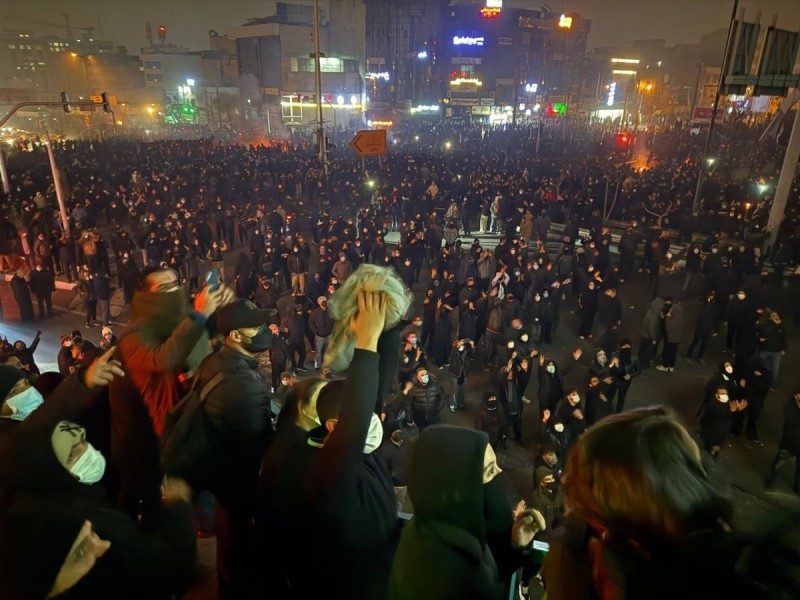
Protesters in the Punak district of Tehran, January 9, 2026. Photo courtesy VahidOnline/Telegram.
The following article is a response to “Iran and the death of politics” by Pierre Luc Junet, published in Canadian Dimension on January 29, 2026.
Donald Trump has deployed what he calls a “massive armada” to intimidate—or prepare for war against—Iran. Meanwhile, Iranian-Canadians who don’t toe the official line are being hounded. Still, some leftist media criticize the few who refuse to cheer a lawless state’s bid to weaken, and even balkanize, its main regional competitor.
During a recent episode of CBC’s Power & Politics, host David Cochrane apologized four times for previously interviewing Iranian Canadian Congress President Mona Ghassemi. The reason? In a live January 15 interview with Cochrane, Ghassemi had the temerity to mention that sanctions and foreign intervention contributed to the protests and violence in Iran. In his mea culpa, Cochrane never said the Iranian Canadian Congress’s claims regarding the effect of sanctions were false. He only said (5:22) that Ghassemi’s comments diverged from the narrative he sought to promote.
As the public broadcaster debased itself, proponents of destabilization and military intervention targeted Iranian‑Canadian professor Nassim Noroozi for challenging their narrative. Some media outlets, including The Guardian, have circulated claims of 30,000 deaths in Iran, a figure Noroozi called into question.
Activists have created a petition pressuring Concordia University to denounce Noroozi for posting, “This unverified number of ‘30,000 killed’ has been spread everywhere. This is another criminal propaganda whose aim is to downplay the genocide in Gaza, absolve Israel, and at the same time promote a military attack on an independent country, all at once.” For asserting that there is no credible evidence for the 30,000‑death figure, Noroozi now faces calls for a formal investigation into her employment. A counter petition in support of her has also been launched.
Recently, Canadian Dimension published “Iran and the death of politics.” Written by Montréaler Pierre Luc Junet for a publication read largely by Canadians, the article ignores Ottawa’s contribution to the crisis. Canadian critics of ‘campism’ invariably ignore the most politically germane ‘camp.’
At an event I spoke at last week on solidarity with Iranians, Junet charged me with supporting the Iranian government because I put forward a series of proposals (initially written up during the Israeli-US attack on Iran in June) aimed at re-establishing bilateral relations:
- Restart diplomatic relations with Tehran. Before winning office, the Liberals promised to reverse Stephen Harper’s policy, but when Trudeau’s first foreign minister, Stéphane Dion, sought to renew relations, his plan was scuttled by the Israel lobby working through its allies in the Liberal caucus (Anthony Housefather and Michael Levitt).
- Remove Iran from Canada’s state sponsors of terror list, which Harper created in 2012 to hamstring future governments’ efforts to restart relations. If the US and Israel aren’t on the terror list, why is Iran?
- Remove the Islamic Revolutionary Guard Corps from Canada’s list of terrorist entities. This decision was a direct sop to Israel and should never have been made. If the Israeli military isn’t listed, why is part of Iran’s?
- Repeal a host of sanctions imposed on Iranian individuals and entities.
- Return Iranian assets that have been seized or commandeered in violation of international norms.
- Apologize for contributing to the 1953 overthrow of Iran’s nascent democracy and initiate a full accounting of Ottawa’s role in the coup against Mohammad Mossadegh.
For Junet, declining to back Canada’s isolation of Iran is effectively the same as supporting the government in Tehran. Yet Canada refuses to enforce its own laws against Israel, even after two years of live-streamed genocide in Gaza and widening regional violence.
Junet derides “campists” for conducting a “forensic hunt for foreign fingerprints.” But no forensic work is required to read Israeli media or hear former US Secretary of State and CIA Director Mike Pompeo openly acknowledge Mossad’s role in fomenting violence inside Iran. One need not hunt for “fingerprints” when US and Israeli involvement is visible in plain sight. The US, G7 states, Israel, and Saudi Arabia form the core of a coordinated campaign to weaken Iran’s government—through sanctions, media financing, NGO funding, and support for armed separatists.
As is well-documented, Iranian living standards have plummeted due to the “maximum pressure” sanctions imposed by the US in 2018. The rial’s collapse has intensified since the 12-day Israeli-US war in June, with the sharp devaluation ahead of the December 28 protests likely driven by an active foreign campaign to weaken Iran’s currency. Sanctions ensure Iran cannot benefit from devaluation through increased export competitiveness.
At the recent World Economic Forum in Davos, US Treasury Secretary Scott Bessent boasted that US sanctions were responsible for the recent protests. “President Trump ordered the Treasury and our OFAC division to put maximum pressure on Iran and it worked. In December their economy collapsed. We saw a major bank go under. The central bank has started to print money. There is a dollar shortage. They are not able to get imports, and this is why people took to the streets.”
The US and Israel have also funded and armed opposition groups. A range of Iran-focused media outlets, including Iran International, receive foreign funding. In addition, numerous Iran-focused civil society and human rights organizations receive National Endowment for Democracy and other forms of Western funding.
It is an open secret that Mossad has long armed and assisted the MEK and Kurdish opposition groups inside Iran. Israel’s Channel 14 recently reported that the Israeli state has also supplied weapons directly to protesters.
Israel seeks to destabilize—or even fragment—a country that constrains its military dominance in the region. Iran’s support for Palestinian and Lebanese resistance movements has long angered Tel Aviv, while Iran’s ballistic missile strikes dealt Israel a significant blow following its belligerence in June. As a BBC headline bluntly put it: “Israel eyes regime change in Iran—and is counting on Trump to make it happen.”
Canada’s primary apartheid and genocide lobby group, the Centre for Israel and Jewish Affairs, now hosts an “Action Hub” on its website titled “Stand with Iranians for Freedom from the Islamic Regime.” Meanwhile, the National Post, Toronto Sun, and other Canadian outlets openly cheer efforts to overthrow Iran’s government.
Recent warship and fighter jet deployments add to the roughly 40,000 US troops already stationed in the region, underscoring the very real risk of a wider war. Left-wing Canadians should not be echoing those beating the war drums. Instead, we should be doing everything possible to ensure Canada does not once again support the escalation of a US–Israeli war.
Yves Engler has been dubbed “one of the most important voices on the Canadian Left today” (Briarpatch), “in the mould of I.F. Stone” (Globe and Mail), and “part of that rare but growing group of social critics unafraid to confront Canada’s self-satisfied myths” (Quill & Quire). He has published nine books.