
Foreign bombs won’t bring Iranian freedom

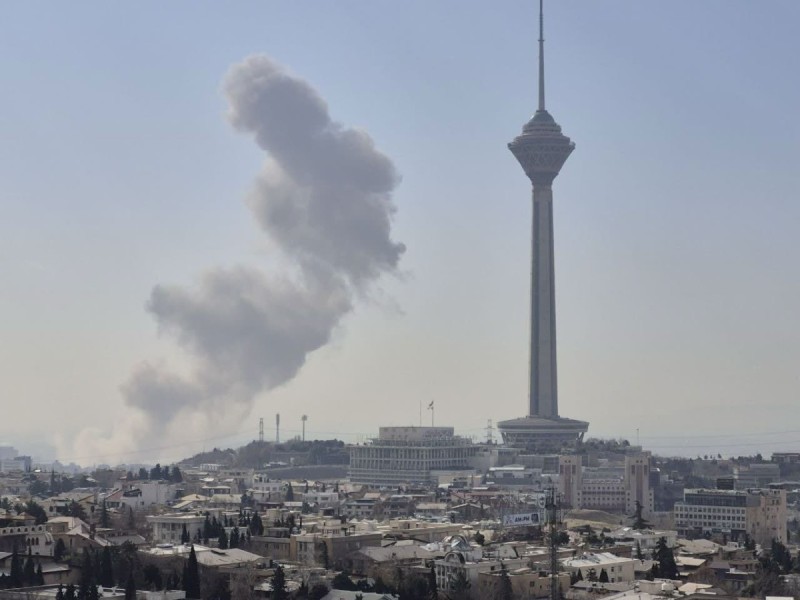
Smoke rises in Tehran following an Israeli airstrike, March 2, 2026. Photo courtesy nayaforiraqi/X.
On February 28, the United States and Israel launched a joint military assault on Iran that killed Supreme Leader Ayatollah Ali Khamenei and marked the start of a brazen campaign of regime change.
Three days into the assault, more than 780 Iranians have been killed, including 175 children at a primary school. Over 50 people in Lebanon have also died as Israel expands its war across the region, bombing Beirut. Gaza is once again under full blockade, with its borders closed to food and essential humanitarian supplies.
As bombs fall on the cities where my family lives in Iran, Donald Trump calls it an opportunity for Iranian freedom. Some in the diaspora have cheered, laying roses at US embassies. The former Shah’s son, Reza Pahlavi, declared that Iranians were “forever in debt” to American service members.
I have marched in support of Iranian protesters fighting for freedom and liberation, and against the repression and corruption of the current regime. But we must not allow ourselves to be misled as two global imperial powers open a new front of war. Nor can we ignore the political machinery preparing the return of an American-backed monarch to replace Iran’s regime—the son of a king who repressed dissent, ruled for elites, suppressed regional resistance movements, and granted imperial access to Iran’s resources.
This assault was never about what Iranians deserve. If we truly stand for Iranian freedom and liberation, we must ask: Who can free Iran—its own people, foreign bombs, or a restored monarch?
Is this about freedom at all?
The US record of intervention makes clear that freedom, human rights, and alleged threats are repeatedly invoked to justify wars that serve American strategic interests.
From US military interventions in Guatemala to Chile to Iraq, promises of liberation have been followed by death, destruction, and foreign control. These interventions secured American strategic advantage and expanded Western capital interests. Trump’s pledge to redevelop a devastated Gaza into the “Riviera of the Middle East” is only the latest illustration. These wars do not benefit ordinary Americans; they drive up the cost of oil, food, and other essentials, while defence contractors and energy corporations reap the profits.
Iran has a deep democratic tradition. In the early 20th century, it established a constitutional order, and in 1953 its democratically elected prime minister, Mohammad Mosaddegh, was overthrown in a CIA- and MI6-orchestrated coup after he nationalized the country’s oil industry to bring its wealth under public control. Western powers backed the reinstatement of Mohammad Reza Pahlavi, the Shah, to secure strategic and economic interests. Western capital prospered as Iranian inequality deepened and democratic possibility narrowed. In 1979, a popular revolution toppled the monarchy, but the uprising was ultimately consolidated by theocratic leadership that crushed leftist and other oppositional forces in its midst.
Benjamin Netanyahu recently addressed Iranians directly: “Your suffering and sacrifices will not be in vain. The help you wished for has now arrived.” He proclaimed this as airstrikes continued to devastate civilian areas across Iran.
Israel’s objective in overthrowing Iran’s Islamic regime has long been bound up with consolidating regional power, especially given Iran’s military capabilities and material support for groups like Hamas and Hezbollah that have resisted Israeli dominance. To equate Israel’s regional agenda with Iranian freedom is specious.
Bombs don’t bring democracy
Trump has offered no coherent plan for what will follow this war.
As former Israeli government advisor Daniel Levy told Al Jazeera: “Israel’s more interested in regime and state collapse. They want Iran to implode, and if the spillover from that takes in Iraq, the Gulf, and much of the region, so much the better.”
Regime change will not be swift or bloodless. With roughly 190,000 active personnel and a sprawling paramilitary and economic network, the Islamic Revolutionary Guard Corps is embedded in Iran’s political and economic infrastructure. External attack is consolidating support for the regime as the country rallies under siege conditions.
This war also unfolds in a global context where international law fails to constrain power. As in the genocide in Palestine, attacks on civilians appear to carry no enforceable consequences for close Western allies. Legal norms are discarded whenever they obstruct geopolitical interests.
History offers sobering lessons for this vision of democratic transition. As Vincent Bevins argues in his recent book, If We Burn: The Mass Protest Decade and the Missing Revolution, when governments fall or are destabilized without pre-existing organization, leadership structures, or articulated alternatives, movements are unable to fill power vacuums or secure lasting change—and, in many cases, the outcomes are the opposite of their demands. Movements are co-opted or leave the state apparatus intact in a new form.
Carrier Strike Group 3 sails in formation in the Arabian Sea during the 2026 United States military buildup in the Middle East, February 6, 2026. Photo by Jesse Monford/US Navy/Wikimedia Commons.

A rebranded king as a false saviour
Reza Pahlavi is the son of the Shah overthrown by a popular revolution in 1979. The US-backed monarchy ruled with authoritarian force, supported by Western security infrastructure. Its regime imprisoned, tortured, and disappeared dissidents through the infamous SAVAK security forces—trained and backed by Israel.
Pahlavi does not hide his political commitments. He advocates an ethnonationalist, strongly pro-capitalist vision that would welcome Western corporate interests back into Iran and realign the country’s foreign policy away from Palestinian solidarity. Iranians revolted against this system in 1979, demanding political freedom, economic redistribution, and an anti-imperialist core in the Middle East to defend Muslims against expansive powers.
So why does he enjoy public support among the Iranian diaspora? His prominence has been amplified by a well-funded network of Western media, lobbying groups, and political actors that suppress the truths of the past, the power of popular movements, and the full breadth of change Iranians demand. In doing so, they have narrowed the political spectrum until only far-right options appear viable.
Some diaspora supporters of the Shah were part of elite classes displaced by the revolution. Others fear social or political isolation for opposing him. Similar patterns appear elsewhere: legitimate grievances are redirected through money, media, and intimidation, shifting the political horizon sharply rightward.
This dynamic diverts anger at the Islamic regime from genuinely emancipatory possibilities. It erases demands for economic justice, minority struggles, and Muslim and Palestinian resistance solidarities that have long animated Iranian activism.
We must wrest power away from any foreign-backed monarch and return it to the people of Iran.
The conditions necessary for a peoples’ liberation movement
Last December, as Iran’s currency plunged and food prices surged amid sanctions and domestic corruption, protests spread across the country. Workers, students, pensioners, informal labourers, and rural families filled the streets.
They were not calling for foreign bombs.
Rather, they were demanding survival. Those same communities will now bear the brunt of the war. The wealthy have exit routes. Dual passports exist. Capital leaves quietly. The working poor and much of the middle class cannot.
Yet the terrain for democratic struggle has been profoundly shaped by decades of Western pressure and repression. Broad sanctions have devastated ordinary people. Oil exports dropped sharply after sanctions were reimposed. GDP per capita dropped dramatically over the past decade. The Iranian currency collapsed, eroding purchasing power and destroying Iran’s middle class. Meanwhile, networks tied to power adapted, reorganizing the economy around smuggling and patronage systems that reinforced regime loyalty.
If the goal is Iranian freedom, strategy must align with that goal: stop the bombardment; end broad sanctions that collectively punish civilians; support independent labour, feminist, student, and minority organizing—without military conditions attached.
For those of us in the diaspora, this requires public opposition to foreign aggression framed as rescue. It means refusing to allow grief to be redirected into support for monarchy or war. It means defending a vision of liberation rooted in political and economic justice.
History is consistent: sustainable freedom is built by people who organize, strike, write, teach, and resist—not by foreign jets, sanctions regimes, or crowns.
Iranians deserve more than a choice between destruction and dictatorship
Sima Atri is a human rights lawyer and organizer at Toronto’s Community Justice Collective (CJC). She formerly served as civil rights counsel in St. Louis, Missouri.