
Canada pursues Gulf markets as its weapons fuel war in Sudan

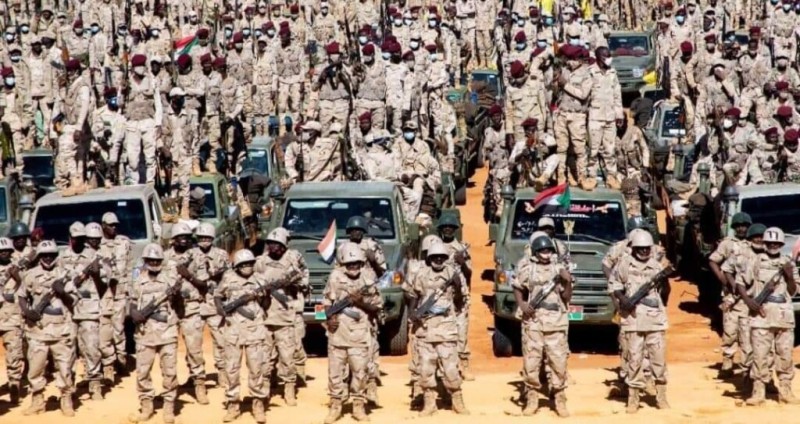
RSF forces before the war with the Sudan Armed Forces erupted in 2023. Photo courtesy RSFSudan/Telegram.
On November 21, Mark Carney landed in Abu Dhabi, becoming the first Canadian leader in more than 40 years to visit the capital of the United Arab Emirates. Ottawa portrayed the trip as a move toward trade diversification—a strategy cast as urgent after Donald Trump’s tariffs and threats against Canadian sovereignty—but the visit also brought Canada into direct contact with a Gulf power implicated in some of the world’s deadliest conflicts.
Not only did the official talks in Abu Dhabi deliberately bypass any mention of the UAE’s funding of war crimes and possibly genocide in Sudan’s Darfur region, but the subsequent media coverage in Canada also conspicuously failed to address the Canadian government’s own entanglement and complicity in these atrocities.
The UAE is currently Canada’s top export destination in the Middle East (over 150 Canadian companies operate in the Gulf country) and relations are now poised to expand in the coming years.
During Carney’s visit, Canada and the UAE struck a range of agreements, including a foreign investment promotion and protection agreement (FIPA), and announced negotiations toward a comprehensive economic partnership agreement (CEPA). The FIPA is a mechanism designed to protect the interests of Canadian corporations investing abroad, while the CEPA is essentially a fast-track, high-ambition free trade deal—both aimed at cementing long-term capital mobility.
According to the prime minister’s office, the CEPA will “cut tariffs, eliminate red tape, and expand market access for Canadian exporters of goods and services,” including in engineering, aerospace, agri-food, seafood, and digital sectors. The UAE also vowed to invest $70 billion into the Canadian economy.
“In a more divided and dangerous world, Canada is securing new deals with new partners,” Carney said. “Our agreements with the UAE will attract billions of dollars in investments into Canada… Canada is diversifying our trade and finding new investors to fuel our plans to build Canada strong.”
While Carney is framing his visit to Abu Dhabi as a pivot away from the US, these investment negotiations have been ongoing for over a decade. The talks were encouraged by the Canada-UAE Business Council (CUBC), which formed in 2013 under the Harper government, following the announcement of the Canada-UAE Strategic Agenda. Members of the CUBC include TD Securities, Telus, BlackBerry, CAE Inc., and Brookfield Asset Management, where Carney previously served as vice-chair and in which he held millions in stock options at the end of 2024. Jean Charest, the former Liberal premier of Québec, is co-CEO of the CUBC.
Carney’s visit to the UAE was preceded by Alberta Premier Danielle Smith, who was there to mark the opening a new international office for Alberta in Abu Dhabi.
But as years of trade talks between Canada and the UAE come to fruition, a wave of harrowing reports from international media has documented extortion, rape, and mass killings carried out by the UAE-backed Rapid Support Forces (RSF) in Sudan.
Prime Minister Mark Carney in Abu Dhabi, where Canada recently launched negotiations toward a free trade deal with the United Arab Emirates. Photo courtesy Mark Carney/X.
The RSF developed out of the Janjaweed militias, which were organized by Sudan’s former head of state Omar al-Bashir in the early 2000s to suppress rebels in Darfur, a vast, impoverished region in western Sudan long marked by political marginalization, ethnic tension, and state-sponsored violence. In the years since its formation, the RSF’s leader, Mohamed Hamdan “Hemedti” Dagalo, expanded the paramilitary force into a conventional army capable of rivalling the Sudanese Armed Forces (SAF).
The power struggle between the SAF and the RSF, which erupted after Bashir’s 2019 ouster and years of political turmoil, has produced one of the world’s worst humanitarian crises. Thirteen million people have been displaced. Half the population, roughly 25 million people, now faces “acute food insecurity,” according to UN agencies, and 8.5 million are experiencing “emergency levels” of hunger. Estimates suggest that more than 150,000 people have been killed since the fighting began.
In late-October, the RSF captured El Fasher, a city of 250,000, from the Sudanese military after a 500-day siege. With El Fasher under their control, the RSF effectively seized control of western Darfur. The ongoing violence in the region is blood-curdling. According to the UN High Commissioner for Refugees, an estimated 26,000 civilians have fled El Fasher since the RSF captured the city. Thousands have been massacred, including 500 patients at the city’s Saudi Maternity Hospital. Summary executions, sexual violence, and ethnically-motivated killings are widespread.
The UAE’s ties to the RSF are deep and well-documented. Both were members of the Saudi-led coalition against Yemen’s Ansar Allah (Houthi) government—the RSF as mercenaries paid by the UAE and Saudi Arabia. Today the UAE’s support for the RSF is part of a broader Emirati strategy to consolidate control over Sudanese resources, namely gold (for which the UAE is a leading global hub) and farmland, a crucial asset for a country that imports 90 percent of its food due to limited arable land and water scarcity.
As Sudan researcher and journalist Joshua Craze explains, “The RSF’s major backer is the UAE, which hopes to augment its domination of Sudan’s lucrative gold trade with the acquisition of a port on the Red Sea, and control of the country’s rich agricultural land.”
Describing the horrors in El Fasher, Tom Fletcher, the UN’s top relief official, stated:
Women and girls are being raped, people being mutilated and killed—with utter impunity… We cannot hear the screams, but—as we sit here today—the horror is continuing… Tens of thousands of terrified, starving civilians have fled or are on the move. Those able to flee—the vast majority women, children, and the elderly—face extortion, rape and violence on the perilous journey.
As Fletcher emphasized, “The Sudan crisis is, at its core, a failure of protection, and our responsibility to uphold international law. Atrocities are committed with unashamed expectation of impunity… the world has failed an entire generation.”
Despite widespread evidence of Emirati support for the RSF, Carney declined to press UAE officials on their role in Sudan’s war during his visit to Abu Dhabi. That omission is hardly surprising, given that Canadian-made weapons are also helping to fuel the carnage in Sudan.
When El Fasher fell on October 26, photographs surfaced showing RSF fighters carrying rifles produced by the British Columbia–based arms manufacturer Sterling Cross Defense. Visual evidence of Canadian-made weapons in RSF hands dates back to 2023.
Sudan : Pictures showing members of the Rapid Support Forces with canadian made XLCR precision rifles. pic.twitter.com/Kx0OflEhy6
— Hammer Of War (@HammerOfWar5) November 21, 2025
“This is not a one-off appearance of the weapon in Sudan,” reported the CBC. “With the help of international open-source intelligence researchers, CBC’s visual investigations team has verified at least nine photos or videos with rifles bearing the Sterling Cross logo.”
The UAE is likely buying Canadian weapons and shipping them to the RSF—a flagrant violation of the UN arms embargo on Sudan. As Emadeddin Badi, a senior fellow at the Global Initiative Against Transnational Organized Crime, told the CBC: “Canada exports millions of dollars’ worth of weapons and systems to the UAE, which supplies the RSF… The UAE does not have a domestic defence industry of its own robust enough to supply multiple paramilitary groups across the region.”
The most recent data on Canadian arms exports shows that, in 2024, Ottawa approved over $7 million in weapons sales to the UAE.
Despite its reputation as an international peacekeeper, Canada is in fact a consequential global weapons dealer. As I have documented in CD, Canada contributes less than one percent of UN peacekeeper totals while acting as the 17th largest arms exporter in the world.
Across the 20th century, Canada built a steady record of exporting weapons to some of the world’s most repressive governments. Ottawa approved major arms transfers to the Shah’s Iran, and Canadian-made weapons later appeared in the arsenal of Saddam Hussein’s forces during the Iran–Iraq War, as chronicled by Project Ploughshares founder Ernie Regehr in his 1987 book Arms Canada:
Canadian military components have in recent years been supplied for weapons systems… that went to almost all of the world’s current war zones and prominent trouble spots: Zimbabwe and Angola in southern Africa; Chad, Libya and Morocco in northern Africa; Sudan in the Horn of Africa, Egypt, Israel, Jordan, Syria, Lebanon and Saudi Arabia in the Middle East; Iran and Iraq in the Persian Gulf region; Indonesia and the Philippines in the Pacific; Pakistan, Thailand and South Korea in Asia; El Salvador and Honduras in Central America; and Chile and Argentina in South America.
Canada’s arms exports remain deeply embedded in conflicts around the world. Canadian-made weapons make up a substantial share of Saudi Arabia’s arsenal; when Saudi forces led the 2015 invasion of Yemen—a war that has claimed an estimated 400,000 lives—a UN panel explicitly accused Canada of “perpetuating the conflict” through its continued arms sales to Riyadh. Canada’s partners in that war included both the UAE and Hemedti’s RSF.
Canadian technology has been used by the US military to bomb civilian boats in the Caribbean on the dubious claim that these boats were trafficking drugs from Venezuela. Companies across Canada have also provided materials for Israel’s genocide in Gaza, from General Dynamics in Valleyfield, Québec to Magellan Aerospace in Winnipeg.
Now the international community knows that Canadian-made weapons are also helping to drive UAE-backed atrocities in Sudan. It is a grim but predictable revelation. Ottawa has long pursued an arms-export policy that prioritizes profit over principle, routinely enabling violence abroad while distancing itself from the consequences.
By sidestepping any discussion of Canada’s role in arming the RSF—and by avoiding the broader issue of Emirati interventionism—Carney has framed “trade diversification” as little more than a euphemism for deepening ties with a government implicated in mass atrocities. The moral stakes of the Sudan war may be impossible to ignore for millions of civilians, but for Ottawa, they appear to be negotiable.
Far from “building Canada strong,” the prime minister’s visit to Abu Dhabi marks the culmination of a decade-long push to secure access for Canadian capital in a lucrative Gulf market. If that requires overlooking the victims of Canadian weapons sales and the brutal consequences of UAE policy in Sudan, the government has shown it is more than willing to do so. In Canadian foreign policy, profit doesn’t simply outweigh human suffering—it eclipses it entirely.
Owen Schalk is the author of Targeting Libya: How Canada went from building public works to bombing an oil-rich country and creating chaos for its citizens, an exploration of Canada’s pivotal yet little-known role in Libya’s history, now available from Lorimer Books.