
Meet the new Western double standards, same as the old ones

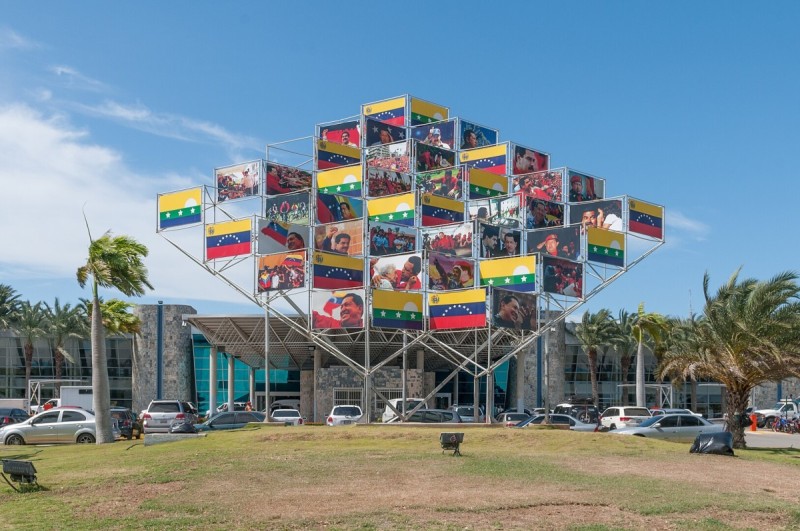
Santiago Mariño Caribbean International Airport, Nueva Esparta, Venezuela, with pictures of Nicolás Maduro and Hugo Chávez. Photo by Wilfredor/Wikimedia Commons.

If Western politicians truly cared about upholding international law, the recent US abduction of Venezuelan President Nicolás Maduro and attacks on Venezuelan territory would have sparked an outpouring of indignation. Such outrage was understandably on display when Russia invaded Ukraine in February 2022. At that time, Western leaders were eager to present themselves as the most ardent defenders of international law in response to Moscow’s clear violation of Ukrainian sovereignty.
Yet while international law is enforced strictly against the ‘bad guys,’ comparable violations by the ‘good guys,’ justified as serving a supposedly righteous cause, are met with indulgence. With regard to recent events in Venezuela, Prime Minister Mark Carney, having condemned the Maduro regime for breaches of international law, posted on X on January 3 that “The Canadian government therefore welcomes the opportunity for freedom, democracy, peace, and prosperity for the Venezuelan people.” This without mentioning the fact that Trump’s actions were themselves a grave breach of the international law that Carney, and by extension Canada, claims to uphold. Conservative Party leader Pierre Poilievre went further, stating in a post on X that same day, “Congratulations to President Trump on successfully arresting narco-terrorist and socialist dictator Nicolas Maduro, who should live out his days in prison.”
While we might dismiss Poilievre’s cheerleading as the sort of thing one might expect of a Conservative leader in opposition, Carney’s response has more significance because it is the response of the government. Carney is not alone in tacitly condoning Trump’s actions because he sees them, at least in part, as having been carried out in the name of a good cause. German Chancellor Friedrich Merz was also unwilling to simply come out and condemn the US action for what it was—a clear breach of international law—suggesting that “The legal situation regarding the US intervention is complex. We are taking our time to consider it.” His foreign minister was also unwilling to stick his neck out, instead highlighting, as apparent justification for US actions, that “Maduro led an unjust regime; eight million people have left the country. There are political prisoners.” Ukrainian President Volodymyr Zelensky’s quip that if Maduro could be removed then the “US knows what to do next” verges on being trite, and probably doesn’t help his cause outside the West.
As a recent editorial in the Kyiv Post pointed out, Zelensky has little choice but to appease Trump despite the damage it will do to his wider credibility. It would also be easy to suggest that both Carney and Merz are simply trying to avoid offending the US president, but that is too simplistic an explanation. Most Western leaders lean towards seeing the world in black and white terms—they are the ‘good guys’ at the head of ostensibly liberal-democratic regimes in which the economic order is a free-market capitalist one. The ‘bad guys,’ meanwhile, are at best pretending to be democratic and tend towards a less-than-capitalist way of organizing economic activity. Putin and Maduro clearly fall into the latter category, whereas the ‘good guys’ like Zelensky fall into the former. Back in December last year, when hosting Zelensky in Halifax, Carney quite clearly stated that “Canada stands with Ukraine, because their cause—freedom, democracy, sovereignty—is our cause,” the press release having already stated that “Ukraine is at the frontline of the struggle between democracy and authoritarianism.”
Carney’s line might be more palatable if Western leaders would actually stick to their purported principles. Clearly ‘sovereignty’ is not an absolute in the minds of Western leaders who are willing to exaggerate the threat from the ‘bad guys’ to justify ignoring sovereignty on a whim, as the case of Maduro highlights. Not all that long ago the West was willing to participate in the overthrow of the Gaddafi regime in Libya, in what was a clear breach of Libyan sovereignty, in order to prevent a dictatorship from crushing a rebellion. However, crushing rebellions with the loss of civilian life that might entail is not the core issue here, as Western unwillingness to take robust action against Israel for its disproportionate response against the people of Gaza shows. In the case of Ukraine, the West was quite willing to tolerate considerable civilian deaths in the Donbas in 2014-2015 as a new Ukrainian government of questionable democratic legitimacy sought to crush uprisings there that had meaningful local support, even if they were supported by Russia.
Which of course brings us on to the second of Carney’s trio of causes: democracy. Other than the West being willing to ignore the people of Gaza’s apparent right to self-determination, the West has been willing to condone ultranationalist governments in Ukraine trampling all over democratic values, not only in the overthrowing of a democratically elected president but by then banning any parties that might pose a challenge to them. Justified by the apparent expediencies of war the West has been willing to tacitly condone the Zelensky government’s subsequent banning of a further slew of leftward leaning parties on the unsubstantiated grounds that they are ‘pro-Russian’—because it is all in a good cause.
Certainly, US and Western toleration of the questionable behaviour of foreign leaders that are on ‘team West’ always makes me think of a famous quote often attributed first to Franklin Roosevelt to describe the Nicaraguan dictator Samoza: “[He] may be a son of a bitch, but he’s our son of a bitch.” While it is unclear whether Roosevelt actually said this, this quotation has subsequently been attributed with variations to other US politicians, probably because it does encapsulate something meaningful about both a US and wider Western view of the world.
Having looked briefly at both ‘democracy’ and ‘sovereignty’ that leaves us with the very nebulous notion of ‘freedom’ in Carney’s triad of causes that he ostensibly champions. It remains to be seen what sort of “freedom, democracy and sovereignty” the Venezuelan people will enjoy going forward. It is difficult to imagine the US being satisfied if the Venezuelan people were to ‘freely’ elect a left-wing government, and it is all too likely that their affairs will ultimately be ‘managed’ by the US in the sort of way that such things were managed during the prolonged US-led Western occupation of Afghanistan. I would like to be proven wrong—but if past behaviour is the best indicator of future behaviour, then both many of the Venezuelan people and I are likely to be disappointed.
As Western politicians celebrate the ramifications of the US riding roughshod over international law in Venezuela, they do so within a political bubble. Outside that bubble, much of the remainder of the world has seen it all before. There is clearly one set of rules for ‘us’ and ‘our people,’ and another for ‘them.’ Western ‘values’ (as opposed to power) have never had the sort of credibility across much of the world that Western politicians seem to think they have, and those outside the Western bubble who are critical of its hypocrisy now have yet another example to help them make their case.
Professor Alexander Hill teaches at the University of Calgary, and is a leading expert on the military and political history of Russia and the Soviet Union since 1917. He is a fellow of the university’s Centre for Military, Security and Strategic Studies.