
Doly Begum’s defection strengthens the case for Avi Lewis

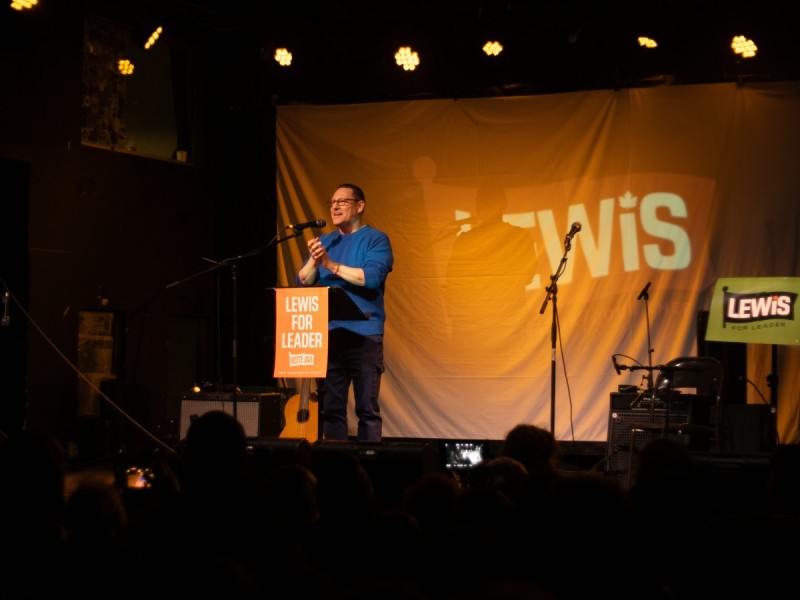
Avi Lewis signals the fresh leadership the NDP requires, giving the party a chance to move beyond internal divisions and present a real left-of-centre alternative, writes Colin Bruce Anthes. Photo courtesy Avi Lewis/X.
In a shock move last week that left the Ontario NDP scrambling, Doly Begum abandoned her post as the party’s deputy leader to run for Mark Carney’s Liberals. She will now seek election in Toronto’s Scarborough Southwest constituency, the riding left open by Bill Blair, under a banner that is red in name but hardly in ideology. Federal NDP interim leader Don Davies captured the mood of many when he accused Begum of “abandoning the progressive policies she claimed to believe in to run for a party that is clearly governing like a conservative party.” Indeed, after campaigning to the right of Trudeau, Carney has governed ever further right, leaving little explanation for Begum’s switch beyond plain opportunism.
The impact, however, may not be particularly substantial for the ONDP, which was already hurtling towards irrelevance. After many years of stagnation in both vision and momentum, leader Marit Stiles alienated much of the party’s base with the expulsion of former MPP and pro-Palestine activist Sarah Jama. The party was able to keep official opposition status in the 2025 election through a combination of popular local incumbents and the inability of the Bonnie Crombie campaign to concentrate its numbers, but they fell to third in the popular vote while Doug Ford scored another majority. Once it was clear Crombie wasn’t viable, an obvious path for the Liberals was paved: the more purposeful Nate Erskine-Smith would take the leadership reigns, and wherever there was vote splitting, the centre-left vote would swing Liberal to break the Tory majority. These wheels are now in swift motion.
One implication that hasn’t been explored is what the effect of Begum’s departure could be on the federal NDP leadership race. After months of too-close-to-call competition between the “big three” candidates of three-time incumbent MP Heather McPherson, journalist and organizer Avi Lewis, and union leader Rob Ashton, it has gradually become clear that Lewis’s policies, communications, and rallies have gained him the most supporters. Recent endorsements from MP Leah Gazan and CUPE Ontario were followed by reports that show Lewis’s grassroots fundraising dwarfing all other candidates. This, however, does not mean the race is over. The leadership ballot is ranked, and while Lewis is almost certainly on track to gather the most first-place votes there are many who remain skeptical about his campaign. His “divisive” opposition to pipeline expansion leaves him at odds with provincial branches of the party and may damage their electoral fortunes, a point McPherson and Ashton have increasingly raised. In the likely event of a second or third ballot, Lewis may well fall off the horse.
His critics’ objections, to be fair, are not merely attempts to moderate a strong left voice. Unlike other parties in Canada, the NDP is federated, which means its federal and provincial branches all belong to the same resource-sharing organization. This in turn means the net effect across all parties is more deeply felt than for the Liberals or Conservatives. Further, the federal branch is structurally disadvantaged compared to provincial parties: our electoral system favours geography over class everywhere, but provinces are reasonably concentrated bodies while Canada is the most sprawling and decentralized federation in the world. Unsurprisingly, the NDP has never formed government federally while it has sometimes held provincial governments for decades. At the time of writing, the New Democrats are strong provincially (two governments and four official oppositions) and, with seven seats, barely existent federally. From a pragmatic standpoint, then, it would take a substantial underdog leap at the federal level to offset a modest loss at the provincial one.
Begum’s defection doesn’t eliminate this dilemma completely, but it does build a stronger case for the Lewis campaign. Research recognized by the party found the Supply and Confidence Agreement greatly confused the public, which could not tell where the Liberal party ended and the NDP began, and the need to reassert its distinct social democratic foundation has been echoed by membership, interim leadership, and all five leadership candidates. It is thus important that Begum has gone beyond this blurry line: she is now a Carney Liberal the party will have to run against.
The NDP, of course, is not merely threatened by those who would push incumbents from the left. It is threatened existentially by the possibility of not having a clear raison d’etre. At various levels the party has struggled to offer and articulate its overarching vision, even if it can often make the less ambitious case it is superior to some other party. As Bryan Evans and Matt Fodor have pointed out, social democratic parties domestically and globally have failed to offer a path beyond neoliberalism with often devastating consequences. The “new labour” of the British Labour Party has now hit an astonishing low. Meanwhile across the border Zohran Mamdani is raising expectations for the level of substance the democratic left is expected to bring to the table.
All this is to say that the case for moderating the federal party to accommodate provincial branches no longer appears as “pragmatic” as it did a week ago. Indeed, especially after the Begum debacle, it could be a boon to provincial parties to have a more ambitious federal pace setter to keep up with. They cannot afford to become characters in search of a plot.
There is still a good of time for debate on policy and approach before the federal NDP leader is selected, and I do not write this against the other candidates (in my view, proposals worth discussing have been made by several candidates). What is clear, however, is that the NDP leader must be able to show they represent a genuine alternative to neoliberalism, and that requires going beyond any federal or provincial branch of recent decades. The case for holding back, to the degree it ever existed, has fallen apart.
Colin Bruce Anthes is an artist, educator, and democratic economy organizer. Colin has been artistic director of two theatre companies, taught in five post-secondary institutions across Canada, and founded Community Wealth Candidates in 2021. He has been a contributor to theAnalysis.news since 2022.