
Poking the eco-socialist bear

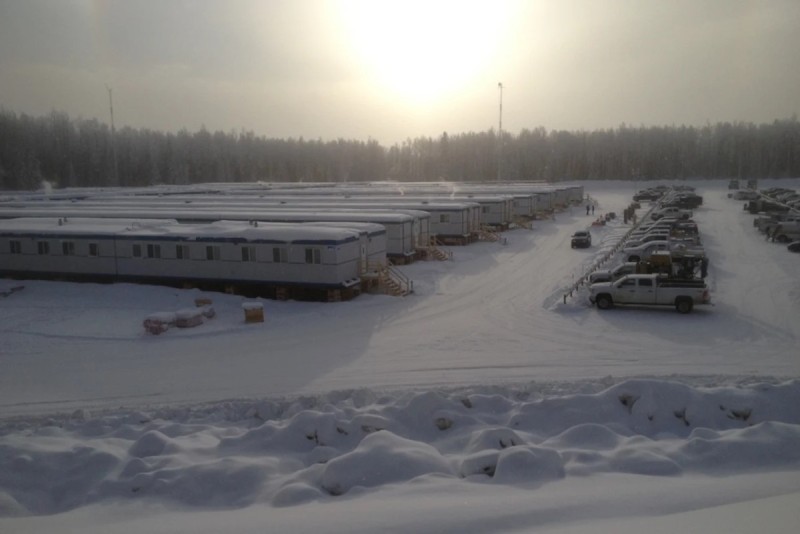
An industry camp for workers on a pipeline near Rainbow Lake, Alberta. Photo by Jason Woodhead/Flickr.
A post on X (formerly Twitter) has brought familiar, dishonest accusations against eco-socialists into the Canadian NDP leadership contest.
The immediate target of the accusations is leadership candidate Avi Lewis, but the real aim is taking shots at a movement that integrates multiple radical perspectives (ecological knowledge, feminism, anti-colonialism, socialism), challenging both right-wing social democrats and a “Promethean” male left.
On February 13, Leigh Phillips, a journalist, science writer, and geologist who works in northern Canada, wrote the following in response to a recently published interview with NDP leadership hopeful Avi Lewis in Jacobin:

Anyone reading the interview will find a clear-eyed socialist critique of the Carney government: its public sector austerity, surging military spending, reliance on capitalist AI investment, and deeper integration with the US military and its border and immigration enforcement apparatus. The interview also offers elements of an eco-socialist agenda: a Green New Deal, and public services funded by a wealth tax and public banking.
Yet that same day, Gil McGowan, president of the Alberta Federation of Labour (AFL), reposted Phillips’ attack, adding: “This is exactly why I’m supporting Rob Ashton.” Ashton is a union leader from British Columbia, where resource extraction sector unions (mining, smelting, forestry) have long exercised substantial influence over the provincial NDP.
The echo of history is striking: in 2016, McGowan, along with Alberta Premier Rachel Notley and members of the NDP caucus, led the opposition against the Leap Manifesto, an eco-socialist platform initiated by Avi Lewis, Naomi Klein, and others. Today, Phillips reprises similar claims that eco-socialists are inviting a backlash against the NDP from working-class voters. Apart from the problematic assumptions underpinning that argument, one might ask how much these NDP leaders care about alienating the diverse base of the climate justice movement that has struggled to see its vision represented by the NDP.
In the past decade, McGowan has supported a just transition plan for coal sector workers, and the AFL has advocated for similar support for oil and gas sector workers, acknowledging declining employment in this sector. His agreement with the characterisation of Lewis as “attacking blue-collar workers” and supporting “eco-austerity” therefore comes as a wake-up call that an “anti-green” faction remains entrenched in the NDP, and is still willing to use the tactics of caricature and the construction of “class enemies” to discredit the eco-left.
They are even willing to borrow the right’s playbook, accusing the green left of trying to intensify workers’ suffering by depriving them of employment, affordable energy, housing, and transportation. This tired trope is used to discredit degrowth economics instead of seriously engaging with its arguments about ecological limits and social justice. Phillips, a self-described “Promethean,” also leans on the familiar right-wing claim that ecologists are hypocrites for living in houses and using energy- and material-intensive products. Seriously?
Phillips uses additional dirty tactics to discredit Lewis and the eco-left. Like Jason Kenney and Andrew Scheer, Phillips frames anyone commenting on the harms associated with the work camps as vilifying blue-collar male workers. This is the classic anti-feminist tactic of accusing those who make statements about well-established patterns of male violence as “painting all men with the same brush,” thereby deflecting attention from the problem. Phillips chooses to misrepresent Lewis’ intent and his reform agenda. He chooses to ignore the extensive body of research on the sexual division of labour and the gendered and racialized violence that is associated with predominantly male work camps located in remote extraction zones. This research incorporates testimonies from the survivors of harassment and violence, including “women who are in the trades, who are cooks, pilots, loggers, geologists, biologists and engineers.” There is undeniable evidence that Indigenous women have been subjected to “horrifying impacts” in these settings. Racialized and gay men are also disproportionately subjected to harassment in these “hyper-masculine” environments. So, who is really throwing whom under the bus?
It’s easy enough to forget or minimize the reality of a culture steeped in petro-masculinity if you are not a woman who has dared to intrude upon its norms or—like me and a handful of others—publicly called for the phasing out of oil and gas extraction. Notley and the women members of her cabinet needed unprecedented police protection from men enraged by her “feminist” agenda and moderate climate policies. These individuals feared no consequences for using a poster of Notley for target practice. Nor did they hesitate to distribute images depicting their fantasy of raping Greta Thunberg. And let us not forget one of the first items on the agenda of the white supremacist leaders of the Alberta separatist movement: the elimination of “gender politics” in a “free” Alberta. Less visible but nevertheless deadly forms of misogyny in Alberta include the government’s devaluing and underfunding of the caring labour that is performed predominantly by women and its refusal to provide services needed by women.
Whose interests does it serve to characterize the eco-left’s agenda of reforms as a plot to “destroy” blue-collar jobs? To downplay the reality of a highly gendered, racialized, and unequal labour market in resource-extraction-dependent economies? To marginalize eco-feminist proposals for a care economy that values the provision of human needs over commodity production?
A third dirty tactic Phillips employs to discredit Lewis (and eco-socialists more broadly) is accusing him of disregarding the interests of Indigenous workers in the extractive sector. While there are indeed many Indigenous workers in these industries, that fact does not prove that Lewis’s proposals run counter to their interests. Anyone familiar with these issues knows that Indigenous communities occupy a difficult and often constrained position relative to extractive industries. Phillips, however, seeks to portray Lewis as yet another white colonizer disconnected from their real concerns—while, of course, assuming for himself the authority to speak for Indigenous workers, based on his own experience as a geologist who has worked in the sector.
It would be nice if the men who feel entitled to tell us what a working-class party “should be for” would take seriously multiple experiences of oppression (as well as ecological limits), and practise solidarity instead of playing the right’s game of pitting one group against another.
Laurie E. Adkin is a professor emerita in the Department of Political Science at the University of Alberta.