
Trump threatens midterm elections

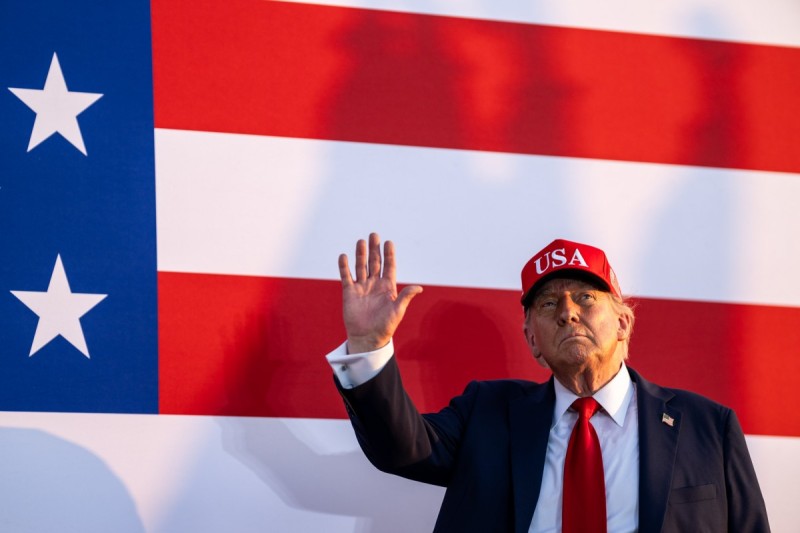
Donald Trump thanks the crowd after remarks at the Salute to America Celebration, July 3, 2025, at the Iowa State Fairgrounds in Des Moines, Iowa. Photo by Daniel Torok/White House/Flickr.
There is no doubt that the US midterm elections in November and the prospect of the Republicans losing control of the House, Senate, or both, have the increasingly unpopular Donald Trump and his inner-circle very worried. In this situation, the notion that they might act to undermine the electoral process is by no means entirely fanciful.
Trump, as is well-known, has a history of calling electoral results into question and his authoritarian proclivities only add to his impatience with voting results that aren’t to his liking. Certainly, with regard to the midterms, some very ominous messages have been put out in the last while.
In January, a report by CNN’s Zachary Wolf portrays Trump fretting about the approaching electoral reckoning and openly casting doubt on the validity of the democratic process. He told House Republicans that “Now, I won’t say, ‘Cancel the election. They should cancel the election,’ because the fake news will say, ‘He wants the elections canceled. He’s a dictator.’” Shortly after this, however, Trump declared that “Republicans have been so successful that when you think of it, we shouldn’t even have an election.”
State of emergency
The CNN article goes on to consider how presidential powers might impact the functioning of the electoral process. It points out that there is a constitutional requirement that a new Congress be sworn in next January 3. However, Wolf points out, “Elections are supposed to be administered by each state, so state governors and legislatures could, in theory, move their own elections to deal with a major disaster, but there’s no precedent for it.”
What flows from this is that, while Trump can’t simply issue an order cancelling the midterms, disruptive tactics, or the creation of a state of emergency, combined with a level of cooperation from Republican allies at the state level, could pose a threat.
Certainly, Wolf writes, “Election officials say they are thinking very carefully about all of this.” And he quotes a statement, cited in The Atlantic, by Arizona’s Democratic Secretary of State Adrian Fontes in which Fontes explains that he is looking at scenarios to prepare for any attempt to interfere with the election and make sure they can get court orders. “The very fact that they are running through these scenarios,” Fontes is quoted as saying, “should tell you something about the health of our democracy.”
Indeed, the effort of the Trump administration to increase executive power at the expense of the legislative and judicial wings of the state, has already created a crisis within the US system of government and the threat hanging over the midterms has greatly intensified this.
If the electoral process itself has become precarious, it is only the logical outcome of the authoritarian course that Trump is charting. Wolf concludes his article with the ominous warning, “There’s a lot of time for more gaming the system between now and November, and Trump clearly already has the midterms on the brain.”
Indeed, already on February 4, NPR reported that Trump said Republicans “should take over voting in a number of places and nationalize elections” and that he “made a number of false claims about noncitizens voting before pushing for more federal control of elections.” The show’s host Michel Martin played a clip of Trump stating: “If a state can’t run an election, I think the people behind me should do something about it because, you know, if you think about it, a state is an agent for the federal government in elections. I don’t know why the federal government doesn’t do them anyway.”
Very significantly, he employs here the same familiar tactic of presenting authoritarian encroachment as a necessary measure brought on by conditions of supposed breakdown and crisis.
Constitutional boundaries and the formal divisions that exist in the exercise of state power in the US need to be properly taken into account but, at the same time, these are uncharted waters and the political motivations of a section of the US ruling establishment that has grown weary of the constraints imposed by democratic forms should be fully taken into consideration.
Among Trump’s inner-circle and those who are politically close to him, the feeling that the midterms pose an intolerable threat to their authoritarian agenda that must be addressed by resolute action, is clearly in evidence. The sense that it’s ‘now or never’ is palpable among his most clear-thinking and reactionary allies.
According to Yahoo News, last November the infamous Steve Bannon told a hall full of conservatives that if “Democrats win the 2026 midterm elections and the presidency in 2028, some of them will go to prison, including him.” Bannon added that “we have to counter that. And what do we have to counter it with? We have to count [sic] it with more action, more intense action, more urgency. We’re burning daylight.”
Recently, Bannon gave a practical example of just what “more intense action” might look like. The Guardian reported on February 4 that, on his War Room show, Bannon repeated falsehoods about undocumented people voting massively in US elections, concluding: “You’re damn right we’re gonna have ICE surround the polls come November.”
In addition to this being a measure of extreme intimidation that would impact voter turnout, it would also introduce an explosively disruptive and highly confrontational element into the voting process that might very well invalidate it. Obviously, although he is an influential figure within Trump circles, Bannon’s musings can’t be taken as firmly laid plans. However, they do provide an indication of the kind of thinking that is developing in those circles as the midterms draw closer.
The enemy within
Without doubt, an effort by the Trump administration to cancel, suspend, disrupt, or disregard the results of the midterms would be a very high-risk undertaking: a modern day crossing of the Rubicon that opens the door to a one-party state. However, the logic of Trump’s authoritarian agenda and the threat it now faces offer a strong inducement for his administration to take such a course of action.
Trump and his cohorts have moved well beyond the traditional Republican self-view of being the conservative wing of the US power structure, engaged in a respectful electoral contest with a more liberal Democratic rival. This administration, as I have argued previously in Canadian Dimension, is very much the product of a situation where “the hegemonic position of the US has been declining and its ability to operate as the cornerstone of a ‘rules-based’ world order has been sapped.” The America First turn and the destructive behaviour of the administration on the world stage express this instability and uncertainty, as US imperialism confronts a late-life crisis.
Trump’s authoritarian course on the domestic front also reflects the volatility of this situation and his whole operation is imbued with the message that exceptional measures must be taken to deal with exceptional threats. Thus, in the Trumpian version of reality, crime is rampant and wild-eyed, violent immigrants are running amok. When his agenda is challenged by protests, they are the product of sinister and treasonous ‘antifa’ networks that must be smashed.
In this way, the conjuring up of a supposed state of emergency is complemented by the creation of an enemy within. This perceived threat, it is important to note, isn’t confined to the radical and criminal elements. Trump’s liberal opponents within the ruling establishment are also presented as dangerous radical extremists who must be punished.
An NBC News report from October of 2024 shows that, even as he campaigned for his second term in office, Trump was already fully prepared to speak of his Democratic opponents in such terms. He declared at that time that “I always say, we have two enemies. We have the outside enemy, and then we have the enemy from within, and the enemy from within, in my opinion, is more dangerous than China, Russia and all these countries.” He added that, while external foes could be contained, “the more difficult are, you know, the Pelosis, these people, they’re so sick and they’re so evil.”
As the reactionary Trump agenda plays out and the electoral process itself comes under threat, the weakness of the Democratic opposition reveals itself at every turn. Even in the face of the murderous brutality that Trump’s ICE enforcers have unleashed in Minneapolis and other cities, leading Democrats distance themselves from calls to abolish this racist and repressive agency.
As The Intercept notes: “So, if they’re not abolishing ICE, what are members of the Democratic establishment doing? According to Politico, top Democrats in DC have been ‘feverishly working to fund the agency—with strings attached.’” It adds that “their incrementalism also shows how out of step they continue to be with the American public—which is rapidly turning against ICE.”
In contrast to this timidity is the powerful and inspiring opposition to Trump and his ICE thugs on the streets of Minneapolis. Disruptive forms of mass mobilization have been combined with ongoing community action to challenge, hamper, and sometimes confound the work of the ICE enforcers and they have shaken the Trump administration in ways the Democrats have failed to.
Trump poses a dire threat, not just to the electoral process, but to the democratic rights of expression and assembly that workers and communities in the US have won and then utilized in order to challenge exploitation and oppression. A decisive confrontation between a regime of oligarchic authoritarianism and working class resistance is developing across the US and the threat to November’s midterm elections may well be a major flashpoint in that pivotal struggle.
John Clarke is a writer and retired organizer for the Ontario Coalition Against Poverty (OCAP). Follow his tweets at @JohnOCAP and blog at johnclarkeblog.com.