
Integration or independence?

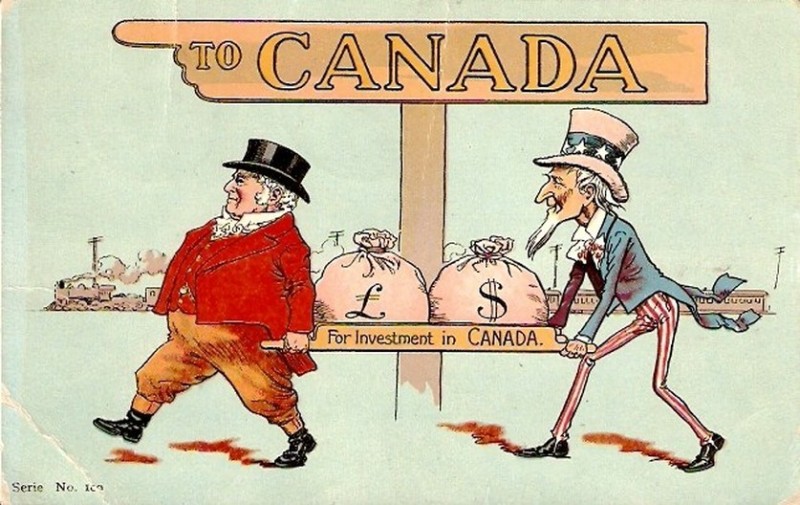
Postcard from 1907 showing John Bull and Uncle Sam beneath a sign reading “To Canada,” carrying sacks of money marked “For Investment in Canada.” Image from Wikimedia Commons.

Over the past year, much has been made in Canada of the various taunts and threats that have accompanied the Trump administration’s decision to impose tariffs as part of what it has described as an effort to reduce trade deficits, bolster national security, and strengthen domestic manufacturing.
Many Canadians have expressed shock and dismay at being “betrayed” by a country they were given to viewing as a livelier, albeit more garish and confrontational, version of their own—a country that is blessed with more jobs, warmer weather, and cheaper goods, but burdened by more guns, greater insecurity, and less predictable institutions. Seen from this perspective, the United States is something like an ill-informed but powerfully built classmate who causes more trouble than needed but ultimately protects their friends in tussles with neighbourhood bullies.
In reality, of course, the US is a thirty-trillion-dollar great power that has spent the better part of the past century browbeating friend and enemy alike, facilitating mass killings from Indonesia to Bangladesh, bankrolling genocides from Guatemala to Gaza, murdering or indirectly causing the death of millions just from its “War on Terror” campaigns, ignoring or openly attacking the very international law it once championed and helped to generate, and plundering the world through a combination of economic coercion, dollar supremacy, the global reach of its corporations, and the outsized influence it wields over international financial institutions. If Trump is an aberration in US history, it is mainly in the sense that he does not bother to disavow any of this, having transformed himself into a smash-and-grab imperialist with the kind of ease that only an unsuccessful real estate mogul and minor television celebrity could manage.
Given Trump’s near-daily jibes to the effect that Canada is little more than an appendage that benefits from American largesse, and that it would do well to accept its fate as the 51st state of the “indispensable nation,” it is not surprising that even some Canadians who are otherwise loath to recognize the brutal realities of US imperialism have recently begun to question their country’s exceptionally high degree of dependence upon its southern neighbour. What is surprising is that so many Canadians should have been so indifferent to so many warnings about this dependence for so long. Aside from standard and now ubiquitous references to George Grant’s 1965 Red Tory tract, Lament for a Nation, few have noticed that engagement with questions of Canada’s economic and political sovereignty has always been a hallmark of socialist practice and thought in this country (including in the pages of this magazine).
The history of such concerns about sovereignty in the lands that now comprise Canada reaches back to the 18th and 19th centuries. Yet a modern date of especial importance in this respect is 1968, when a task force chaired by political economist Mel Watkins produced the report on foreign ownership in Canada that Lester Pearson’s government had asked it to prepare. Summarizing the report’s conclusions in an accompanying article, Watkins explained that “the extent of foreign ownership of Canadian industry is unique among the industrialized nations of the world.” Indeed, foreigners owned over half of all Canadian manufacturing, with the rate of foreign ownership approaching one hundred per cent in key sectors like rubber and automobiles, in addition to more than two-thirds of its mining, smelting, and hydrocarbon industries. Watkins would go on to form the NDP’s Waffle tendency, whose 1969 manifesto called for an “independent socialist Canada” that would confront not only US corporate capitalism but those Canadian elites that had “opted for a junior partnership with these American enterprises.”
Mel Watkins in 1981. Photo courtesy the Toronto Star.
1968 was an auspicious year for many causes, including various forms of Canadian socialism, but 1970 saw the publication of Kari Polanyi Levitt’s Silent Surrender, an instant classic that commenced with the observation that Canadians had spent much of their country’s centennial year anxious about its “chances of survival as an independent sovereign country.” And Canadians were by no means alone in pointing out the absurdity that a large, industrialized, and astoundingly resource-rich “First World” state could be as thoroughly dependent upon the US as their country had allowed itself to become. Discussing the internationalization of capital and related transformations in state structures in the early 1970s, Greek-French Marxist theorist Nicos Poulantzas was sufficiently puzzled by Canada’s peculiar role as a quasi-satellite to suggest that US domination of the country could potentially be understood as both an “exemplar” and a “borderline case” of neocolonialism.
Among the many Canadian public intellectuals who would remain animated by concerns of economic and political sovereignty during the years that followed was Mel Hurtig, whose maverick patriotism regularly led him to claim that “by the mid-1960s the amount of foreign ownership in Canada was greater than in all of the western European nations combined, plus Japan thrown in for good measure.” That evaluation may have been exaggerated, but Hurtig was on firmer ground when he denounced the fact that most of the country’s “vital industries were foreign-owned or foreign-controlled, many by seventy per cent, or eighty per cent, with several key Canadian industries over ninety per cent foreign-owned.”
In August 1988, at the height of public debates about “free trade” and less than three months before the pivotal election that would usher in the North American Free Trade Agreement, federal NDP leader Ed Broadbent rebuked Brian Mulroney’s government for failing to adhere to a policy of economic nationalism that would enable it to dominate domestic markets and increase manufacturing exports. “The Japanese did not start out with half our resources and they are exporting their manufactured goods all around the world,” he argued in the House of Commons, adding that “if we took even the conservative approach of the Japanese, we would have used our mining and forest potential not simply as hewers of wood and drawers of water” but for the purpose of “manufacturing and exporting our goods all over the world.”
The NDP would perform better at the polls that November than they ever had in any federal election (it remains the party’s second best national result), even as Broadbent was criticized by some for not making the argument about economic nationalism more trenchantly and vociferously during the campaign. However, the fundamental issue of Canadian sovereignty, with its mammoth implications for workers, would be relegated before long to the margins of mainstream political discourse, with many Canadians coming to view continental economic integration—that is, subordination to US capital—as both salutary and inevitable in an age that had supposedly left the Cold War behind.
These are merely a handful of snapshots from the long, complicated, and multi-faceted history of socialist engagement with questions of Canadian sovereignty, both economic and political. This country boasts a strong socialist tradition that has consistently produced voices of the kind typified by Watkins and Polanyi Levitt. These voices find an echo today among the ruins of Canada’s “post-neoliberal” social landscape, with some Indigenous movements, labour organizations, activist networks, and small parties pressing for coordinated economic planning, advancing claims to collective ownership and control of core resources and industries, and emphasizing the need to counter not only US militarism and interference but the power of US corporations. It is high time that Canadians cultivated more voices of this kind—and that they began to listen to them in earnest.
Umut Özsu is Professor of Law and Legal Studies at Carleton University. He is the author of Completing Humanity (Cambridge University Press, 2023) and Formalizing Displacement (Oxford University Press, 2015).