
The overlooked minority—again

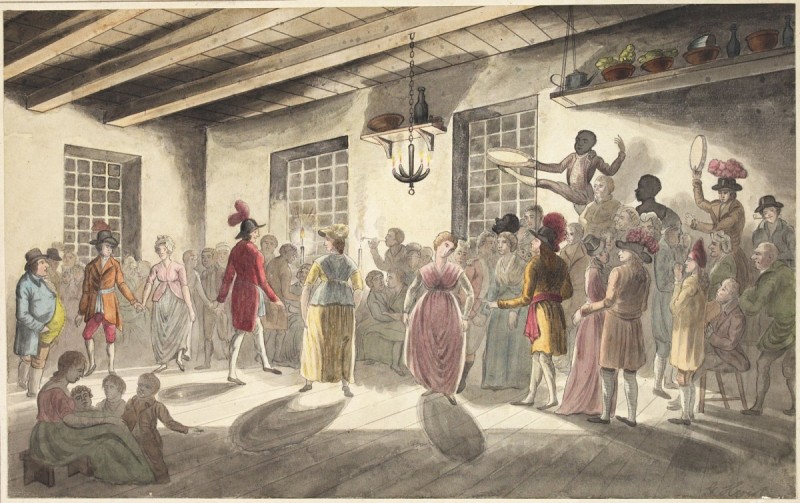
“Minuets of the Canadians,” George Heriot, 1807. Image courtesy Library and Archives Canada.
In the November-December 1996 issue of Canadian Dimension, one article began with the following lines:
Blacks in Canada? Sure. Some. For over three hundred years? Okay. Maybe. Slavery? Segregated schools? You must be thinking of the United States.
Such a conversation could easily be heard on almost any schoolyard or street corner in Canada—if such questions were ever asked.
As 2026 begins, these words remain as true today as they were then. The big question is why. Why aren’t these questions being asked?
I wrote that 1996 article while I was a graduate student.
The work is there
In 2026, after 30 years as an educator, I still struggle to understand how Black Canadian history remains largely invisible to so many Canadians when the information is in plain sight.
This is despite tremendous efforts over the past three decades to raise its profile. There are the films of Sylvia Hamilton, including the documentaries Portia White: Think on Me (2000) and The Little Black Schoolhouse (2007). The poetry, novels, and plays of George Elliott Clarke, such as George and Rue (2005). The many books of Lawrence Hill, including The Book of Negroes (2007), and Cecil Foster’s work on the history of Black porters in They Call Me George (2019). This is only a partial list of works that embed the stories of Black Canadians into the national narrative. The work is out there.
Indeed, there has also been a significant rise in academic research focused on Black Canadian history and its legacy—far more than was available to me when I began my studies in the early 1990s. A few recent notable works include Robyn Maynard’s Policing Black Lives: State Violence in Canada (2017), Desmond Cole’s The Skin We’re In (2020), and Unsettling the Great White North (2022), edited by Michel A. Johnson and Funké Aladejebi. These texts contribute to a richer understanding of Black Canadians’ experiences for those who read them.
Awareness of Black Canadian history in mainstream society has increased somewhat. However, well-known examples are often presented in isolation, detached from a broader historical narrative.
Cover of the November-December 1996 issue of CD
For example, Viola Desmond, who was arrested in 1946 for challenging racial segregation at a Nova Scotia movie theatre, is widely celebrated, and her courage and activism rightly warrant recognition—including her appearance on a Canadian banknote. But the follow-up questions—how widespread was segregation in Nova Scotia and elsewhere, and how long did it exist before and after her case—are rarely asked. If they were, then Carrie Best’s story—a woman who challenged discrimination at the same Roseland Theatre five years earlier—would also be better known.
Another prominent example is the destruction of Africville, the systematic uprooting of a Black community that had existed for over a century in Halifax. When community members finally received an official apology from the City of Halifax in 2010, credit was due to the dedication and hard work of the Africville community in keeping their story alive.
The fate of Africville deserves to be widely known, not only for the racist actions of society but also for the courage of the community in responding to them.
Like the Desmond case, Africville should be understood in a broader context. It was not the only Black community to face demolition under the guise of “urban renewal” in the post-Second World War period. Add to the list Little Burgundy in Montréal and Hogan’s Alley in Vancouver. Cabbagetown South in Toronto could also be included, cleared to make way for Regent Park, although this community was not predominantly Black. Expanding the lens to racially targeted communities, the demolition of Rooster Town, a Métis settlement outside Winnipeg, would also be a logical addition. Regardless, a clear pattern emerges.
An elusive memory
But neither the Viola Desmond case nor the razing of Africville were the earliest entries in the Black Canadian historical timeline. Whether one considers Mathieu Da Costa in 1604 or Olivier Le Jeune in 1628 to be the first Black person in Canada, over 200 years remain largely unaccounted for.
This gap is unique to Black Canadians because it encompasses the period when slavery was practiced in Canada. This historical reality remains difficult for Canadian society to accept. It was present in both French and English Canada, even if it did not thrive to the extent it did in the United States.
Canadians generally respond in three ways when confronted with the existence of slavery here. One is to diminish its impact, as if there could be such a thing as “slavery lite,” suggesting it failed in Canada because Canadians are somehow morally different from their neighbours to the south. Another is to acknowledge its existence but quickly pivot to celebrating Canada as the last stop on the Underground Railroad—a land of freedom for Blacks fleeing the United States—arguing that this cancels out slavery’s negative effects. The third is to dismiss it entirely, treating Black Canadians as if they were just another immigrant group over the past 150 years, ignoring prior centuries. Even when Canadians accept the history, efforts are often made to present it in softer, more palatable terms.
Illustration from Uncle Tom’s Story of his Life from 1789-1881 by Rev. Josiah Henson. Image courtesy Metropolitan Toronto Library Board.
This is not to say that Black Canadian history is defined solely by slavery—far from it. But for every Black Canadian from the early 1600s to the early 1800s, whether free or enslaved, Black Loyalist or Black Refugee, the institution and its ideology were realities. For those arriving after abolition, the legacy of slavery persisted. Ignoring 200 years of history—and the trauma and resistance it entailed—leaves only a fractured picture of both the Black Canadian experience and Canada’s history as a whole.
The cost of denying slavery was confronted in a two-part series on CBC Radio’s Ideas in 2019: “Canada’s slavery secret: The whitewashing of 200 years of enslavement” and “Slavery’s long shadow: The impact of 200 years of enslavement in Canada.” The series presents indisputable evidence of slavery’s existence and the lasting damage caused by its denial.
As the series and historians such as James St. W.G. Walker and Afua Cooper have shown, denying slavery helped sustain a tidier national narrative that cast Canada as a moral counterpoint to the United States. This is yet another example of how available evidence should prompt deeper questions about Canada’s historical record.
Lessons unlearned
The events of 2020 highlighted how little is still known about Black Canadian history. When news organizations reported on George Floyd’s death and the subsequent protests, historical gaps became apparent: anti-Black racism was often framed as a purely American problem, and Canada’s own history of slavery and segregation was ignored. It felt like 1996 all over again.
Conversations with the public confirmed this: the 400-year history of Blacks in Canada is far from common knowledge.
At a workshop I ran for Toronto-area teachers in May 2021, I presented a map pinpointing historic sites of racism and resistance in the Maritimes, based on my graduate research and ongoing work. Many teachers were encountering this information for the first time. Some participants raised in Nova Scotia admitted they were unaware of much of this history. It was a clear reminder that despite the efforts of Black Canadian artists, researchers, writers, historical associations, and community groups, this lack of knowledge remains widespread.
Discouraging? Absolutely. But there is hope.
Clearing a path forward
One model worth considering is Indigenous education. While it has not fully addressed the conditions and status of Indigenous peoples, progress has been made. When I attended public school in Ontario in the late 1970s and 1980s, Residential Schools and the Indian Act were barely mentioned. Today, Indigenous literature, art, and teaching are integrated into curricula across Canada, reflecting decades of advocacy, UN support, and reconciliation efforts.
Another hopeful development is new curriculum. Currently, most provincial education ministries fall short in providing compulsory Black Canadian history—a situation repeated over decades. As the executive summary of the 2023 CUNESCO report Black Canadians and Public Education notes:
[P]rovincial and territorial curricular documents across the country could do more to include Black representation in comprehensive and meaningful ways… Black Canadians are included only sporadically in curricula, with no mandatory expectations about including Black representation.
Most provinces and territories lack dedicated Black Canadian history courses. Nova Scotia offers one Grade 11 course on the topic, but it is elective. Ontario has Deconstructing Anti-Black Racism, developed around 2020 by Toronto District School Board teachers on their own initiative. It is also elective and limited in availability. Ontario had planned to launch new compulsory content for grade 10 Canadian history and grade seven and eight social studies in 2025; this has been delayed to September 2026. While a positive step, it will require teachers to receive professional development to effectively teach the material.
Resources to support learning are also growing. The eight-part documentary series Black Life: Untold Stories (2023) spans all four centuries of Black presence in Canada. Graham Reynolds’ 2016 book Viola Desmond’s Canada: A History of Blacks and Racial Segregation in the Promised Land provides a more comprehensive view than Desmond’s singular story.
Canadians can also draw on US scholarship. Though the contexts differ, comparative study can illuminate Canadian slavery, ideologies, and forms of resistance. For example, Kellie Carter Jackson’s We Refuse: A Forceful History of Black Resistance (2024) provides a framework easily applied to Canadian history.
All of this offers reasons for hope. But it does not fully answer why Black Canadian history remains largely invisible. It is not for lack of effort. Black Canadians have been telling their story in every available format. After 400 years, it is time for all Canadians to broaden their understanding, recognizing these stories as integral to the national narrative. Only by accepting, embracing, and building on this history can it become as familiar to children and adults as any other part of Canada’s story.
Sheridan Hay is currently Head of the Department of Canadian and World Studies and Social Sciences at Lawrence Park Collegiate Institute in Toronto. His graduate research examined Canada’s long history of racism and resistance, and he continues to focus his work as an educator on issues of equity and social justice.