
Shedding light on the CUPW labour conflict

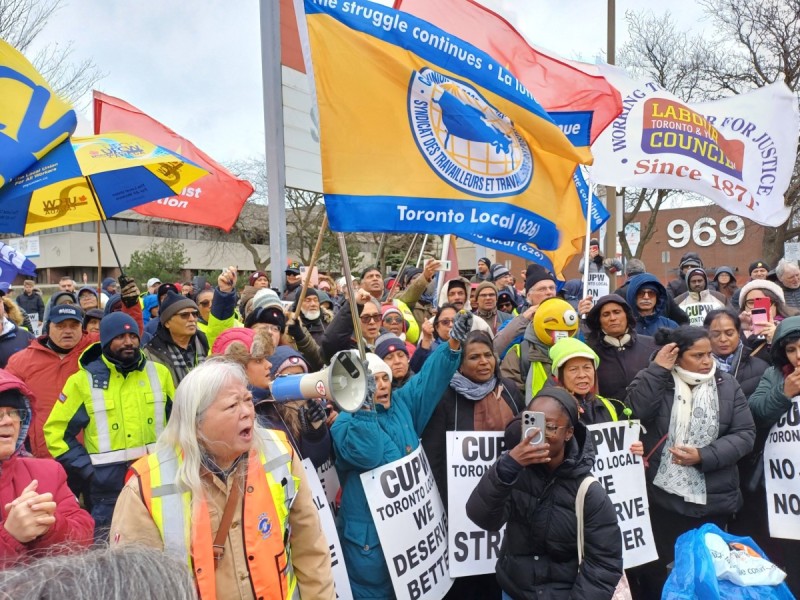
Solidarity rally with CUPW workers in Toronto. Photo by John Cartwright/X.
The following article is a response to “Canadian labour movement needs a wake-up call” by Alex Passey, published in Canadian Dimension on January 20, 2026.
In his recent article for Canadian Dimension, Alex Passey takes a look at some recent union struggles, including those of the Canadian Union of Postal Workers (CUPW). As a former CUPW activist, I want to respond to his remarks, focusing primarily on his discussion of my union.
CUPW has fought major battles in defence of public services and has had a significant impact on the labour movement and popular movements by broadening union demands to encompass wider appeals for social change. For instance, it was one of the main instigators of the left-wing caucus within the Canadian Labour Congress (CLC), aiming to strengthen its positions and promote a united fight against neoliberalism.
It is not surprising, then, that the union has been targeted by employers and governments, which have sought to hamstring it. The federal government has imposed special back-to-work legislation six times (in 1978, 1987, 1991, 1997, 2011, and 2018) to end work stoppages. Ottawa has always operated in league with private enterprise and has long sought to scale back the public postal service, partly in response to the determination of the union. The Carney government’s recent actions clearly demonstrate this.
During the 2024-2025 labour dispute, the union deployed various strategies. It used rotating strikes initially, rather than taking general strike action. This ensured that pressure was maintained without immediately triggering legislative intervention, while raising public awareness of the issues surrounding the public postal service. The Montréal local also occupied ministers’ offices, including that of Alfonso Gagliano, on several occasions, as well as Canada Post offices in the La Gauchetière Street building. These actions garnered considerable attention and brought the union public support.
An unprecedented attack on CUPW
In an unprecedented move in the history of the labour movement in Canada, Minister of Employment and Families Patty Hajdu announced on June 12, 2025, that she would exercise her authority under subsection 108.1(1) of the Canada Labour Code to order a vote on the final offers that Canada Post made to the CUPW on May 28, 2025. The Canada Industrial Relations Board was tasked with conducting this vote. If a simple majority of workers voted in favour of Canada Post’s offer, a new collective agreement would be imposed, ending the union’s ability to bargain.
The union put a tremendous amount of energy into meeting with members across Canada and succeeded in winning the vote, with 70 percent of members rejecting the employer’s proposal. A total of 80 percent of the members voted, representing approximately 40,000 members. This confirmed the union members’ determination to pursue the fight. The government had actually stooped to taking away the union’s right to give its own members its views on the employer’s offer, but the union’s efforts paid off and the offer was rejected.
In December 2025, Steven MacKinnon, then minister of labour, used section 107 of the Canada Labour Code to put the legal strike on “pause,” to avoid bringing the issue before Parliament.
He also used section 108 to create an Industrial Inquiry Commission. Each time the government intervened, it did so in favour of Canada Post management: suspending a legal strike; creating a Commission of Inquiry with a mandate biased towards management positions; and imposing a vote despite strong opposition from the union. Further, Prime Minister Mark Carney eliminated the title of minister of labour, creating the new position of minister of employment and families, and appointing Patty Hajdu to that position. So the federal cabinet no longer has a dedicated labour portfolio.
The postal workers’ union was thus confronted with Canada Post’s refusal to negotiate, which was based on the Carney government’s anti-union offensive.
What Passey neglects
In a personal communication, Roxanne Gale, union representative and member of the mobilization committee of the CUPW’s Montréal local, commented on Passey’s article:
Alex Passey criticizes the decision to comply with government orders, arguing that it breaks with the labour movement’s history, which is based on civil disobedience and direct action. He calls on unions to return to these practices and to show courage in the face of state and corporate pressure. His article is inspiring and powerful, as it raises questions about the role of unions and the need to defend workers in a neoliberal context.
However, his analysis remains incomplete. It simplifies the reality of contemporary conflicts by ignoring the human, legal, and strategic constraints that unions face. The comparison with Air Canada ignores specific contexts and varying levels of public support. Furthermore, the author does not take into account the complexity of current struggles, which are played out as much in the streets as in legal proceedings and arbitration, nor the real risks incurred by workers in the event of prolonged civil disobedience.
In my opinion, the article raises relevant issues and reignites a necessary debate on union militancy. Nevertheless, it would benefit from a more nuanced understanding of contemporary realities and effective strategies for defending workers in the long term. Its analytical scope remains limited by a narrow focus on criticizing union choices.
Passey maintains that “in December 2024, CUPW had an opportunity to do something historic” and “union members were ready to defy the back-to-work order and decried it as an unconstitutional subversion of our right to bargain with our employer.” He notes, “Many voices called for CUPW to stay on the picket line and show that our right to negotiate a fair contract on our own terms was not to be compromised by the whims of the government.”
However, Passey charges that “CUPW meekly followed the back-to-work order, tacitly accepting that we can only conduct collective bargaining at the convenience and under the conditions of the very institutional powers we are bargaining against.”
In my view, these characterizations do not help advance the debate. Defying back-to-work laws was an option, but we need to consider the power relationship required in a situation where the CUPW was the government’s main target.
Toward a general strike by the labour movement
We can’t allow unions to go on the offensive one at a time, in isolation. In this respect, I understand the issues that Passey raises. Our challenge is to find ways to unify our struggles. That’s what we need to work on.
The struggle of the CUPW and the public and parapublic sector unions depends greatly on broad public support. Strategies must also take this into account and innovative pressure tactics have to be found that will put the government on the defensive. CUPW has often been the target of attacks by various governments because it has been at the forefront of social struggles. It was one of the first to win substantial parental leave, for instance. It has succeeded in broadening its sights and spearheading a political struggle to which other social groups can relate.
Faced with a large-scale anti-labour offensive, unions have had to fight in a fragmented way, and the CLC has not assumed the role it was expected to play. Struggles in various individual sectors will grow increasingly harsh and gains will be difficult to achieve. It is therefore urgent for the CLC to set up a general assembly of trade unions so that the unions can build a common strategy. Our challenge is to work to unify our struggles against anti-worker government policies.
On October 14, 1976, more than one million workers across Canada joined a general strike called by the CLC to denounce the federal government’s plan to impose wage and price controls. It’s time to take up that mantle once again.
André Frappier is a regular contributor to CD and a member of the magazine’s coordinating committee. He also serves on the editorial board of the online weekly Presse-toi à gauche and has been a member of the FTQ Montréal Labour Council for many years.