
Empire in a heating world

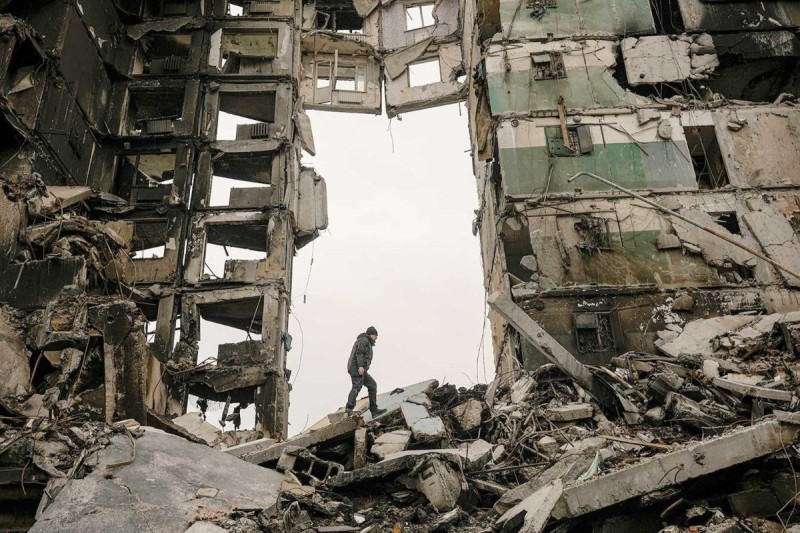
A destroyed residential block in Borodyanka, Ukraine. Photo by Vadim Ghirda.
Today marks the four-year anniversary of Russia’s invasion of Ukraine. It was never supposed to last this long. Indeed, Vladimir Putin, who bears sole responsibility for launching this disaster, thought it would be wrapped up in a few days. He should have known better, having watched George W. Bush’s blunder in Iraq and, earlier, Leonid Brezhnev’s in Afghanistan. But, like many leaders before him, he fell prey to false optimism about war.
The result has been devastating for ordinary people, for Ukraine, Russia, the European Union, and for our collective planetary future. The number of dead and wounded is not known but estimates put it at well over one million in Russia, and perhaps half that in Ukraine. Officially, the number of Ukrainian soldiers killed on the battlefield is 55,000. It is likely far higher. Ukraine now has severe personnel shortages in its armed forces, a challenge made more acute by a broader demographic collapse: its population today is 17 million people smaller than it was at independence after the Soviet Union’s fall.
The psychological burdens of the war have been considerable for ordinary Ukrainians, both in the country and in the diaspora. Facing irregular assaults from drones and missiles, and related infrastructure failures, Ukrainians have demonstrated remarkable resilience. A poll in December 2025 found that 62 percent are ready to endure war as long as is necessary. Yet estimates suggest that at least half of those living in Ukraine suffer from some degree of post-traumatic stress disorder.
War and sustained occupation have cleaved Ukraine’s territory apart. Crimea has been integrated into Russia since 2014. The Russian occupied Donbas is being assimilated in a heavy-handed manner with forced Russification policies and an active de-Ukrainianization of everyday life. Hundreds of human settlements, from villages to cities, lie destroyed. Ukraine is presently one of the most mined countries on Earth, with hundreds of thousands of square kilometers of its land contaminated by landmines, unexploded ordnance, and cluster munitions. Approximately 10 percent of Ukraine’s fertile black soils, which made the country a critical world supplier of wheat, maize, and barley, are now poisoned by remnant munitions.
Wealth from selling hydrocarbon fuels to the European Union and other global markets made Russia’s war against Ukraine possible. At the time the German-driven policy of Wandel durch Handel (“change through trade”) seemed to make sense, though it built short-term geopolitical peace on long-term damage to the planet. Putin went along until, isolated during the COVID-19 pandemic, his growing megalomania got the better of him. Two decades in office, he came to see himself as a transhistorical Russian strongman, a new Peter the Great returning ‘historic Russian lands’ to the motherland.
Ukraine’s resolute resistance to Putin’s imperial fantasies created opportunity amidst crisis. The EU belatedly realized it was funding a revisionist petrostate just as the urgency of climate action became clear. But rather than using this revelation to pivot decisively toward renewable energy, the EU muddled its response. Ending the purchase of Russian oil was positive. Doubling down on natural gas, with new infrastructures and contracts for Middle East petrostates and others, was not. Only recently has the EU decided to ban Russian natural gas imports, but that will not start until the end of 2027.
From the foolish decision of one man have flowed consequences that are planetary in their implications. Global arms-production supply chains now feed the battlefield. Putin’s war has intensified geopolitical rivalry between the West, Russia, and China, hardening blocs and casting suspicion on interdependencies once built on shared economic interests. Ties that were once framed as stabilizing are now viewed as vulnerabilities to be weaponized. Cooperation among major powers on arms control and on curbing greenhouse gas emissions has largely stalled.
Energy markets have been reshaped in the process. Russia redirected its hydrocarbons to Asia, with India and, increasingly, China purchasing oil and gas at steep discounts. The United States, meanwhile, sought new markets for its liquefied natural gas, and Europe—determined to end its reliance on Russian pipelines—deepened a new dependence across the Atlantic: by 2025, the US supplied well over half of the EU’s LNG imports, a dramatic rise from before the invasion. Rather than accelerating a decisive turn toward renewables, the EU compromised elements of its climate agenda and prioritized rearmament. Putin’s aggression has even emboldened voices within US leadership to contemplate territorial aggrandizement of their own in Greenland, straining the Western alliance itself.
The damage caused by Putin’s war is plain to see across Ukraine: settlements destroyed, territories broken, and cemeteries bulging. It is visible also across Russia’s regions where graveyards are full of young men who died on the battlefield. More difficult to discern, though, are the structural consequences of this war: the radicalization of geopolitical competition, the prioritization of defence spending over social needs, and collective failure in a decisive decade for sustainable development to bend the curve of greenhouse gas emissions.
At the Munich Security Conference recently, US Secretary of State Marco Rubio snidely cited a “climate cult” blocking Europe. But if anything is a cult, it is the game of geopolitics. Major states think they are playing for primacy on a stable chessboard, not acknowledging that these very games, and the imperial ways of life they advance, are destabilizing the planetary systems we all share. This obsession with short-termism prevents world leaders from facing the long-term material realities of climate catastrophe. Future generations will be unforgiving about this.
Upon winning the Democratic nomination for president in June 2008, Barack Obama spoke of a turning point in history. “The moment when the rise of the oceans began to slow and our planet began to heal,” he said. This was wishful thinking. While there are many inflection points in history, Putin’s decision on February 24, 2022 stands as a dark counterpoint to Obama’s lofty rhetoric. It is an anniversary that merits sober reflection on all the violence—fast and slow—it has unleashed on our world.
Gerard Toal is a political geographer and professor at Virginia Tech, and author of Oceans Rise Empires Fall: Why Geopolitics Hastens Climate Catastrophe (Oxford University Press, 2024).