
Carney’s gambit: Atlanticism with Canadian characteristics

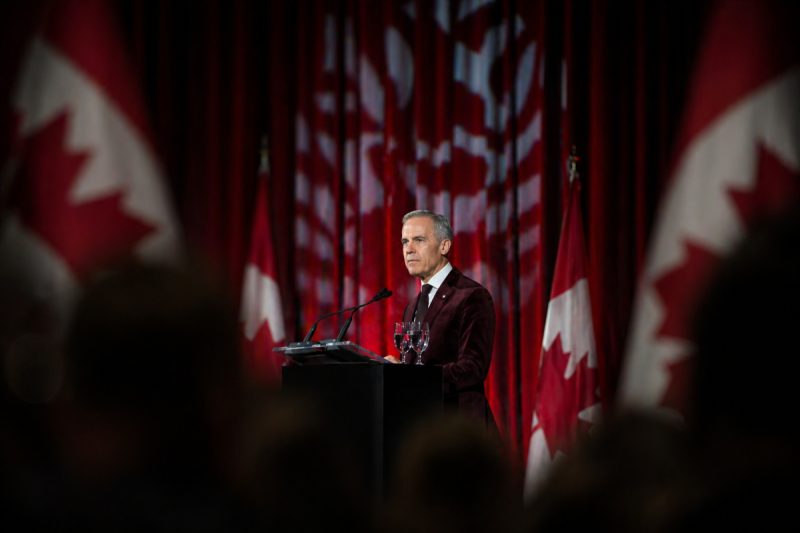
Carney’s brief break with the “rules-based order” in Davos gave way to a rapid return to Canada’s familiar role within American power, writes Peter McFarlane. Photo courtesy Mark Carney/X.
The following is an excerpt from Last Call for Canada: Sovereign Nation or Vassal State by author, journalist, editor, and arts administrator Peter McFarlane, set to be released June 1, 2026 by Baraka Books. For more information, visit www.barakabooks.com.
When Mark Carney arrived in Beijing on January 14, 2026, it was an important moment in Canadian-Chinese relations after ten difficult years. Since then, the hope of it leading to a bold new Canadian foreign policy has been lost as his government offers the occasional brave words while continuing to serve American foreign policy interests.
The previous visit by a Canadian prime minister to China had been in December 2017 when Justin Trudeau announced that Beijing and Ottawa were beginning negotiations on a Canada-China free trade pact. That initiative was quickly abandoned three weeks later when the US declared China a strategic rival. The following year, Canada formally surrendered its right to enter into a free trade pact with China in the 2018 CUSMA trade agreement. The following day, on December 1, 2018, relations between Canada and China collapsed completely when Canada arrested the Huawei executive, Meng Wanzhou, at the request of the Americans.
The Carney trip in January 2026 only came after the US had opened the door to China again with the October 2025 Trump-Xi meeting at the Asia Pacific summit in South Korea. After that meeting, Canada’s Foreign Affairs Minister, Anita Anand, felt secure enough to announce that “Canada now views Beijing as a strategic partner.”
In Beijing, Carney lifted the crushing 100 percent tariff Canada had put on Chinese electric vehicles in 2024 under the direction of the Biden administration—opening the door to the import of 49,000 Chinese EVs into Canada, representing three per cent of the Canadian auto market. In return, China agreed to lower its retaliatory tariffs on Canadian canola from 85 percent to 15 percent by March 1, 2026.
Immediately after his China visit, Carney made an even higher profile move. From Beijing he travelled to the World Economic Forum in Davos, Switzerland, and on January 20 gave a speech entitled “Principled and Pragmatic: Canada’s Path” that was heard around the world.
Carney told the Western business and political class at Davos that “the rules-based order is fading, and he quoted the Thucydides’ line that we were entering a world where “the strong do what they can, and the weak must suffer what they must.”
Carney said there was “a tendency for countries to go along to get along. To accommodate. To avoid trouble. To hope that compliance will buy safety. Well, it won’t.”
His most surprising admission was that:
For decades, countries like Canada prospered under what we called the rules-based international order. We joined its institutions, we praised its principles, we benefited from its predictability. And because of that, we could pursue values-based foreign policies under its protection. We knew the story of the international rules-based order was partially false. That the strongest would exempt themselves when convenient. That trade rules were enforced asymmetrically. And we knew that international law applied with varying rigour, depending on the identity of the accused or the victim.
It was this first half of his speech that set the liberal world on fire by suggesting, in carefully moderated language, that the rules-based order was a Western instrument to circumvent international law while pursuing military and economic dominance. In effect, Carney had admitted to the world at Davos what would have gotten you labelled as a Chinese or Russian propagandist a day earlier.
Those who focused on the first part of Carney’s speech, like French leftist and China expert Arnaud Bertrand, would describe it as one that “may prove to be one of the most important speeches made by any global leader over the past 30 years.”
“Riddled with hypocrisy”
But those who took into account the second half of the speech were less enthusiastic.
After his exposé of the fraud baked into Western foreign policy, Carney went on to lay out a position that one conference member described as “Atlanticism with Canadian characteristics.”
Intermediate powers like Canada, Carney suggested, could band together to promote their values “like respect for human rights, sustainable development, solidarity, sovereignty, and territorial integrity of the various states.” They could remain principled in their commitment “to fundamental values: sovereignty and territorial integrity, the prohibition of the use of force except when consistent with the UN Charter, and respect for human rights.”
Carney then became increasingly vague and rambling. “We are no longer just relying on the strength of our values, but also the value of our strength… To help solve global problems, we are pursuing variable geometry… Middle powers must act together because if you are not at the table, you are on the menu.”
He continued: “In a world of great power rivalry, the countries in between have a choice: to compete with each other for favour or to combine to create a third path with impact.”

Realist political thinkers like John Mearsheimer praised Carney’s truth telling in the first part of the speech but dismissed the idea that “middle powers can follow a third way and that they can form a non-aligned movement and can create their own institutions. In that regard, I think he’s wrong. It is great powers that create international institutions and it is great powers that create international orders and countries like Canada have remarkably little maneuver room. So I think he is wrong in thinking that he can do that.”
Leading economists from both the left and the right, like Yanis Varoufakis and Wolfgang Münchau had an even tougher take. Münchau, associate editor of the Financial Times, said that the idea that we all have to get together is completely delusional. The reason we have this problem is that we have become dependent on the US for security, for technology… there is so many parts of our society that has become dependent on the United States, that we cannot extricate ourselves from this dependency… Carney’s talk of mutual alliance is Davos talk. It’s stupid. It’s silly.”
Varoufakis said “the speech was riddled with hypocrisy and that it concluded in a muddled non-credible proposal.”
He asked why people like Carney and the British prime minister and the Europeans went along with American hegemony for so long even though they knew that it was false. Now Carney was talking about the middle powers like Britain, Germany, France, Australia and Canada getting together in order to create an alternative multilateral rules-based order and to essentially group together to fight the hegemony. How is he proposing to do that?
“Canada is striking a deal with China but it is a tiny minuscule little deal which is calibrated in such a way as to not upset Washington. So I don’t think it is that historic a speech.”
In the long run, the real importance of Carney’s speech would be measured less in the immediate waves it created than the new direction that it signalled. And it would soon become apparent that there would be no brave forward movement after Davos.
The art of the high-speed back-pedal
Trump’s initial response to Carney’s China deal was not at all hostile. He did not see a deal that focused on the import of a limited number of EVs, capped at three percent of the domestic market in a sector that was not in competition with US automakers, as significant.
When Carney was leaving China, Trump said, “That’s what you should be doing. I mean, it’s a good thing for him to sign a trade deal. If you can get a deal with China, you should do that, right?”
The imperial wrath only began after Carney’s Davos speech when he suggested that Canada was preparing to exit its vassal relationship with the US. The speech was followed by three days of ominous silence from Trump. Then the dam burst on Trump’s Truth Social:
If Governor Carney thinks he is going to make Canada a “Drop Off Port” for China to send goods and products into the United States, he is sorely mistaken. China will eat Canada alive, completely devour it, including the destruction of their businesses, social fabric, and general way of life. If Canada makes a deal with China, it will immediately be hit with a 100% tariff against all Canadian goods and products coming into the U.S.A.
Carney responded with a quick backtrack. In a hastily-called Sunday morning press conference, he said Canada has “no intention” of pursuing a free trade agreement with “non-market” countries like China.
The deal he had previously characterized as historic was now simply an arrangement with Beijing “to rectify some issues that have developed in the last couple of years,” referring to trade items like Chinese-made EVs, agriculture and fish products.
Then in a stellar example of vassalage, he admitted that Canada had surrendered the right to do a free trade deal with China in CUSMA and Canada, he said, “respects our commitments.”
In response, Trump drew a line in the sand. “Canada lives because of the United States. Remember that, Mark, the next time you make your statements. The last thing the World needs is to have China take over Canada. It’s NOT going to happen, or even come close to happening!”
On Monday, the day after Trump’s post, Trump and Carney spoke on the phone and in his characterization of the call, US Treasury Secretary Scott Bessent told Fox News that Carney had been “very aggressively walking back” some of his Davos remarks.
Carney, who had originally not acknowledged the call, denied Bessent’s accusation. Then he hurriedly added that “relations are good with the United States. We have good conversations—good back and forth with the Americans. There’s a lot of work to be done for the review of CUSMA. When it’s time to sit down at the negotiating table, we’ll be ready,” he said, and referred to Trump as a “strong negotiator.”
But there were more ominous sounds coming out of the American administration, this time about the Canadian purchase of the full allotment of F-35s.
Earlier in the month, Carney had begun discussions with Sweden over the purchase of Gripen fighter jets, and the US ambassador Pete Hoekstra was not amused, warning that “a trade deal would be off the table if Canada decides not to purchase the American fighter jet.”
On January 28, Hoekstra raised the threat level. He said that Canada’s NORAD partnership would also be affected. Canada choosing non-US aircraft, he said, would lead to the US military unilaterally increasing its flights over Canadian territory—a thinly veiled threat to take over dominance of Canadian airspace if it didn’t go through with the F-35 order.
The ambassador was then asked by a Montréal radio station reporter whether the US might invade the Canadian north, on the same grounds as it was threatening to invade Greenland.
In a startling response, Hoekstra refused to take invasion off the table, saying only that it was a hypothetical question.
A strange dance
In most countries, a foreign ambassador threatening to take over airspace and possibly invading the host state would have created a massive diplomatic incident, resulting in at least a summoning of the ambassador to the foreign affairs ministry. But the Carney government greeted the threats with silence.
There was a similar reaction when Bessent openly backed the Alberta separatist movement, telling an American right-wing commentator that members of the administration were meeting with Alberta separatists and suggesting that Alberta was a natural partner for the US. “They have great resources. The Albertans are very independent people. There’s a rumour they may have a referendum on whether they want to stay in Canada or not. People are talking. People want sovereignty. They want what the US has got.”
Once again, more shocking than the American statements was Carney’s response. Asked about Bessent’s suggested alliance with Alberta separatists, Carney meekly called on “the White House to respect Canadian sovereignty over Alberta.”
In the space of a week, the US president had ridiculed Carney as “Governor Carney,” the US ambassador had threatened to take over Canada’s airspace and refused to rule out an outright invasion of the country, and the treasury secretary was publicly supporting a separatist movement in Canada’s oil-rich province while members of the administration were openly meeting with the separatists in Washington.
Carney’s call to respect Canadian—or anyone’s—sovereignty was not heard by Washington, and once again it became clear that Carney himself did not really respect national sovereignty either. When the US announced a complete fuel blockade on Cuba in early February, he quickly abandoned his Davos commitment to “fundamental values: sovereignty and territorial integrity, the prohibition of the use of force except when consistent with the UN Charter, and respect for human rights.”
The US move was another clear breach of international law designed to destroy the Cuban economy and starve the people into surrendering their country to the same American control it had had in 1959 before the revolution. The Canadian government refused to criticize the US’s attempt to strangle the country, just as it had with the kidnapping of the Venezuelan president and his wife in January and the seizing of the country’s oil production.
If there was any doubt that Canada was still acting as a loyal and even enthusiastic vassal state, it came with Carney’s strong initial statement in support of the US and Israel’s launching of a brutal, illegal, aggressive war against Iran on February 28, 2026.
A former Liberal Foreign Affairs Minister, Lloyd Axworthy, pointed out the danger Carney was leading Canada into by supporting American lawlessness. “For a country that depends on law more than force for its own security, that is not realism; it is recklessness.”
After two days of avoiding the issue, Carney held a press conference where he said he regretted his initial support for the US and Israeli attack on Iran because it was a serious breach of international law. One day later, he pivoted again and said that Canada might send troops into the Gulf to fight alongside the Americans and other allies.
This strange dance brought Carney international derision. When the BBC headlined a story “Carney says he supports Iran strikes ‘with regret’” social media postings replied with comments like “This is Western liberal imperialism in a nutshell: Canada’s Liberal Prime Minister Mark Carney does support the far-right US rogue regime’s illegal war of aggression against Iran, in which it’s bombing schools and hospitals—but don’t worry, because he does so ‘with regret.’”
The Carney doctrine appears to be built on brief moments of brave pronouncements while meekly offering the Americans the acquiescence they demand as a servant of their empire. In the new multipolar world, sovereignty often comes at a high cost, and it seems clear that Carney and his Liberal government are not willing to pay it. For Canadians, the stakes could not be higher.
Peter McFarlane is a Canadian author, journalist, editor, and arts administrator based in the Laurentians, north of Montreal. He is known for works focusing on Canadian history, Indigenous issues, and politics, including Northern Shadows: Canadians and Central America and Brotherhood to Nationhood: George Manuel and the Making of the Modern Indian Movement.