
The case for voting NDP in Toronto’s University–Rosedale
_800_471_90.jpg)
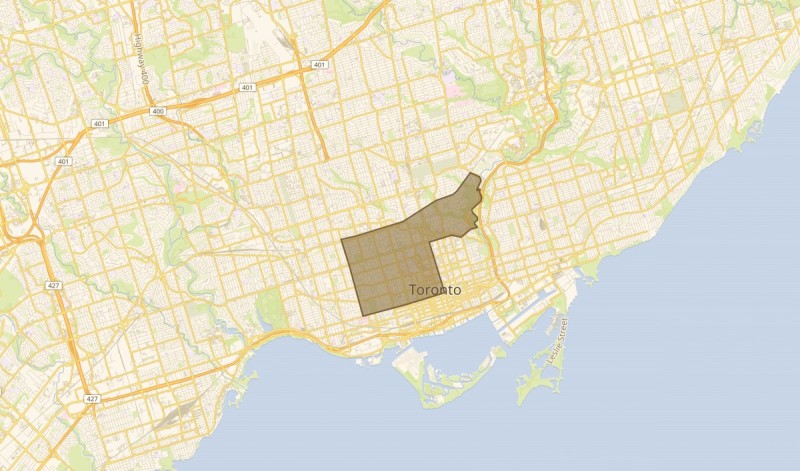
University—Rosedale riding boundaries from the 2025 federal election. Image from Wikimedia maps.
Last year, Mark Carney presented himself to Canadians as a seasoned, level-headed economist and an “elbows up” negotiator ready to confront the sovereignty threat posed by Donald Trump. He was rewarded with a strong minority government—and an unusually generous grace period from the public. Yet he has used that time to pivot sharply away from the image of the rounded economist, who promised a mild neoliberal blend of efficient government, sustainable finance, non-market housing, and union jobs, toward something far more familiar: the caricature of a Goldman Sachs lobbyist.
First, he purged moderate progressives like Nate Erskine-Smith and Karina Gould from cabinet, eliminated the minister of labour position for the first time in a century, scaled his commitment to non-market housing down to nearly nothing, and spoke of the “sacrifices” required from working Canadians while facilitating the “capital formation” of the rich. Then he wrecked his “honest talk” image, first by trying to peddle “decarbonized oil” and then by trying to pass off the Ksi Lisims LNG fracking project as Indigenous-owned when it is Indigenous-opposed, entirely owned and operated by Texas-based Western LNG, and backed by MAGA-supporting Blackstone (British Columbia Green Party leader Emily Lowan more aptly called it “elbows up for Epstein” given the project’s connections). He capped it off by scrapping taxes on the luxury yachts and private jets of the ultra-rich. He has not mentioned any agenda item to reduce Canada’s exorbitant wealth inequality—with the recent World Inequality Report estimating that the top one percent now owns over 29 percent of the nation’s wealth. And it is therefore not unreasonable to draw a comparison between “elbows up” Carney’s response to Trump’s invasion of Venezuela—likely a precursor to further territorial ambitions, from Greenland to deeper incursions across the hemisphere—and the logic of appeasement associated with Neville Chamberlain a few generations ago, if not its precise historical circumstances.
But so far the bar keeps lowering conveniently for Carney. The last election, aided by our first-past-the-post system, turned Canada into a two-party duopoly, and Carney’s supposed main adversary is a foaming-at-the-mouth McCarthyite in Pierre Poilievre. We have a race-to-the-bottom neoliberal politics fighting over fewer and fewer principles, with a well-sealed Overton window spanning from those who could get a job at Goldman Sachs and those who want one but aren’t qualified. Carney creeps towards a majority by consolidating the neoliberal consensus, recruiting Conservatives while shedding obligations to deliver benefits to working people.
And surely, winning the Liberal stronghold riding of University–Rosedale in Toronto will further cement this consensus. Nevertheless, the Liberals do have to win the riding again in a byelection now that former Deputy Prime Minister Chrystia Freeland has announced she will be stepping down as an MP to take a position as an economic advisor to Ukrainian President Volodymyr Zelensky. While flipping the seat is a longshot, Pierre Poilievre can attest that stranger things do happen.
Canadians should have a good look at the prospects for making a push for the NDP in University–Rosedale. First, there is the “Pascal’s wager” logic of the race: gunning for the NDP is a low-risk, high-reward proposition. In the unlikely case vote splitting causes the seat to flip Conservative, little of the federal picture changes. If the seat flips NDP, however, Canada’s dangerous consolidation into a right-wing two-party duopoly—so instrumental in producing the downward spiral of our neighbours to the south—is greatly stalled.
Then there is the benefit of broadening the policy conversation, specifically with a democratic left voice. Now it is true that voice is currently rather faint: the NDP are reduced to a paltry seven seats, have lacked clarity of vision since at least the Mulcair days, and won’t choose a party leader until March. It is also true the party has an internal cleavage over the status of Yves Engler as a candidate—though I suspect Engler would be in solidarity with an effort to take the riding. Nevertheless, it has become refreshingly clear—from both their candidates and their interim leader Don Davies—that the party is resisting the neoliberal temptation to follow others in an endless slide to the right and is instead seeking to retrench more coherently towards its social democratic roots. Candidates are putting forward bold, comprehensive proposals that would make Tommy Douglas proud: head-to-toe health care, federal jobs guarantees, the mass-production of cooperative and non-market housing, and free electrified public transit, among others. The NDP were right on Gaza, and both the interim leader and its candidates have correctly identified the invasion of Venezuela as the imperialist violation of international law that it is.
Lastly, and most speculatively—but nevertheless worth considering—there is the question of global preparedness. It is possible, for a variety of reasons, that we may see a global shift in political economy in the coming years. Most of those reasons, unfortunately, have to do with the need to rebuild after potential disasters: AI bubbles may burst, extreme weather events may intensify, and Trump’s imperialism now places us in astonishingly precarious times. Others, more optimistically, have to do with democratically elected governments changing the rules in favour of the working class, following the victories of Zohran Mamdani in New York and Katie Wilson in Seattle. We may yet find ourselves seeking to align with a more progressive global era, much as many did in the post-war years. In short, Canada should have wheels in motion for a world beyond neoliberalism, and bringing our social democratic party back into the conversation would strengthen that preparedness.
Most importantly, Carney should understand that his fight must be to win the working class. So far, he has not thought it necessary to prepare for that fight. For Canadians, replacing a Liberal stalwart with a New Democrat could hardly send a clearer warning shot.
Colin Bruce Anthes is an artist, educator, and democratic economy organizer. Colin has been artistic director of two theatre companies, taught in five post-secondary institutions across Canada, and founded Community Wealth Candidates in 2021. He has been a contributor to theAnalysis.news since 2022.