
Trump’s bloodsoaked ‘peace’

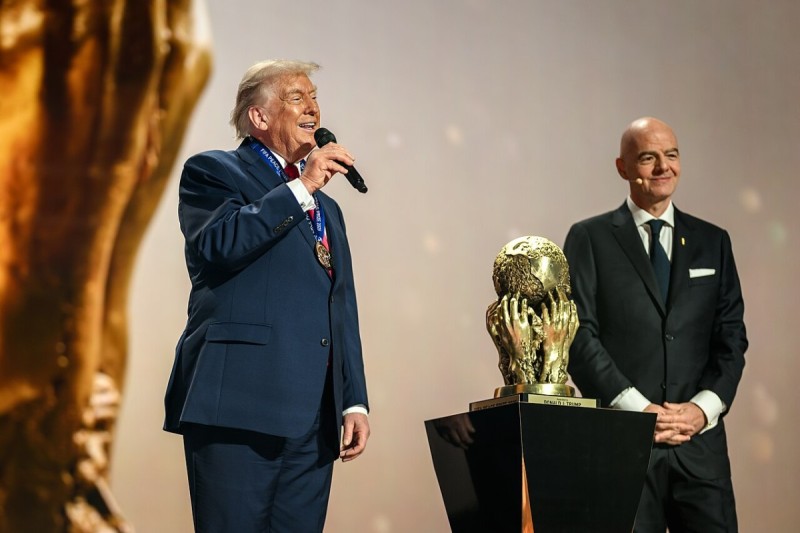
Donald Trump delivers remarks after accepting the inaugural FIFA Peace Prize from FIFA President Gianni Infantino, December 5, 2025, during the World Cup draw at the John F. Kennedy Center for the Performing Arts in Washington, DC. Photo by Daniel Torok/White House/Wikimedia Commons.

In recent months, Donald Trump has clearly demonstrated his great readiness to unleash state violence and, as a sitting US president, he has an enormous capacity to do just that. On the face of it, it would seem unlikely that the Trump name would in any way be associated with the pursuit of peace but, strangely enough, he cherishes the idea, to an almost obsessive degree, that he may be remembered in such terms.
The dust has barely settled on Trump’s assault on Venezuela, which was an unassailably violent affair. According to CNBC, “[s]pecial operations forces from multiple service branches and more than 150 military aircraft” were involved in the attack. Venezuelan Interior Minister Diosdado Cabello reported that over 100 people were killed by the display of US power.
This intervention involved the forcible abduction of President Nicolás Maduro and his wife, Cilia Flores, who is also a major political figure in Venezuela. It was preceded by a series of extrajudicial killings and the Trump administration is quite clear that further attacks will be mounted if the Venezuelan authorities don’t accept US control of the country’s oil industry and comply with other demands. Al Jazeera reports that Trump is keeping US ships at the ready for another assault in order to emphasize the need for submission.
At the same time, it is very clear that the Venezuelan operation was not some uncharacteristic outburst on Trump’s part. Politico informs us that he has also threatened aggressive action against Cuba, Colombia, and Mexico and that “the threats of military force against—and the broadly more muscular posture towards—Latin America speak to how the administration is prioritizing the region and willing to use all the tools at its disposal to achieve its aims close to home.”
Bloody track record
A violent application of an updated Monroe Doctrine is undeniably underway, and Trump’s commitment to peace in other parts of the globe is also highly questionable. The ceasefire he boasts of in Gaza has involved a great deal of bloodshed since it went into effect. Al Jazeera reports that “Israel violated the ceasefire agreement at least 969 times from October 10 to December 28, through the continuation of attacks by air, artillery and direct shootings.”
With horrible irony, a recent Associated Press article was headlined “Israeli strikes kill at least 13 across Gaza, as Trump is expected to announce Board of Peace.” This formation, which Trump himself will chair, is a classic example of colonial trusteeship that will exclude the Palestinians and further their dispossession. As Progressive International explains, it “would place Palestinian land and labour under the control of foreign investors—from Wall Street to Silicon Valley to no doubt the real estate empire of the Trump dynasty—without a single Palestinian voice in the process.” This speaks volumes to the particular brand of ‘peace’ that Trump is peddling.
Despite the continuing genocide in Gaza and the ongoing dispossession of its inhabitants, Trump emerged from a late December meeting with Israeli Prime Minister Benjamin Netanyahu ready to declare that “Israel has been doing its part in the Gaza ceasefire” and to lay the blame entirely on the Palestinian resistance, calling on Hamas to disarm. He also took the opportunity to suggest that US support and involvement in another Israeli attack on Iran was highly likely.
Trump’s peace-loving credentials are further undermined by the fact that his Department of Defense has been renamed the Department of War. Fully in keeping with the ugly spirit of that initiative, “the US [has] carried out—or been a partner to—622 overseas bombings in all, using drones or aircraft, since January 20, 2025, when Trump took office.” This involved attacks on seven countries during 2025.
Despite this bloody track record, Trump has gone to great lengths to present himself as an accomplished peace broker but his loud claims have not gone unchallenged. Time comments rather bitingly that “[e]ven as a cease-fire between Thailand and Cambodia brokered by President Donald Trump earlier this year is falling apart, the self-styled ‘President of Peace’ has continued to tout his ability to resolve global conflicts.”
The Time article also argues that Trump’s “transactional” approach to conflict resolution is clumsy and questionable. He “has been able to broker several deals that led to pauses in violence in the short-term. But his unilateral approach to achieving them—at times bypassing multilateral institutions and enforcement mechanisms—also makes the long-term outcomes uncertain.”
If Trump’s dedication to the cause of peace is worse than dubious, there is no doubting the strength of his desire to be viewed in that light. He fervently hoped for a Nobel Peace Prize and, when this failed to materialize, he gleefully accepted the preposterous and hastily generated “FIFA Peace Prize.” This was handed to him, in an effort to stroke his vanity, at the 2026 World Cup draw in Washington, DC.
So well-known is Trump’s craving for peace honours that María Corina Machado, the right-wing Venezuelan oppositionist who received the Nobel Peace Prize this time around, is actually offering to turn her medal over to Trump. NBC News reports that he insists that his decision to freeze her out of any leadership role, following the US attack on Venezuela, has nothing to do with her taking the prize instead of him. Nonetheless, she has hopes that her fortunes as a puppet of Washington may be enhanced by such a grovelling gesture of submission.
Fake peace
Trump’s self-aggrandizement and absurd pretensions aside, the question arises of how someone with such a record of death and destruction can seriously claim to be a dove of peace. In this regard, it is striking that Trump is hardly the first war criminal to covet or receive such honours. In 2009, Howard Zinn commented that “I was dismayed when I heard Barack Obama was given the Nobel Peace Prize. A shock, really, to think that a president carrying on two wars would be given a peace prize. Until I recalled that Woodrow Wilson, Theodore Roosevelt, and Henry Kissinger had all received Nobel Peace Prizes.”
If mass murderers and those who direct military aggression on a devastating scale are held up as champions of peace, it starts to become clear that this concept has been seriously distorted. The term ‘peace’ has been applied in a very particular way within capitalist societies that has nothing to do with the right of people to live lives that are free from the threat of violence. In fact, the exact opposite is the case and this fake notion of peace has a very long and particular history that predates Trump by several centuries.
In Anglo-Saxon England, the system of public order that the ruling establishment maintained was referred to as the King’s Peace. It wasn’t at all focused on the well-being of the mass of people but was devoted to an enforced stability in which the powerful and propertied could thrive at their expense.
By the 1500s, under the Tudor monarchs, as the process of driving the peasants off of their land holdings intensified and the creation of a modern workforce that was suited to the needs of capitalism advanced, this concept of a ‘peaceful’ and exploitative form of public order was taken further.
As the clearing of the land increased the levels of destitution and desperation, brutal repressive measures were employed to preserve social stability. As the Renaissance English History podcast explains, “[p]unishments were harsh. To set an example, even for small infractions, there was vagrancy, which was considered both a social problem as well as a crime.” Laws like the Vagabonds Act of 1531 made it illegal to be homeless or unemployed with offenders, whipped or branded.”
The selective notion of ‘peace’ imposed by the English Tudor authorities has proven to be remarkably durable and sets its stamp on modern capitalist societies. As the police clear a path for the scabs that cross a union picket line, they will maintain that they are only there to ‘keep the peace.’ Anyone who tries to stop them might be charged with “disturbing the peace” and be brought before a “justice of the peace” who will set bail conditions that include an obligation to “keep the peace and be of good behaviour.” This ‘peace’ of theirs is obviously ready to tolerate a great deal of inequality and injustice.
It becomes clear that Trump’s fake peace has a long history that has consistently served the interests of exploiters and oppressors. For them, it means the preservation of their wealth and power but, for the rest of us, it demands submission on pain of consequences that are far from peaceful.
The Trump administration’s National Security Strategy is a chilling document that maps out a plan for naked and brutal imperialism, especially in Latin America and the Caribbean. Yet, it confidently asserts that “President Trump has cemented his legacy as The President of Peace.” A very important point of qualification is included here, however.
The actual objective being pursued by the Trump gang is described as “peace through strength” because “[s]trength is the best deterrent” and this unsurprisingly requires “the world’s most capable military.” Since the Korean War, people all across the world have experienced the death and destruction that “peace through strength” keeps in reserve and unleashes when it feels it needs to. Trump is utterly devoted to this blood-soaked approach to international dealings.
Clearly the kind of peace that Trump deals in is a lie and an exercise in coercive brutality. A ‘peace’ that serves the interests of exploitation and injustice needs to be disturbed and, indeed, shattered. The famous and celebrated proposition that without justice there can be no peace has never been more relevant than it is at this terrible and dangerous moment.
John Clarke is a writer and retired organizer for the Ontario Coalition Against Poverty (OCAP). Follow his tweets at @JohnOCAP and blog at johnclarkeblog.com.