
Canada’s muted response to US regime change in Venezuela undermines international law

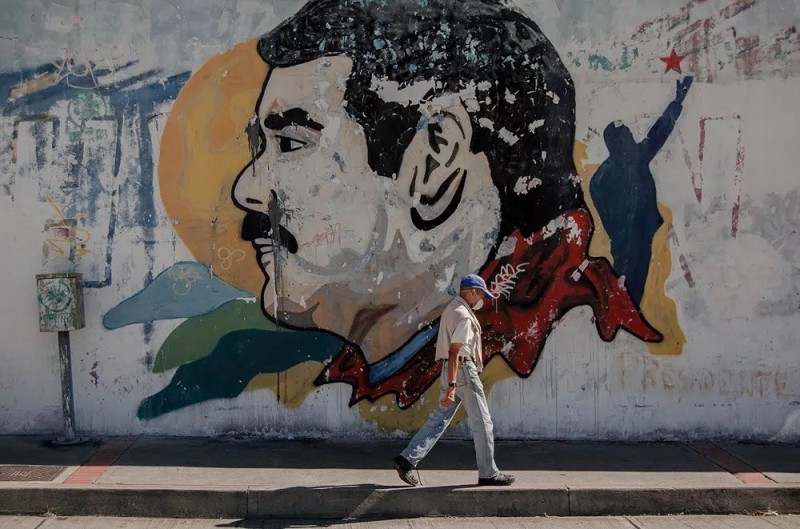
Street painting of Nicolás Maduro in Caracas. Photo courtesy Orinoco Tribune.
Following last week’s American military operation in Venezuela that captured President Nicolás Maduro, Canada’s political parties offered a spectrum of responses.
At one end, interim NDP leader Don Davies said, “The U.S. attack on Venezuela is neither an act of self-defence nor does it have UN Security Council authorization. It is therefore totally illegal and a breach of the UN covenants the U.S. has agreed to uphold as a member state.”
Bloc Québécois leader Yves-François Blanchet acknowledged US complaints against Maduro but said it was “troubling” that Washington was “risking violation of international law, particularly by resorting to military force at the peril of civilian lives and by detaining a head of state, even an illegitimate one.” Blanchet called on the United States to “respect the sovereignty of states” and to work through the United Nations.
The Green Party “strongly condemn[ed]… the kidnapping of Nicolás Maduro” and denounced the operation “as a flagrant violation of the Charter of the United Nations and the fundamental principles of national sovereignty.”
At the other end of the spectrum, Conservative leader Pierre Poilievre offered “congratulations to President Trump on successfully arresting narco-terrorist and socialist dictator Nicolás Maduro.” He then added, “Down with socialism,” strangely politicizing the operation while also acknowledging—however inadvertently—a long-standing truth about US regime-change politics that others preferred to ignore.
The most important statement, however, was the one issued by the Government of Canada. Prime Minister Mark Carney criticized not the US, but Maduro’s “brutally oppressive and criminal regime,” and “unequivocally condemn[ed]” not America’s breach of international law, but Maduro’s alleged “grave breaches of international peace and security.” He responded to Washington’s military operation by “welcom[ing] the opportunity for freedom, democracy, peace, and prosperity for the Venezuelan people,” before calling “on all parties to respect international law.” Carney offered no criticism of the American action. Indeed, his statement did not mention the US at all.
Even after it became clear that the US intended not merely to arrest Maduro but to “run the country,” Canada continued to criticize the Venezuelan government while refraining from criticizing Washington. On January 6, Foreign Affairs Minister Anita Anand condemned Maduro for stealing the 2018 election and destroying the Venezuelan economy. Both claims are incomplete.
While Canada has a right to raise questions about Venezuela’s most recent election, it is irresponsible to declare the 2018 vote “stolen.” The case against that election rests largely on low voter turnout and the absence of a legitimate alternative candidate. But turnout was low because the radical opposition—at the request of the US—called on its supporters to boycott the election. And the leading opposition candidate, Henri Falcón, was, according to polls, tied as the most popular opposition figure. Maduro defeated Falcón by 6,245,862 votes to 1,927,387. No serious observer disputes that this was the result.
It is also irresponsible and misleading to place sole responsibility for Venezuela’s economic collapse on Maduro. US sanctions played a decisive role, cutting Venezuela off from the international financial system and reducing oil production by roughly 75 percent. Those sanctions contributed to what economists have described as the “worst depression, without a war, in world history,” and to tens of thousands of deaths.
By the time it was public record that the US intended not merely to arrest Maduro but to administer Venezuela for an extended period—abandoning any pretence that the operation was a narrow law-enforcement action carried out by the Department of War in support of the Department of Justice—Anand still refrained from criticizing Washington. Instead, she posted that she had “heard from Secretary Rubio on the importance of freeing political prisoners, putting in place conditions for a functioning democracy, and planning for elections with a legitimate president chosen by the Venezuelan people in the future.”
Canada’s diluted response to the US military operation in Venezuela is harmful to Canadian interests for three reasons.
First, Canada is a member of an international community governed by an architecture of international law whose foundation is the United Nations. Canada has long prided itself on being in the vanguard of that order. Yet none of the government’s statements raised concern about possible US violations of the UN Charter.
Second, Canada’s position is hypocritical and actively erodes international law. At its core, international law is a codified system grounded in the UN and meant to apply universally and impartially. Canada has not applied it in that way.
The Government of Canada has repeatedly stated that “Canada remains steadfast in its support for Ukraine’s sovereignty and territorial integrity in the face of Russia’s illegal and unjustifiable war.” Ottawa has been unequivocal in describing Russia’s invasion as “illegal” and as a “violation of Ukraine’s sovereignty and territorial integrity, and an attack against freedom, democracy, and international law, including the United Nations Charter.” Carney himself has said, “Canada stands with Ukraine, because their cause—freedom, democracy, sovereignty—is our cause.”
Canada has refused to make comparable statements about Venezuela’s sovereignty and territorial integrity.
When the Trump administration made clear that it was the “formal position” of the US that “Greenland should be part of the United States,” Carney quickly affirmed Canada’s support for Denmark and Greenland, citing “basic principles… [of] self-determination of nations, sovereignty, [and] territorial integrity.”
He has not clarified that those same basic principles apply to Venezuela. By refusing to apply international law universally and impartially, Canada has contributed to its erosion.
Finally, Canada’s response to the US military operation in Venezuela harms not only international law and global stability, but Canada’s own interests. At a moment when Canada’s sovereignty has itself been repeatedly threatened by the Trump administration, it is not in Canada’s interest to set a precedent—or send a message to other states—that international law prohibiting violations of sovereignty and territorial integrity is optional, selective, or contingent on political convenience.
If Canada wants international law to protect its own sovereignty, it must defend that law everywhere—or risk losing it altogether.
Ted Snider is a regular columnist on US foreign policy and history, including at Responsible Statecraft. To support his work or for media or virtual presentation requests, contact him at [email protected].