
Canada’s new resource deals drive a climate and rights backslide

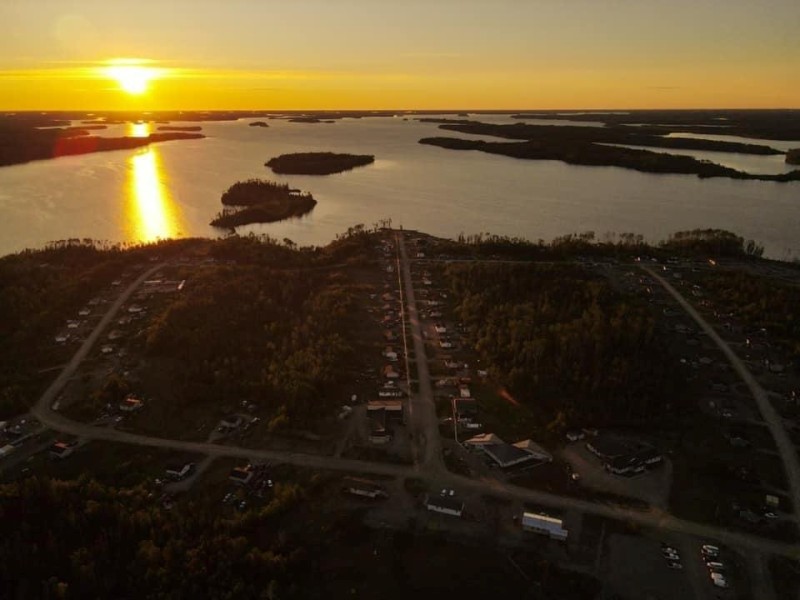
Neskantaga First Nation is a remote northern Ontario community facing mounting development pressure from the Ring of Fire, a mineral-rich region targeted for mining and new road construction. Photo courtesy Neskantaga First Nation/Facebook.
The Government of Canada has recently negotiated agreements with Ontario and Alberta to streamline regulatory processes for ‘critical’ mineral mining and pipeline development. These agreements raise profound concerns about Indigenous rights, democratic governance, and climate responsibilities.
While the agreements are framed as pragmatic responses to investment uncertainty and vehicles for economic stability, their central commitments—to accelerate regulatory pathways for new mines and pipelines—threaten to erode constitutionally protected Indigenous rights and silence communities who have already borne the costs of extractive industries.
Compounding these trends is the federal push to overhaul how major infrastructure and resource projects are approved through legislation like Bill C-5—the One Canadian Economy Act and its Building Canada Act provisions—which aims to designate certain projects as in the “national interest” and expedite them through a new Major Projects Office.
Supporters argue that faster timelines are needed to attract investment and counter external economic pressures. But this fast-track framework concentrates sweeping powers in cabinet, allows projects to proceed with minimal oversight, and risks sidelining meaningful environmental review and robust Indigenous consultation.
Trading climate commitments for pipeline expansion
On November 27, Canada and Alberta signed a memorandum of understanding (MOU), committing the Government of Canada to work with Alberta to “streamline” regulatory processes for an oil pipeline to the coast of northern British Columbia. It also commits the federal government to “adjust” legislation prohibiting oil tanker traffic on the northern BC coast.
In exchange for these federal obligations to help expand tar sands extraction, Alberta committed to support the construction of a massive carbon capture and storage project, increase the carbon tax on industry, and enrol Indigenous groups as co-owners of the new oil pipeline. The agreement was quickly denounced by First Nation leaders across Canada.
Coastal First Nations responded by reiterating their opposition to tanker traffic in the region. In a media release, Marilyn Slett, president of the Coastal First Nations-Great Bear Initiative said, “we will never allow oil tankers on our coast… this pipeline project will never happen.”
The British Columbia Assembly of First Nations issued a statement denouncing the MOU:
The [agreement] between the federal government and the Province of Alberta exposes a fundamental contradiction and ongoing disregard for the rights, laws and sovereignty of First Nations on whose territories the proposed bitumen pipeline is proposed to be built. Canada’s words of commitment to reconciliation and climate action are weakened and deceptive as they make plans to prioritize a project that poses profound risks to First Nations’ lands, waters, and communities, risks that many First Nations strongly oppose.
Treaty 8 First Nations similarly rejected the MOU and called for its withdrawal. “We have formally notified the prime minister that any further attempt by Canada, Alberta, or industry to move ahead without us will result in immediate action,” Grand Chief Trevor Mercredi told the press.
The Assembly of First Nations subsequently passed resolutions calling for the MOU to be withdrawn and opposing oil tanker traffic in northern British Columbia.
An oil tanker sits in the waters at the Westridge Marine Terminal in Burnaby. Coastal First Nations are reiterating their opposition to tanker traffic in the region. Photo by Orin Blomberg.
Fast-tracking mining approvals in Ontario
On December 18, Ontario and Canada announced a cooperation agreement on environmental and impact assessment, which commits both governments to remove regulatory “duplication.” Canada agreed to defer to Ontario’s environmental assessment process for proposed projects that are primarily provincially regulated. This will reduce the role of the federal government in environmental assessment of new mining projects, as the Government of Canada will rely on Ontario’s system to address issues under federal jurisdiction.
In a press release announcing the agreement, the Ontario government suggested that the agreement would “unlock” the development potential of the Ring of Fire, a vast mineral-rich region in northern Ontario’s James Bay Lowlands that is being targeted for large-scale nickel, chromite, and other “critical” mineral extraction.
While removing so-called duplication may speed-up approvals for mining projects, it also effectively reduces opportunities for consultation with the public and mining-affected First Nations. As Ontario Regional Chief Abram Benedict explained:
This agreement prioritizes streamlining approvals while sidelining First Nations’ inherent jurisdiction and weakening the duty to consult. Governments cannot decide when consultation and accommodation are ‘appropriate.’ These legal obligations are owed to rights holders from the outset.
The Ontario-Canada agreement comes on the heels of a cease-and-desist letter from Neskantaga First Nation, demanding a halt to mineral exploration in the Ring of Fire.
In late October, Neskantaga requested a federal environmental assessment of the proposed Eagle’s Nest mine, the most advanced project in the Ring of Fire. In a letter to the Impact Assessment Agency of Canada, Neskantaga Chief Gary Quisses wrote:
[T]he proposed mine is likely to cause severe adverse effects in areas of federal jurisdiction, particularly on Indigenous peoples including our First Nation, fish and fish habitat, as well as migratory birds. Further, cumulative impacts from induced development caused by the approval of Eagle’s Nest, the most advanced mining project in the Ring of Fire, are also likely to be adverse, severe, and irreversible, including on the rights of Indigenous peoples, and Canada’s ability to meet its international climate change mitigation commitments.
While the Impact Assessment Agency has yet to publicly respond to Neskantaga’s letter, the Ontario-Canada agreement suggests that there will be no federal assessment of the Eagle’s Nest mine.
In fact, the project may proceed without any rigorous environmental assessment at all. Bill 5, the Protecting Ontario by Unleashing Our Economy Act, allows the provincial government to establish “special economic zones” exempt from existing laws and regulations.
The Ford government has repeatedly indicated its intention to use the legislation to “fast-track” mining in the Ring of Fire. This would allow the government to bypass or seriously reduce some of the typical environmental assessment processes.
Schedule 3 of Bill 5 also removed provincial environmental assessment requirements for the Eagle’s Nest project.
The Ontario-Canada agreement raises questions about the future of an ongoing federal regional assessment in the Ring of Fire area. The assessment, which is co-led with 15 affected First Nations, would examine the cumulative effects of multiple potential road and mining projects in the region.
After years of negotiation, terms of reference for the assessment were issued in 2025. While the Ontario-Canada agreement makes no reference to the ongoing regional assessment, the commitment to avoid duplication in the spirit of regulatory streamlining suggests that it could be sidelined.
Mineral extraction in the Ring of Fire is framed as essential to the energy transition, but development there risks destroying peatlands and releasing vast amounts of stored carbon into the atmosphere. Photo by Michael Oldham.
A step backwards for climate action and Indigenous rights
Both federal–provincial agreements mark a step backward for climate action. The climate consequences of expanding tar sands production are obvious. And while critical mineral extraction in the Ring of Fire is often presented as integral to energy transitions and climate mitigation, in reality the destruction of boreal peatlands is likely to release huge amounts of stored carbon into the atmosphere.
Indigenous rights in Canada are enshrined in Section 35 of the Constitution, which affirms existing Aboriginal and treaty rights. The Supreme Court has repeatedly upheld the Crown’s duty to consult and accommodate Indigenous peoples when development projects may affect those rights. In landmark decisions such as Haida Nation v. British Columbia (2004), the court emphasized that consultation must be meaningful and conducted in good faith.
These agreements move in the opposite direction. First Nations were excluded from their negotiation, despite the fact that both will have significant implications for how First Nations are consulted on major projects going forward. The commitment to reducing regulatory barriers risks treating consultation as a procedural box-checking exercise rather than a constitutional obligation. Compressing timelines, constraining environmental assessments, and shifting risk onto Indigenous communities undermines the principles of reconciliation and contradicts Canada’s stated commitment to uphold the United Nations Declaration on the Rights of Indigenous Peoples (UNDRIP).
UNDRIP’s framework of free, prior, and informed consent requires that Indigenous communities meaningfully participate in, and consent to, decisions affecting their lands. Decision-making processes must be collaborative and grounded in respect for Indigenous laws and jurisdiction. Agreements designed primarily to expedite mining and fossil fuel infrastructure makes that kind of engagement structurally impossible.
Indigenous nations have clearly expressed concern over the government’s orientation to prioritize resource extraction over their rights, lands, and environmental well-being. Mines and pipelines carry substantial risks—spills, tailings breaches, cumulative habitat destruction, and long-term climate impacts that disproportionately affect Indigenous communities. By preemptively committing to faster approvals, these agreements signal a willingness to sacrifice Indigenous relations and environmental protection for short-term political and economic gain.
Recent history illustrates the consequences of such an approach. When governments attempt to push projects through without adequate consultation, they invite conflict, legal challenges, and public unrest. Court battles over procedural failures can delay projects by years, ultimately costing more—financially and politically—than engaging Indigenous nations as genuine partners from the outset. Indeed, the first attempt to build a tar sands pipeline to the northern Pacific Coast, the Enbridge Northern Gateway, ultimately failed because the courts overturned regulatory approvals due to rushed consultation processes.
Proponents of the agreements argue that creating a more “predictable investment climate” is essential for economic resilience. But doubling down on economically volatile and environmentally destructive sectors, while weakening Indigenous decision-making, sets a dangerous precedent. It locks the country into a dependency on oil that has too long constrained our political imagination, even as global markets shift toward decarbonization.
Neskantaga First Nation is a remote fly-in community and part of northern Ontario’s mineral-rich Ring of Fire region. Photo courtesy Matawa First Nations/Flickr.
Towards a just transition
Indigenous nations have demonstrated leadership in renewable energy initiatives, conservation strategies, and community-driven economic development. A sustainable future will require building these partnerships—not sidelining them. Rather than accelerating approvals, Canada could support Indigenous-led land-use planning and regional assessments, expand investment in renewable projects, and engage in long-term economic diversification that aligns with global climate realities.
These agreements represent a choice: to remain on a path defined by extraction, polarization, and constitutional risk, or to imagine an economic future grounded in partnership, democratic accountability, and environmental responsibility. After all, the social and ecological costs of extractive dependency are becoming increasingly undeniable.
A more sustainable path forward begins with genuine engagement, respect for Indigenous peoples, and a commitment to shared governance. A just future cannot be built through rushed agreements that ignore Indigenous rights. It must be built with Indigenous nations in a spirit of collective stewardship.
Tyler McCreary is an Associate Professor of Geography at Florida State University and author of Indigenous Legalities, Pipeline Viscosities (University of Alberta Press, 2024).
Warren Bernauer is an Assistant Professor of Environment & Geography at the University of Manitoba and Canada Research Chair in Energy Transitions and Social Justice in the North.