
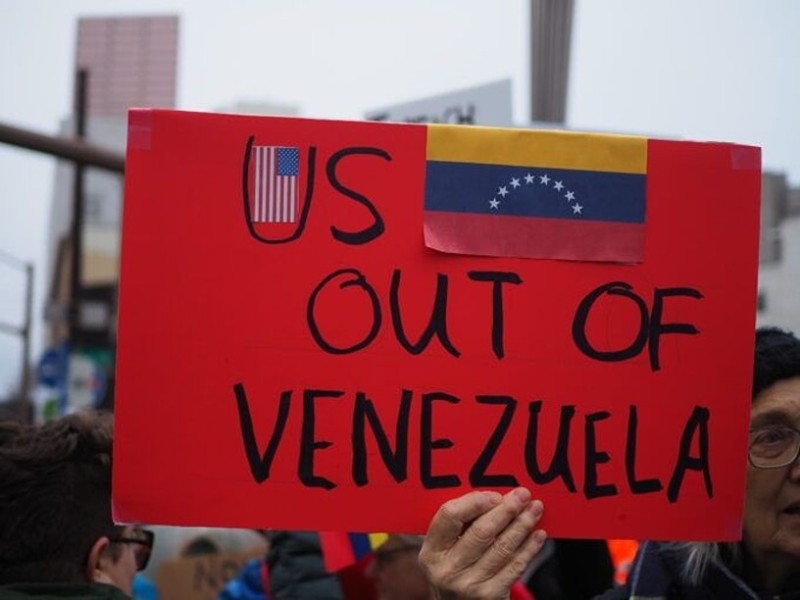
Venezuela against the empire

Photo by Nathaniel St. Clair
The United States is descending into a state of general lawlessness, both at home and abroad. From deploying domestic paramilitary units like Immigration and Customs Enforcement (ICE) to snatch people off American streets and send them abroad, the government has now sent secret military special operations forces, including Delta Force, to abduct foreign heads of state from their homes and imprison them on US soil. Political human trafficking has become the law of the land under the Trump administration.
Before 2025, the two major parties engaged in a crescendo of lawfare against each other, employing the FBI, courts, and even the CIA behind the scenes to destroy opponents. Both routinely abused the rule of law, pardoning family members, wealthy friends, and business associates to protect themselves and personal connections. This rendered a travesty of the fiction that no one in America is above the law. Senior politicians enriched themselves, often becoming multi-millionaires after leaving office through special deals arranged while in power.
The recent invasion of Venezuela represents a gross violation of international law—a hypocritical disregard for sovereign boundaries that neoconservative ideologues and the echo chamber of captured US media have relentlessly levelled at Russia in Ukraine over the past four years.
Trump himself has publicly admitted that the operation was intended to secure American control over Venezuela’s natural resources, particularly its oil reserves. In other words: naked, old-fashioned imperialism aimed at plundering another nation’s wealth.
The pretext was the usual nonsense—charges of narco drug trafficking. This is the neocons’ substitute for “weapons of mass destruction,” previously used in Iraq, Syria, and Libya to justify military intervention. This accusation would not have worked against Venezuela, nor would older pretexts like Remember the Maine, the Tonkin Gulf incident, or “killing incubator babies.” The hawks needed a fresh false excuse, and from their magic bag of false flags and fake rationales, they pulled out “narco drug trafficking.” It fits Latin American interventions better, as Panama’s former President Manuel Noriega discovered in 1989.
Colombian President Gustavo Petro, who defended Venezuela’s sovereignty and criticized Trump’s aggression, should take note. And Mexican President Claudia Sheinbaum, beware: you could be next. Ditto Cuba.
Does Greenland have a president Trump can threaten? Perhaps the excuse will be that Chinese ships are melting the ice cap.
Make no mistake: Trump is not only waging naked military aggression to enact regime change. His bluster revealed that the US plans to install a new form of colonialism. Within 24 hours, he declared publicly that Washington intends to “rule” Venezuela directly until a compliant puppet regime is installed. Direct rule constitutes colonial imperialism.
As the saying goes, truth often emerges from the mouth of a drunkard. Trump, a braggart drunk with power, has spoken what the neoconservative imperial elite behind him are really planning.
In an attempt to spin Trump’s blunt admission, cronies like Marco Rubio rushed to the media to try to put lipstick on the “US will rule” pig, insisting there were no such plans.
Another neocon, Mike Walz, former national security advisor to Trump and now ambassador to the United Nations, claimed in an emergency speech that the kidnapping of Venezuelan President Nicolás Maduro was not about colonial rule—or even a military operation. According to Walz, it was merely a “police operation”—accompanied by 17 warships, aircraft carriers, submarines, and 10,000 marines stationed on nearby Trinidad.
Rubio added that the US only wants Maduro to stand trial in New York, conveniently omitting the ongoing naval blockade of Venezuelan shipping. No further military plans, he insisted. Really? Anyone want to buy a bridge from him?
This is raw gunboat imperialism, reminiscent of the early-20th century, when the US invaded Latin American countries by the dozens. It also foreshadows plans to impose a new form of colonialism on Venezuela—and perhaps other nations that dare pursue an independent path from Washington.
Trump and his allies will try to disguise these plans through externally-managed elections this spring, whose outcome is already predetermined. The US-designated candidate, Maria Corina Machado, is packing her bags for Caracas, likely accompanied by US agents during the forthcoming sham campaign.
Imperialism in Venezuela has been a US objective for a quarter-century, just as it has been in Iran for nearly 50 years and Cuba for 65. In 2002, the Bush administration attempted to depose Venezuelan President Hugo Chávez after he nationalized American oil interests—an unforgivable capitalist sin. Chávez was rescued and reinstated by the Venezuelan people and armed forces.
Under Barack Obama, the CIA continued supporting opposition movements financially, aiming to overturn Venezuelan elections. Despite the US launching an economic war—wrecking currency, stoking inflation, blocking oil exports, and impeding medical and food imports—left-wing candidates kept winning.
During Trump’s 2018–2019 term, American efforts intensified: Venezuelan gold in Western banks and Citgo, the US-based oil company, were seized and handed to opposition movements. Still, no electoral success. Operations paused temporarily during the COVID recession and the chaotic US exit from Afghanistan, as Washington turned its attention to engineering a proxy war in Ukraine.
When Trump returned to office in January 2025, regime change in Venezuela moved to the forefront of US foreign policy. This time, the empire intended to act decisively—not merely via electoral interference but with special ops interventions and direct military action. The emperor removed his clothes and waded in—perhaps over his head, as time will tell.
One must see the bigger picture. Venezuela is not a standalone operation. Colombia, Mexico, and Cuba will recognize this. The invasion is part of a broader strategy to reclaim the Western Hemisphere, neglected while Washington was preoccupied in the Middle East and Eastern Europe. While attention was diverted, other powers quietly expanded in Latin America—most notably China.
Over the past decade, China invested heavily in Latin America through its Belt and Road Initiative, acquiring ports in Panama, constructing a massive EV plant in Mexico, developing ports in Ecuador and Peru, planning a trans-Amazon railway, striking a trade deal with Venezuela worth over $100 billion, and buying significant quantities of Venezuelan oil.
Washington wants that oil. With 13 million barrels daily of domestic production, US fracking wells are projected to decline within a decade. The US also needs additional oil for European allies, displaced by Russian sanctions. Venezuela is next door.
The Trump administration has refocused on the Western Hemisphere to restore economic hegemony and drive China—and its investments—out of Latin America, especially Venezuela. In the first year of Trump’s term, Mexico faced threats of drones and special ops, prompting cancellation of its China EV deal. Panama faced 1989-style threats, leading to cancelled Chinese projects and US private equity taking over ports. Ecuador, Peru, Argentina, Chile, Bolivia, Brazil, and Venezuela all faced various pressures, including military threats, economic coercion, and political interference. The Delta Force abduction of Maduro and his wife is just the latest tactic. Stand by—there’s more to come.
Trump’s lawless actions are only beginning. Greenland may soon be next, with the goal of preventing Chinese and Russian Arctic shipping access to the Atlantic. US threats and bullying of Canada are part of a broader Arctic strategy, compelling Ottawa to develop its military presence alongside installations in Greenland and Alaska, with Canada footing part of the bill.
Trump’s strategic refocus—from Europe and NATO to the Western Hemisphere and Western Pacific—is outlined in the Trump administration’s National Security Strategy. It is explicit: the empire is restructuring.
The deeper reason for this shift is the staggering cost of maintaining the global empire as previously structured. US defence spending alone exceeds $2.1 trillion annually when all hidden and indirect costs are included, with a national debt of $38 trillion and annual deficits of $1.5 trillion.
The empire can no longer sustain the old structure. Consolidation to the Western Hemisphere and Pacific Basin is a fiscal and strategic necessity.
That context explains current events in Venezuela and what is yet to come throughout the hemisphere, as the US resorts to direct military action to reassert control and unchallenged hegemony in its backyard once again.
Dr. Jack Rasmus is the author of several books on the United States and the global economy, including The Scourge of Neoliberalism: US Economic Policy from Reagan to Trump (2020), Systemic Fragility in the Global Economy (2016), and The Twilight of American Imperialism (forthcoming later this year form Clarity Press). He is a host for the radio show Alternative Visions on the Progressive Radio Network, a journalist, a playwright, and a former professor of economics at St. Mary’s College (retired). He worked for 20 years for various tech start-ups and global companies, prior to which he served for 15 years as an organizer and local union president with several American unions.
This article originally appeared on ZNetwork.