
A warning about civil liberties on Canadian university campuses

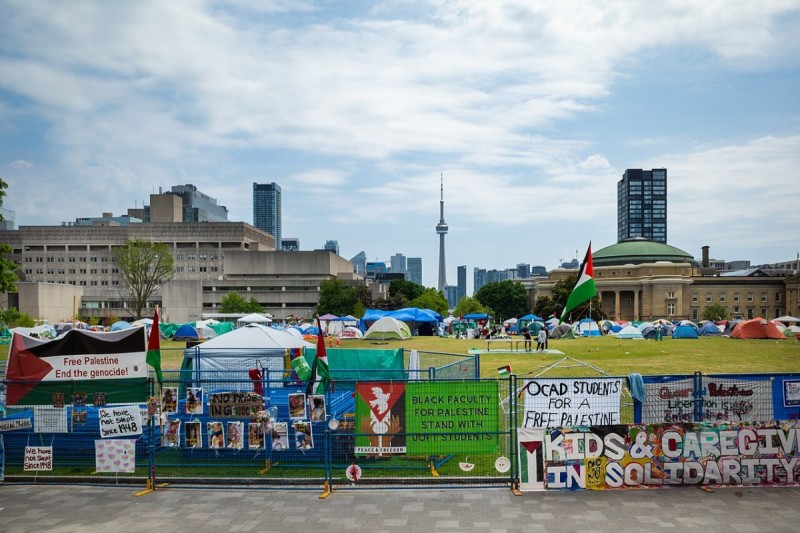
University of Toronto pro-Palestinian encampment, May 20, 2024. Photo by Maksim Sokolov/Wikimedia commons.
Canadian universities are rapidly becoming sites of repression rather than debate. Across the country, students protesting Israel’s assault on Gaza are facing suspensions, bans, police violence, and sweeping restrictions on speech and assembly—often imposed before any investigation has taken place. What is unfolding on campuses is not a series of isolated incidents, but a coordinated erosion of civil liberties that demands immediate public attention.
These patterns are readily visible in how universities have responded to pro-Palestinian students and organizers. McMaster University suspended a student group, Students for Palestinian Human Rights, for disrupting a board meeting, then banned three students from campus activities prior to their investigation concerning a pro-Palestine protest. At the University of British Columbia, the RCMP and campus security guards destroyed a sukkah erected by pro-Palestinian Jewish students, who sat praying in the rain.
This climate has also resulted in physical violence against students. At York University, one student was stabbed by a member of an extremist Zionist vigilante group. At two events involving Toronto Metropolitan University students, security guards used physical violence against protesters. In another, students were violently assaulted by an Israeli soldier who was hosted by a student group off-campus. This incident was followed by police arrests of five of the assaulted students.
This backlash has unfolded quietly but persistently. A recent article in Briarpatch surveyed protest policies at 17 universities with pro-Palestinian encampments. It found that nearly all campuses “either introduced or reinforced restrictions on the type or location of campus protests.” Many policies were so vague as to make these restrictions completely arbitrary. Other examples include Western University, which tried to implement a “no demo without permission” policy that was repealed. At the University of Toronto, “affixing signs, posters, or flyers (including the use of chalk, marker, paint, and projections) outside designated areas” has been designated as a form of vandalism. Most recently, faculty and students at Carleton University have been vigorously opposing an “Institutional Impartiality Policy” that bans departments and student groups from making public statements on political or social issues.
Universities did not stop at protest policies but also instituted new rules around events held on campus, supposedly the very purpose of the university itself—the exchange of ideas. McGill relocated an event hosting United Nations Special Rapporteur for the occupied Palestinian territories, Francesca Albanese, in November 2024. Then, in response to calls by community groups to cancel an event with an Israeli influencer, the university suspended all extracurricular events on campus until January 2026. In September of last year, Wilfrid Laurier University abruptly cancelled the room booking for a talk on Canada and the genocide in Gaza, citing security concerns. More recently the University of Guelph capitulated to pressure to cancel a sold-out conference on Palestine (it was successfully rescheduled elsewhere).
In all of these cases, basic rights are being violated. The presence of vigilante security forces and aggressive policing on university campuses is part of a broader move towards eroding free speech and restraining free expression in Canada. The growing number of incidents suggests, alarmingly, that civil liberties in Canada are only relatively protected compared to what we are currently witnessing in the United States. These acts of repression are the inevitable result of a campus landscape that criminalizes Palestinians and their allies as “terrorists” and “terrorist sympathizers,” and contributes to a rising spectre of authoritarianism.
These campus-level decisions do not exist in isolation. They are reinforced by provincial and federal policy shifts that further constrain dissent.
At the provincial and municipal levels, restrictions on civil liberties impacting academic settings have been introduced through legislation and policy changes such as Bill 33 in Ontario. This legislation mandates police access to schools despite community concerns, changes post-secondary admissions requirements to “merit”-based (despite university autonomy to serve under-represented groups), and empowers the provincial minister of education to intervene to control the decision-making of school boards. In addition, the Ford government’s Strengthening Accountability and Student Supports Act introduces unprecedented incursions into the autonomy of universities and threatens academic freedom and freedom of speech. More broadly, municipal “bubble zone” legislation in Toronto, Vaughan, and Ottawa has been introduced that prohibits protest outside houses of worship and community spaces, with a wide berth of interpretation regarding the nature of the protest and proximity to such spaces during marches and rallies.
At the federal level, new ‘hate speech’ legislation in the form of the recently-tabled Bill C-9 signals a significant erosion of civil liberties, introducing new limits on Charter-protected rights to freedom of speech and assembly. Bill C-9 includes three new Criminal Code offences relating to hate-motivated incidents that will further limit speech and protest, increases penalties for hate related offences, and reduces oversight of policing by removing the longstanding requirement of the attorney general’s consent to proceed with hate speech prosecutions. The federal government has also introduced constraints on support for Palestinian human rights in its release of the “Canadian Handbook on IHRA Working Definition of Antisemitism,” which erroneously posits that political association with anti-Zionism—whether held by Palestinians, Jews, or others—is a form of antisemitism.
These initiatives are all moves designed to restrict and police legal protest. Collectively, they have arisen in the context of a groundswell of activism and protest against Israel’s genocidal violence against the Palestinian people of Gaza and the West Bank.
This form of authoritarianism is often accompanied by increased surveillance, securitization, and threats, alongside the repression of what ought to be understood as a new McCarthyism, in which political dissent is recast as a security threat and punished accordingly. Students on our campuses will not be protected from these types of attacks until the right to freedom of speech and assembly are protected and until the attacks on Palestine speech and action cease to be framed as antisemitic threats.
University administrations must exercise leadership against this climate of repression. Specifically, we believe that university and college administrators across Canada can begin by exercising extreme caution when pressured by pro-Israel lobby groups on issues relating to antisemitism, including the Centre for Israel and Jewish Affairs (CIJA) and B’nai Brith. Reports such as the Jewish Faculty Network’s The CIJA Report, Independent Jewish Voices’ Unveiling the Chilly Climate, and Jasmine Zine’s The Islamophobia Industry Report all illuminate the underlying racism animating much of this advocacy work.
Universities and colleges should also promote and adhere to principles of academic freedom. This would involve taking a substantive approach and recognizing that incursions on student rights to speech and assembly also impact the academic freedom of professors. They should do more to halt violent threats and stop the actions of extremist—including Zionist—vigilante groups. They must also work proactively to enhance equity and safety on campus and prohibit violence against students.
Student protests should not be met with police and security. University administrations must protect legitimate protest as part of academic freedom: students’ capacity to express ideas is as integral to the university, as is professors’ capacity to teach in an atmosphere that protects academic freedom. Relying on policing and securitization interferes with this important commitment of university life.
Universities and colleges must also be courageous in addressing antisemitism on campuses and ensure that effective measures are taken to protect Jewish students, in line with established anti-racism policies and practices. They must learn to distinguish between “safety” and “discomfort” and recognize the troubling weaponization of antisemitism that has become pervasive in silencing Palestinians and their allies.
Most of all, they must foster campus environments that embrace discussion, debate, and robust academic exchange and stop enacting violence against students.
As members of the Jewish Faculty Network, which represents faculty from universities and colleges across Canada, we see an urgent need to save universities from themselves. If university administrations cannot uphold their basic purpose—the free exchange of ideas without fear or repression—then it will fall to faculty to defend it. The stakes could not be higher.
Shiri Pasternak is an Associate Professor in Criminology at Toronto Metropolitan University.
Charles Z. Levkoe is a Professor and Canada Research Chair in Equitable and Sustainable Food Systems at Lakehead University.
Jillian Rogin is an Associate Professor of Law at the University of Windsor.