
The culture war comes for Alberta’s books
_800_533_90.jpg)
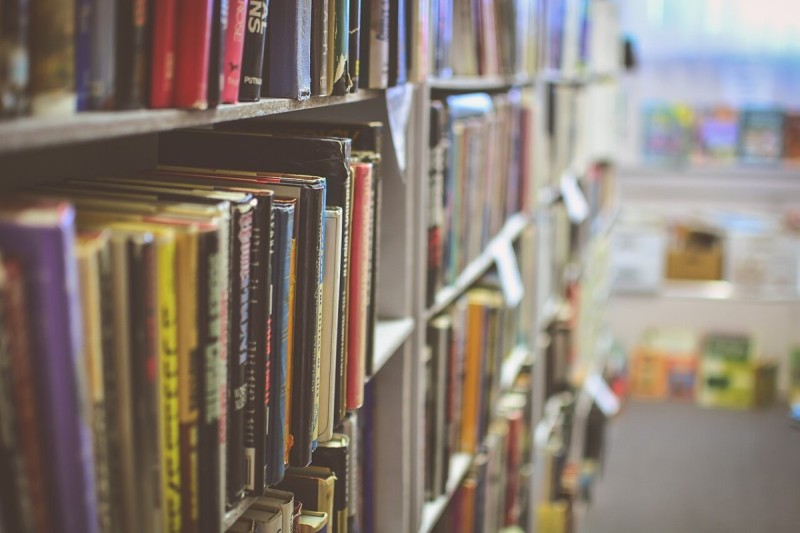
Photo by Jamie Taylor/Unsplash
This month, Alberta school boards began removing dozens of books from library shelves to comply with a provincial government order banning literary materials deemed “sexually explicit.” The order was originally issued in July of last year, when Education Minister Demetrios Nicolaides defined “sexually explicit” as a “detailed and clear depiction of a sexual act” and made no distinction between written and visual representations. Naturally, the order carved out an exemption for religious scripture—sparing the Bible—and informational, non-narrative books, like biology textbooks. However, critics were quick to point out that the order would effectively ban literary classics, like Margaret Atwood’s The Handmaid’s Tale.
Faced with widespread public criticism, the original ministerial order had been gradually watered-down. In September, age ranges were introduced, with students between kindergarten and grade nine being blocked from accessing books with explicit and non-explicit sexual content, and students in grades 10-12 being allowed to read works with “sexual passages” but not “sexual imagery.” By December 2025, the final revision of the book ban only targeted visual mediums like graphic novels, leaving books without a pictorial component untouched. Instead of the hundreds of books implicated by the original order, the policy implemented last week resulted in the removal of just a few dozen titles.
In their attempt to ban books they deem sexually explicit, Danielle Smith’s government followed a script well-worn by politicians in red districts across the United States. Back in 2023, Republican Governor Ron DeSantis had Bill 1467 passed in Florida. It stipulated that “book selections be free of pornography” in school libraries—but instead of defining “pornography” the bill only referenced Florida’s Obscenity Statute 847.012, which describes obscenity as any visual or printed representation of “a person or portion of the human body which depicts nudity or sexual conduct, sexual excitement, sexual battery, bestiality, or sadomasochistic abuse.” With such a broad definition, even a glimpse of bare skin could qualify as obscene—so watch those ankles.
In both Alberta and Florida, this ambiguity is strategic. When the Canadian Civil Liberties Association criticized the ministerial order for banning George Orwell’s Nineteen Eighty-Four and Atwood’s The Handmaid’s Tale, Education Minister Nicolaides decried their comments as “false and shockingly deceptive”—this, despite the books obviously meeting the order’s criteria for removal. Likewise, when the Edmonton School Board released a list of over 200 banned books, Premier Smith accused them of “vicious compliance” for doing what her government had ordered. In this way, these vague, poorly-worded laws are deliberately intended to mean whatever their crafters want them to in the moment while still offering a veneer of plausible deniability when their implications are questioned.
Banning books is part of the Smith government’s broader social conservative agenda in Alberta. Restrictions have already been introduced on what pronouns and names students can use at school, what sport teams children can play on, and how children can identity without parental permission. Many of these policies target LGBTQ+ people, and the book ban disproportionately targeted works that portray queer sexuality. For instance, Mike Curato’s autobiographical graphic novel Flamer is frequently targeted by pearl-clutching conservatives because it depicts gay teenage sexuality. This is no surprise when one considers that, just like in the US, Alberta’s book ban was influenced by lobbying not from parents, but socially conservative activists.
The entire book banning saga began when a conservative interest group complained to the Alberta government in May 2025 about graphic novels it said were inappropriate for minors. Christian nationalist groups like Parents for Choice, Action4Canada, and Take Back Alberta claimed to speak for all parents, and the provincial government echoed their talking points by alleging that their legislation simply gives parents control over their children’s education. Yet, the illusion of parental or public oversight is dispelled by the refusal of school boards to say what books are being banned.
Released in February 2025, just months before Alberta announced its planned book bans, critic and essayist Ira Wells’ On Book Banning examines the history of libricide with a special focus on Ontario and Florida. Wells explains how, in 2023, Ontario’s Peel District School Board purged thousands of books from school shelves as part of an “equity based weeding process.” Ostensibly intended to remove books that reinforced discriminatory ideologies and to ensure that books reflected the “lived experiences” of students, the school board decided to throw out every book that was more than 15-years-old. The result was barren shelves. Despite originating from the other end of the political spectrum—the edict cited a need to “promote anti-racism, inclusivity and critical consciousness”—the motivation behind the removals was the same: protect kids from allegedly corrupting ideas. That attitude is needlessly coddling when a book is the least dangerous way to explore fraught ideas and topics.
In the internet age, attempting to save children from pornography by banning artbooks containing Michelangelo’s David is laughably quaint. A literary depiction of sexuality is about the safest way that a young person can encounter sexual topics today. Students are just a couple clicks away from all manner of sexual content online that is less appropriate for them than a masturbatory pun in the opening of Gulliver’s Travels. Alberta’s book ban also reflects an odd bias against visual mediums. Apparently, a written description of violent sexual assault (à la The Handmaid’s Tale) is more age-appropriate for 10-year-olds than an artistic depiction of consensual sexual activity (such as in Flamer).
A book demands something of its readers that few things do today: careful attention. Children are inundated with fast-moving, attention-dividing images across numerous heavily-subscribed social media platforms. A generation ago, parents fretted about the influence of television. Marshall McLuhan called TV and film “hot media” because they demanded little participation from their audience compared to “cold media” like literature. Yet, a 22-minute television episode from that generation moves glacially slow and requires more attention to follow compared to the 10-second TikTok clips and Instagram reels of today. Appreciating cold media takes mental participation: the critical exercise of our comprehension, imagination, and interpretive skills. This makes literature an ideal medium for presenting and experiencing difficult subjects; it demands enough of a reader that they are primed to engage with its contents more critically, and less passively, than they might if the same message is expressed in another format.
Book bans must be vigorously opposed at school board meetings and in the court of public opinion. School libraries are different from public libraries, and they should be curated for the students that they are meant to serve. However, curation of school library collections must be guided by certain principles. There is no obligation to include works that are pseudo-scientific or straightforwardly untruthful, and books that are included should represent a wide cross-section of ideas, experiences, and literary expression. The antidote for collections that are overly Eurocentric or lean towards the Western canon is not to toss those books in the trash, but to add greater variety from other traditions and cultures. What should not guide the curators of library collections is an excessive “safetyism” that aims to protect children from human sexuality or retrograde ideas contained within artistically significant works.
The opposition to Alberta’s book ban has been largely successful. Public outrage was instrumental in causing the provincial government to retreat from the original ministerial order’s puritanical censure of anything that hinted of sexuality to the declawed prohibition on a handful of graphic novels. In the end, the Calgary Board of Education is pulling merely 44 titles from its shelves, and Edmonton Public Schools has singled out just 34 of its over 700,000 books to remove. Like most of Danielle Smith’s tilting at windmills—an allusion I should avoid since she’d surely think Don Quixote is obscene—the book ban has proven to be a massive waste of government officials’ time and taxpayer money.
Eric Wilkinson is a postdoctoral fellow in the Department of Philosophy at the University of British Columbia.