
Empire, ecology, and Canada’s foreign policy ‘reset’

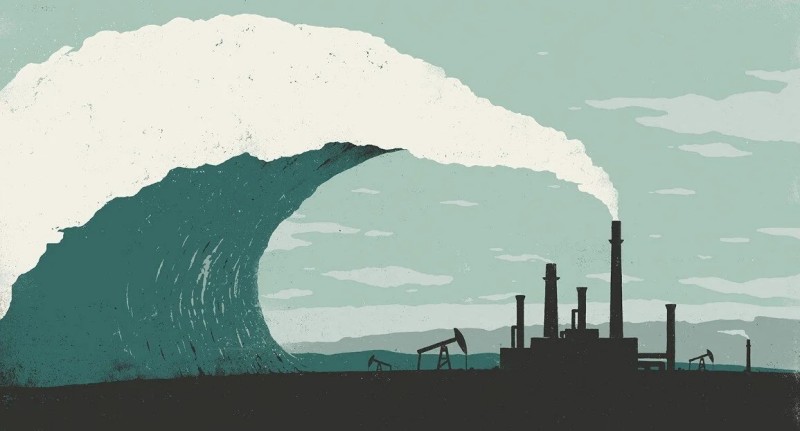
Ecological economists have warned for decades that global trade accelerates environmental collapse. The crisis we are living in is the result of ignoring them, writes Laurie Adkin. Image courtesy the Hampton Institute.
“We participated in the rituals. And largely avoided calling out the gaps between rhetoric and reality.”
This statement, made last week by Mark Carney during his speech at the World Economic Forum in Davos, has been celebrated the world over as a belated acknowledgement that the so-called “rules-based international order” is mostly a fiction that gives cover to the use of force by powerful states.
But his remark also confesses what Canada’s foreign policy has long been: a performance of virtue that, in effect, enables injustice. For decades, Canadian governments have cloaked alignment with US imperial priorities in the language of multilateralism and “shared values” while turning a blind eye toward the violence and suffering those priorities produce.
According to Carney, the new goals can be summed up as, “Principled in our commitment to fundamental values: sovereignty and territorial integrity, the prohibition of the use of force except when consistent with the UN Charter, respect for human rights.”
“Principled” and “consistent” are precisely what Canadian foreign policy under the Liberals has not been. Will that change now? Critically, when Carney mentioned “global problems,” including violations of sovereignty in Ukraine and Greenland, there was no mention of Palestine, Venezuela, or Iran.
Carney plays well-used cards when he posits a balance between “values and interests,” or principles and pragmatism. In reality, values and interests often conflict. When will the principles of respect for sovereignty, international law, and human rights be subordinated to “interests,” and whose interests will these be? What are Carney’s red lines? Why has he “stood firm” only in relation to the sovereignty of Ukraine and Greenland, while abetting or condoning the worst imaginable travesties of justice committed by the “global hegemon” across the Global South?
If Carney is truly signalling a break from that tradition, the test will be actions, including the immediate imposition of full sanctions on Israel, termination of economic partnership negotiations with the UAE, opposition to US intervention in Venezuela and Iran, and an embargo on Canadian arms exports to the US that are being used against civilians.
Turning to Carney’s comments about the world economic order, we see that—despite his reference to Thucydides—the prime minister has a short historical memory. Great powers have always used economic weapons, whether these were protectionism, forced free trade (gunboat diplomacy), imperial zones of control, unilateral sanctions intended to overthrow governments, or the structural adjustment agreements imposed by the International Monetary Fund on countries in the Global South. None of these are only “recent.”
Carney now acknowledges that “economic integration” has always been a system of “subordination” and that the “financial infrastructure” imposed by Western governments in the service of finance capital has been a system of “coercion.” This system, known to political economists as neoliberal globalization, is the world that capitalists like Carney built. He was one of its machine operators. What does Carney propose to establish in place of the order that is governed by the World Bank, the International Monetary Fund, the World Trade Organization, central banks, hedge funds, and asset management corporations like the one he used to work for? And does he have a vision for a sustainable, self-sufficient economy for Canadians?
There are few signs of any such vision in the federal budget he tabled in November 2025, in his climate and energy policies to date, or even in trade policy. In his Davos speech, he said:
Since my government took office, we have cut taxes on incomes, capital gains and business investment, we have removed all federal barriers to interprovincial trade, and we are fast-tracking a trillion dollars of investment in energy, AI, critical minerals, new trade corridors, and beyond. We are doubling our defence spending by 2030 and are doing so in ways that builds [sic] our domestic industries.
Most of this is continued neoliberalism and extractive capitalism, now with added military spending. He goes on to describe more free trade agreements, forgetting what he has just said about reducing reliance on global economic integration.
Can we think of economic development in any terms other than “free trade” and distant export markets? Can we attach social and ecological conditions to our trade relationships? Can we stop assuming that the key to providing for the needs of Canadians is to multiply exports? The scramble for foreign export markets and foreign investment and his belief in economic growth driven by private capital indicate that considerations of ecological health, human rights, and social equality have made little impact on Carney’s economic thinking.
Ecological economists have been crying in the wilderness for decades that global trade—which exploits cheap labour and destroys environments—is accelerating ecological crises, and that the global economy needs to shrink back to sustainable levels, shifting toward local production for local markets. Carney is wrong to say that this world will be “less sustainable.” Degrowth in material and energy throughput, combined with a radical redistribution of wealth and the devolution of decision-making power to local governments is the only path that can rein in the forces driving ecological destruction and human suffering.
What Vaclav Havel had to say about Stalinist industrialization and propaganda applies just as well to neoliberal capitalism and its rapacious relationship to the Earth (although Carney was careful to make state socialism his example of totalitarian ideology, rather than the neoliberal doctrine that has served capitalist elites so well since the 1970s):
The previous regime–armed with its arrogant and intolerant ideology–reduced man to a force of production, and nature to a tool of production. In this it attacked both their very substance and their mutual relationship. It reduced gifted and autonomous people, skillfully working in their own country, to the nuts and bolts of some monstrously huge, noisy and stinking machine, whose real meaning was not clear to anyone.
Here are some simple, biophysical realities: Earth’s resources are finite and its ecosystems are not infinitely exploitable. Fresh water aquifers, forests, soils, coral reefs, phytoplankton populations, and every other foundation of life on our planet need time and propitious conditions to regenerate. When the rate of exploitation of nature exceeds regeneration rates, the results are net loss and eventual collapse.
As for the ecological consequences of free trade, these were best captured by ecological economist Herman Daly in the pithy formulation: All countries cannot be net importers of natural capital. Somewhere, net losses are occurring; since the beginning of colonialism, the deepest ecological degradation has been inflicted in regions of the Global South. “Net loss,” or the overshoot of ecosystem boundaries, has now been occurring on a planetary scale for decades, driven primarily by neoliberal globalization.
The “global economic integration” of which Carney speaks has created the illusion, for people in the Global North, that natural limits can be exceeded. Technologies are invented to allow a depleting resource to be extracted at a rate that maintains supply to markets. There may be an appearance of abundance even when the stock of a resource or the numbers of a species are in sharp decline. The richest consumers who can pay for increasingly scarce commodities may not be aware of the depletion of the resource until it has been completely exhausted. They will be the last to suffer food and water scarcity. The key point here is that the Earth has limits, and if our economies exceed these, they are, by definition, unsustainable. We have long since passed the stop signs.
In making these observations I am aware how they will land with most Canadians, who have been primed since the 1980s to believe that their prosperity depends on demand for Canadian exports. Obviously, the jobs of thousands of workers in the agricultural, forestry, fisheries, mining, oil and gas, and some manufacturing sectors are currently dependent on the existence of global markets for the products they produce. Scaling back and reorienting our production in these sectors to meet primarily domestic demand must happen in conjunction with growth in other sectors where demand for products and services is unmet or can substitute for imported goods (the “Buy Canadian” federal procurement policy could be a step in this direction, but needs to be part of a comprehensive economic plan).
A guarantee of income security for all citizens is a critical foundation for economic transformation. Generating revenue and credit for public investment in human services, energy transition and conservation, water protection and conservation, and other areas is essential to achieve the transformation on the scale and in the time frame that is now imperative for our survival in a rapidly warming, increasingly unstable climate. This calls for substantial fiscal reform and the expansion of public finance.
Like other ecological economists and political ecologists, I believe we can build a better way of life with greater security for all, while respecting ecological limits. But to do so, we must escape from the ideological indoctrination that holds such goals to be unattainable, and insists that extractive capitalism is the only path available to Canadians. Carney continues to promote this path. He grasps that our access to the US market is closing, but his primary response is to secure new overseas markets and new sources of foreign investment. He seeks to remove obstacles to intensified resource extraction for export. This is not a new vision; it is retrenchment. This path will dig us deeper into the holes from which we must inevitably climb.
In his Davos speech, Carney identified two strategies for “middle powers” like Canada that hold some promise. First, he suggested that these nations collaborate to build or reform global institutions that are not under the thumb of the imperial United States. What does he have in mind? A collective project to bolster the resources and authority of the UN while reforming its governance structure? Replacing or reforming the mandate and governance structure of the World Bank and the WTO? What about NATO, which integrates Canadian and US military intelligence? Will Canada respect its commitments under the UN Framework Convention on Climate Change? Under the Genocide Convention? Will it obey the rulings of the International Criminal Court? Will it, in these ways, defend and support international law?
So far, Carney has not proposed such initiatives. On the contrary, his reply at Davos to questions about Trump’s “Board of Peace” inspired no confidence that the prime minister is turning over a new leaf. He did not clearly reject the legitimacy of this body, which aims to render the UN irrelevant once and for all, replacing it with an imperial apparatus. Instead, he hedged, describing the Board of Peace as a “positive vehicle.” This was an opportunity to reject Trump’s plan outright, and he didn’t take it. Previously, Carney endorsed the president’s “peace plan” for Gaza. Will there be a substantial realignment of Canadian foreign policy under the Carney government, or will the path be mainly one of continuity decorated with new rhetoric?
Carney also argued that middle powers should coordinate their positions so they may act as a bloc, in lieu of negotiating bilaterally with (one assumes) the US. This was, after all, the entire point of the European Union having a common market and foreign policy (even if European elites have continued to act as vassals of the US). Evidently, Carney would like to move Canada closer to this European bloc of “middle powers.”
What does he envision with regard to relations with the BRICS states? Is this where tactical coalitions come into play? If so, there is a lot of work to be done to redeem the role Canadian governments have played in the past in backing US imperialism in these countries (especially in Latin America), as well as the role Canadian-based corporations have played in violating human rights and Indigenous rights–particularly in the mining sector.
We may hold out hope for this government to take new directions, but we cannot rely on hope—and certainly not on faith that does not stem from a sober reading of the historical record. We must be relentless in demanding from our politicians that they implement reforms that will bring us closer to a just and ecologically sustainable world.
Laurie E. Adkin is a professor emerita in the Department of Political Science at the University of Alberta.