
Iran and the death of politics
_800_533_90.jpg)
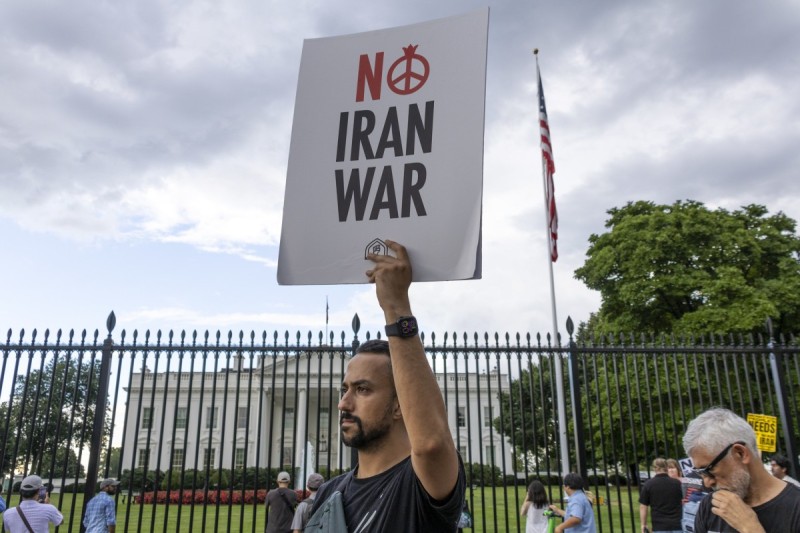
Anti-war protest outside the White House, Washington, DC, June 18, 2025. Photo by Diane Krauthamer/Flickr.
When we look at the treatment of the Iranian uprising by some left-wing commentators, imperialism appears as an all-purpose explanatory solvent, the all-encompassing force that shapes our world. Geopolitics becomes the main plot, while Iranian society is reduced to scenery. In this overly simplified view, history’s primary drivers become camps, blocs, states, and empires, while the role of classes or autonomous action recedes and genuine social agency is obscured. Complex historical dynamics are replaced with a mere dance of opposing blocs, with the United States and its vassals, such as Israel, holding all the cards. Once this move is made, analysis stalls. Popular revolt is no longer approached as the product of social contradictions, class antagonisms, or political closure, but filtered almost entirely through the question of who might benefit from it internationally. The lived reality of repression, exploitation, and resistance is displaced by a single geopolitical test: does this uprising embarrass the right enemy?
In the case of Iran, instead of urging solidarity with ordinary people risking their lives against an entrenched state, news of crowds risking prison, torture, or death is met not with inquiry—what compels such courage?—but with suspicion, calculation, and the cold detachment typical of the geopolitical gaze. The Islamic Republic’s violence is subtly displaced by a forensic hunt for foreign fingerprints, until Tehran’s own executioners disappear and the ‘true’ authors of disorder are found in Washington or Jerusalem—a reversal rehearsed so often it now writes itself.
But Iran is neither a blank canvas for Western projection nor a passive tableau for foreign intervention. The recent sequence of uprisings did not originate only from external influence or the arbitrary actions of a foreign entity. The insistent return of mass turbulence, animated by the uneven, antagonistic energies proper to politics, means the street is reasserting its central role as a detonator. Since 2009, protests in Iran have become less an event than a language—improvised, recursive, stitched from memory and necessity. It is true that autonomy remains a wager and not a guarantee; but to deny it is to foreclose the very possibility of politics. The expression of widespread discontent always risks blurring events, mainly because it fundamentally shakes the existing power structure.
For some leftists these eruptions get recoded as the tantrums of an alienated bourgeoisie: students, ‘compradors,’ or rootless cosmopolitans, severed from the life of the masses and essentialized as potential traitors. But this reading does not hold up to a reality check. This latest unrest is the convulsion of a society in which social reproduction itself is collapsing. Chronic inflation, currency free-fall, precarious labor, and the fraying of survival have driven millions past the threshold of endurance. In this landscape, the regime’s foundational compromise—an exchange of redistribution, informal protection, and the promise of stability among religious lower classes, bazaar interests, and state organs—begins to unravel. The withdrawal of consent in religious or conservative quarters, the emergence of strikes in the bazaars, are not marginal events. They are symptomatic of rupture at the regime’s core. And that should remind us that crisis never produces a single, legible response. It provokes, in turn, liberation, reaction, contradiction—sometimes all at once. This ‘messiness’ is not a defect of revolt but its condition of possibility. It is the raw, unprocessed substance of politics, and those who refuse to confront it are condemned to irrelevance.
Economic strangulation, diplomatic isolation, covert operations, regional militarism, and the perpetual threat of escalation saturate the Iranian field. The result is a labyrinth in which every node—monetary, political, existential—is under stress. To acknowledge this is not to surrender to the narcotic of total explanation, in which all roads lead, inevitably, to Washington or Jerusalem. Of course, sanctions amplify crisis, deplete state revenue, increase inflation, and make survival itself precarious. But attributing revolt solely to external forces confuses contributing factors with causality. When you look at a complex situation from top to bottom what takes shape is a mesh: imperial pressure and domestic domination, mutually imbricated, producing a crisis whose logic cannot be mapped by a single vector. Under pressure, currency dualism, informal trade, and rent-seeking proliferate, realigning the regime’s inner circuitry. The Islamic Revolutionary Guard Corps (IRGC), far from being a mere repressive appendage, functions as a governing bloc, its tentacles sunk deep into the tissue of the economy—construction, trade, engineering, and beyond. Dictatorship is not simply the muting of opposition but the reorganization of accumulation around coercion, until coercion itself becomes some kind of business model. But this is only the most visible layer.
In the hands of some commentators, sanctions, foreign threats, intelligence operations—all real and documented—are treated as sufficient explanations in themselves. Iranian workers, women, students, minorities, and organized left currents barely appear, and when they do, they are viewed less as political actors than as liabilities. Their revolt is framed not as a response to repression and material deprivation, but as a potential pretext for Western aggression. Legitimacy is postponed indefinitely.
This geopolitical reduction quietly negates Marx’s profound observation in The Eighteenth Brumaire of Louis Bonaparte: People make their own history. That they do not do so “just as they please… but under circumstances directly encountered, given and transmitted from the past” implies a constraint. But constraint does not erase agency. To acknowledge imperial pressure while denying political subjectivity to the masses is to retain only half the sentence, and lose the method.
This mode of reasoning has a long and uncomfortable lineage on the left. The imperative to preserve the state, so often cloaked as justice, metastasizes at every crisis. When the Hungarian uprising of 1956 was reduced to a CIA plot, or the Prague Spring of 1968 reframed as Western subterfuge, the logic behind that reasoning was not merely paranoia but a refusal to countenance the possibility of autonomous revolt. This political performance entered a new phase with the emergence of the Arab Spring and the various ‘colour revolutions’ in the former Eastern Bloc. The same reflex reasserts itself today.
Citing regime-organized rallies as proof of popular support treats coerced spectacle as consent. Highlighting violence by protesters reframes repression as a reaction rather than the baseline. But a society held together by surveillance, prisons, and fear is not stable; it is compressed. Revolt doesn’t invent violence. It runs into the violence that was already structuring everyday life.
The most consequential move comes next. Anti-imperialism is redefined as a label attached to states, not as a struggle waged by classes. Once a regime positions itself against the US or Israel, it acquires a kind of moral insulation. Its prisons fade into context. Its class relations disappear from view. Workers striking, women resisting patriarchal domination, minorities challenging exclusion are treated as destabilizing forces whose demands must be postponed for the sake of geopolitical resistance.
At this point, it’s hard to see how this can still be described as dialectical thinking. So let’s follow the logic to its conclusion.
Iran solidarity protest in Santa Barbara, California, October 1, 2022. Photo by Brett Morrison/Flickr.
The “enemy of my enemy” logic eschews complexity, choosing the state over the insurgent, order over emancipation, rulers over the ruled. It prefers the comfort of present stability, which protects ruling blocs, to the unpredictable reality of popular revolt, with all its mixed motives, uneven consciousness, and messy class composition. Behind the anti-imperialist rhetoric is a familiar purism: uprisings are treated as illegitimate unless they arrive in the correct class costume, with the correct slogans, at the correct geopolitical moment. It’s the old orthodoxy in a new outfit, the reflex that sneers at rebellions for being “inter-class,” “confused,” or “petty-bourgeois,” as if history ever waited for a perfectly composed proletarian choir. And at that point a materialist question becomes unavoidable: who benefits from this automatic delegitimation of popular struggle whenever it threatens a state that calls itself “anti-imperialist”?
What the current revolt signals is not the abrupt eclipse of reformist hope, but the slow, grinding exhaustion of a two-decade compact—a managed, incrementalism that never risked unsettling the regime’s foundations. The security apparatus did what all such machines do. It became a set of interests, capable of surviving even ideological hostility. While external adversaries portray themselves as existential threats, they are nevertheless willing to engage with the regime’s infrastructure, working within or around it when it suits their interests. The campist worldview pulls back from this terrain, because it shatters the fiction of ‘anti-imperialist states’ as coherent, organic subjects. What confronts us instead is a regime internally stratified, traversed by oligarchies, rents, and security-capital circuits—an anatomy that resists every consoling simplification.
To return to Marx’s famous quote, it remains indispensable precisely because it refuses both the romantic impulse and the paralysis of fatalism: people make their own history, but never under conditions of their own choosing. These conditions are awash with domestic class antagonism, repression, gendered domination, and the everyday lived experience of foreclosure. The work of analysis is not to weigh one form of oppression against another, but to trace the articulations through which these forces become mutually conditioning.
The specific spatial configuration of the Iranian revolt itself serves as a rebuke to those who view the situation solely through a geopolitical lens. Kurdish, Baluchi, and Arab regions remain at the vanguard of mobilization, and this is not accidental. Consigned to the margins by a form of governance that is as extractive as it is militarized, these zones have become the permanent outposts of internal colonialism. The echo of Persian supremacism, once explicit under the Shah’s centralizing modernization, is not dissolved by the Islamic Republic’s universalism; it is sedimented beneath it, layered and unresolved. Internal colonies are where the ‘anti-imperialist’ state reveals its own imperial mimicry.
Revolts in these areas cannot be chalked up to the mere impatience of a Westernized middle-class, which is only a surface manifestation. Ethnic domination, developmental arrest, and the forced grafting of peripheral communities onto the nation state intersect with class exploitation, generating sites where rupture is simultaneously more likely and more hazardous. The periphery functions as a laboratory where the state perfects its machinery of control, fusing economic neglect with a permanent security siege. These regions are far from being mere historical footnotes. They stand as the central, unrelenting antagonists to the Iranian state. But some on the left seek to evade this reality by dismissing Kurds as Western-backed secessionists, and Baluchis and Arabs as ISIS-inspired terrorists subject to manipulation by Israel, thus playing into the hands of ruling interests who are all too happy to frame dissent as foreign manipulation.
Once these ‘Mossad agents and CIA benefactors’ are airbrushed from the scene, the uprising is reduced to a generic reflex—a mere ‘reaction’ to sanctions—rather than a rupture possessing its own historical density and political will. Those who insist on a secular, pluralist, democratic future unburdened by clerical rule, royalist nostalgia, or the tutelage of foreign powers are conveniently left behind.
However, for those who still profess materialism, the task is clear: one must seek out Iran’s internal opposition, listen to their debates and constraints, build direct lines of contact and solidarity—whether on the ground in Iran or across the diaspora. It is the slow, stubborn labour of cultivating solidarities that resist translation into the grammar of blocs, solidarities irreducible to either nostalgia or geopolitics. This work is neither glamorous nor immediate. It is, however, indispensable if politics is to mean anything more than the choreography of power and history, more than a tug-of-war between states.
The recent statement issued by the Syndicate of Workers of Tehran and Suburbs Bus Company (Vahed) provides a direct and pertinent commentary on the current situation, which every leftist must consider. In their words:
While expressing our solidarity with popular struggles against poverty, unemployment, discrimination, and repression, we categorically oppose any return to a past marked by inequality, corruption, and injustice. We believe that genuine liberation can only be achieved through the conscious, organized leadership and participation of the working class and oppressed people themselves—not through the revival of outdated and authoritarian forms of power. Workers, teachers, retirees, nurses, students, women, and especially young people—despite mass repression, arrests, dismissals, and relentless economic hardship—continue to stand at the forefront of these struggles. In this context, the Syndicate of Workers of Tehran and Suburbs Bus Company (Vahed) stresses the need to sustain independent, conscious, and organized forms of protest. We have stated repeatedly, and we reaffirm once again: the path to liberation for workers and the oppressed does not lie in the imposition of leaders from above, in reliance on foreign powers, or in factions within the ruling establishment. It lies in unity, solidarity, and the building of independent organizations at the workplace, community, and national levels. We must not allow ourselves to once again become victims of power struggles and the interests of the ruling classes.
To ignore such a clear articulation of political will in the name of a purportedly dispassionate geopolitical analysis reflects a left weakened by exhaustion and cynicism—by-products of globalization’s shocks and the attrition of political imagination. In a 2021 interview with The Breach, historian Barnaby Raine voiced this malaise, arguing that some leftists in the West tend to sympathize with autocratic dictatorships “not because they think these states are building a majestic New Paradise, but because they think there’s nothing else.” As alternatives recede, legitimacy is granted to any state prepared to antagonize Western power. This is not a substantive politics, but a placeholder for an imagination now in eclipse.
In classical tragedy, catastrophe is not typically the fruit of ignorance, but of a trained incapacity to see what is manifest. Despite questioning the city, a witness, and a prophet, Oedipus remains blind to the reality of the situation he is in. Iranian cinema, attuned to this dialectic of constraint and improvisation, often offers a visual grammar for agency under pressure. It pictures small gestures and partial refusals as solidarities laced with ambiguity. Social critique in cinema always begins with a fundamental sense of societal unease. A feeling that something is amiss or fundamentally wrong within our social relationships, indicating that our collective life is not unfolding as it should. Jafar Panahi’s Taxi Tehran (2015) renders the car as resistance-in-motion. It’s a space of constraint, yes, but also of dialogue and dissent. This is why rupture rarely erupts in heroic form. More often, resistance is the product of friction between ordinary life and imposed order. Failing to recognize this sensibility indicates the poverty of the conceptual lens.
George Orwell’s dictum—“to see what is in front of one’s nose needs a constant struggle”—captures this difficulty as structural rather than moral: it is definitely a product of historical conditions. That is why the classical Marxist tradition insists that analysis of class struggle begins neither with abstraction from society nor with its collapse into external causality. Instead, it starts from the granular: the ways exploitation, domination, and resistance are organized within concrete historical formations. These relations are entangled with the world system. They are shaped, constrained, traversed, but never utterly dissolved by it. Imperialism describes structural asymmetry. It’s not a script that absolves societies of contradiction. Dialectical analysis insists on mediation: the refracting of global power through local class structures, state apparatus, gender regimes, religious authority, and the textures of everyday coercion and consent. That is taking class struggle, as a dynamic whole, seriously.
Some argue that as citizens of imperial states, our cardinal duty should be to oppose our own governments—Canada, not Iran; Ottawa, not Tehran, and so on. There is some truth in this: imperial power is real, and resisting it locally is an ethical and political imperative. Yet this insight is habitually transposed into a narrowing principle, as if political responsibility were a zero-sum calculus—as if taking class struggle in Iran seriously subtracts from the struggle against sanctions, arms sales, or diplomatic complicity at home. To put it bluntly: one can resist imperial power at home without erasing social conflict abroad.
Moreover, when uprisings occur in the imperial core, those calling for us to look to our own backyard, subject them to rigorous analysis: class composition is examined, contradictions are explored, and limitations are highlighted. Yet, when a revolt erupts in a state that is a target of the empire, this analytic rigour vanishes. Complexity is dismissed, internal antagonisms are silenced, and class struggle is ignored. The primary focus becomes the defence of that state as a geopolitical victim, even as the state violently suppresses the very people it refuses to acknowledge.
This double standard yields grotesque outcomes. Measures that would be denounced without hesitation in the imperial core, restrictions on strikes, bans on protest, the criminalization of dissent, are suddenly explained, contextualized, even justified elsewhere. Orwell, writing about nationalism, named the habit precisely: the power “of not seeing resemblances between similar sets of facts,” and of judging actions “not on their own merits, but according to who does them.” Campism is this habit translated into geopolitics. It treats “national liberation” less as the emancipation of people than as the preservation of a state, and adjusts its moral standards accordingly. This is where the logic becomes pathological. A left forged in opposition to domination begins to echo the language of order, stability, and discipline. In the name of realism, politics is emptied of its emancipatory content. It is not enough that some on the left misread revolt. They also come to fear them.
As internationalists, the final question remains: what should our response be? The campist response is to retreat behind the walls of the nation state, seeking shelter in a sovereignty that capital dismantled long ago. It is a seductive nostalgia—the hope that the nation can still withstand the empire. But this is a fantasy. Imperialism has returned to its raw, unmasked state, redrawing the map without the pretext of law. To counter this, we cannot simply mourn the liberal order or mimic the nationalism of the oppressor. The nation captures the popular imagination only because the left has failed to make the global struggle for emancipation palpable in day-to-day life. Our task then must be to help internationalism evolve from a mere concept into a deeply ingrained practice of the working class.
Pierre Luc Junet is a filmmaker and researcher based in Montreal. In addition to working on his own films, he is currently completing a practice-based PhD in cinema at Université de Montréal.