
No blood money for the arts

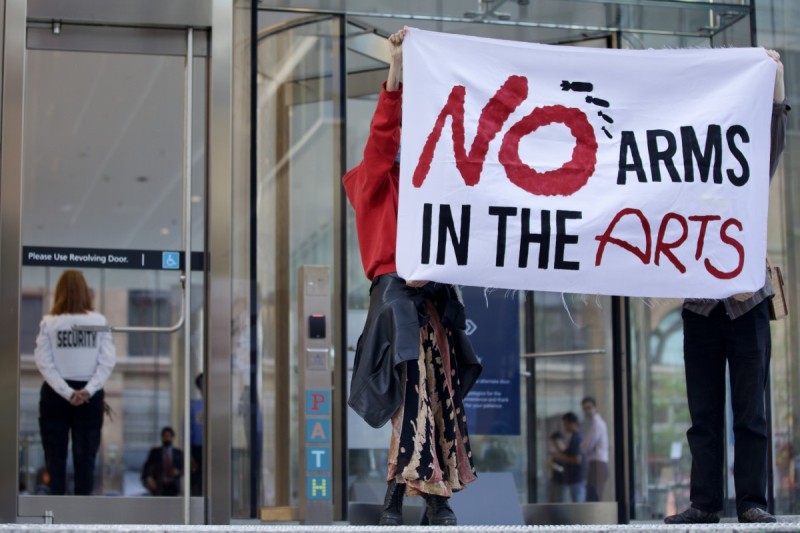
Activists unfurl a banner reading “No Arms in the Arts” outside Scotiabank’s corporate offices during an action in downtown Toronto, 2024. Photo by Nur Dogan.
In November, as Israel continued to violate the ‘ceasefire’ in Gaza, almost 200 cultural workers signed a pledge to boycott the Scotiabank Photography Award, an annual Canadian peer-nominated lens-based prize founded in 2010. “We refuse to be a nominee, nominator, or juror for the Scotiabank Photography Award, or participate in the Award in any way, until Scotiabank divests completely from Elbit Systems,” the statement reads. The pledge has been signed by writers, curators, artists, and photographers, including former nominees, finalists, and nominators of the award.
Headquartered in Haifa, Elbit Systems is a major Israeli weapons manufacturer responsible for producing a significant share of the military equipment that has maimed, murdered, and terrorized Palestinians for decades. During the current genocide, homes, schools, libraries, hospitals, religious sites, and other institutions have been destroyed by one of the most powerful militaries in the world, fuelled by corporations such as Elbit.
Amid a cultural landscape that profits from genocide, the boycott of the Scotiabank Photography Award emerged from No Arms in the Arts (NAITA), a coalition of authors, artists, and organizers who have spent the past two years demanding that festivals like the Toronto Biennial of Art and CONTACT—Toronto’s international festival of photography—and awards such as the Giller Prize, pressure their sponsor Scotiabank to divest from Elbit. The bank has major investments in the company and is one of its top foreign shareholders. To see, to make, to show, and to write about art in Canada is too often premised on money that funds the technologies and weapons used to brutalize and kill Palestinians.
Sukaina Kubba, a multidisciplinary artist and organizer with NAITA, notes the particularities of this award. “It’s not just an award sponsored by Scotiabank. It’s co-founded by Scotiabank with Edward Burtynsky [a world-famous Canadian photographer]. The ceremonies are sometimes held at Scotiabank headquarters. They’re attended by higher-up members of the bank as well. It’s also the only award listed on their website. So it’s their award.”
Branding itself as a patron of the arts, Scotiabank describes the Photography Award on its website as “Canada’s largest and most prestigious annual peer-nominated and peer-reviewed award.” The winner receives an exhibition, a book publication, and $50,000 in cash—money indirectly derived from the dispossession of Palestinians. The award, which will be handed out in May, functions as a reputational laundering mechanism for bankers, donors, and other war profiteers. Artists, writers, and organizers involved in cultural boycotts like this one are refusing that veneer of respectability and legitimation.
It is also worth noting that the Canadian government uses taxpayer dollars to purchase Israeli weapons directly from Elbit, making calls for a “two-way arms embargo” increasingly urgent. Elbit produces drones like those referenced by Palestinian-Canadian photographer Rehab Nazzal in a photo she posted on Instagram in December, taken in Jenin near the refugee camp in the northern West Bank.
I reached out to Nazzal, who was in Palestine at the time and is among the boycott’s signatories. “Photographers are being honoured by the very bank that contributes to the targeting and killing of Palestinian photographers and reporters,” she told me. “I believe that Canadian photographers should reject the claim that such an award is apolitical or neutral.”
In the Jenin refugee camp in the northern West Bank, a shelter from the sun’s heat or a cover from the eyes of Israeli drones above. Photo by Rehab Nazzal.
What can cultural workers do to intervene against Israel’s assault on Palestinians? “My colleagues should not remain silent while their Palestinian peers are targeted, massacred, and tortured for using their cameras and voices to reveal the truth amidst bombs raining over their heads or machine guns at checkpoints, gates, and walls,” Nazzal said. Alongside rejecting participation in Scotiabank-sponsored awards, she urged colleagues to join the Boycott, Divestment, and Sanctions movement.
The Scotiabank Photography Award boycott situates the prize within a broader ecosystem of Canadian cultural funding complicit in genocide, as well as a growing wave of grassroots organizing. Across recent campaigns and disruptions, cultural workers have refused to attach their names and labour to institutions that profit from the Israel’s destruction of Gaza. Arts work is profoundly precarious, yet there is money being made: an October report from the Canadian Chamber of Commerce highlighted the creative industries’ significant contributions to economic growth.
“There is a sense of cross-sector, cross-medium solidarity that’s important,” says Emerson Maxwell, an artist and NAITA organizer. Some readers may be familiar with CanLit Responds actions, including the boycott of the Giller Prize, which ended its decades-long sponsorship relationship with Scotiabank in February 2025 after sustained pressure (I read at one of these actions in November 2024, at Toronto’s Boycott Giller counter-gala, part of NAITA’s nationwide tour). Last year, the Hot Docs International Film Festival also ended its partnership with Scotiabank.
Scotiabank subsidiary 1832 Asset Management had divested much of its Elbit shares after June 2023, when activists launched a national campaign at the bank’s Vancouver headquarters. In 2025, Scotiabank “quietly” began reinvesting, as Marion Kawas reported in Mondoweiss, while Scotiabank’s latest quarterly report reveals that the bank sold some of its shares when Elbit stock was at peak value, further demonstrating the financial profits made from war.
Protest at Toronto Metropolitan University’s Image Centre at the Scotiabank Photography Award Exhibition, May 7, 2025.
Some NAITA organizers protested last May at Toronto Metropolitan University’s Image Centre, picketing outside the museum and disrupting the Scotiabank Photography Award reception inside. They carried signs reading “Divest the rest” and held a portrait of Fatima Hassouna, a photojournalist in her twenties who was killed in an Israeli airstrike on her home in Gaza City the month before, along with members of her family.
“She was a colleague across the ocean,” says Kubba. “This idea that here we are celebrating with money used to kill her—the dissonance.”
In the months following, boycott organizers discussed how to continue their solidarity with Palestine. They chose November to launch strategically, coinciding with the award’s nomination period. Organizers contacted people implicated in the award—potential nominators and nominees alike. As of this writing, the Scotiabank Photography Award website has not been updated with 2026 information, and the bank has not publicly responded to the boycott.
“After last year’s action, Scotiabank has become a lot quieter—fewer announcements, fewer public gestures—like if they stay under the radar, the negative attention will go away,” Maxwell told me. “As long as Scotiabank is invested in Elbit, it won’t.”
Over the past two years, English-language media have often framed Israel’s war as one over language. In 2024, author Isabella Hammad noted the “verbal contortions many writers have gone through to avoid engaging with the gravity of Israel’s assault on Gaza.” The image, too, plays a central role in the violent Zionist project, which controls populations through economic, bodily, and psychic force.
The phrase “live-streamed genocide” points not only to the illusion that those outside Gaza have seen everything—maimed bodies, starving babies, flattened buildings, tents in flames—but also to the fact that this deluge of imagery, meticulously documented by Palestinian media workers, has failed to stop Israel’s campaign. This is not a metaphorical war on words and images. A recent roundup by Reporters Without Borders found that nearly half of journalists killed in the past year were murdered in Gaza by the Israeli Occupation Forces. Journalists, photojournalists, writers, media workers, academics, and archivists are targeted to conceal information and erase historical truths, even as hasbara campaigns openly call for the eradication of Palestinian life.
For Nazzal, the visual remains a site of struggle against settler violence and a means of holding perpetrators to account. “The visual plays a significant role in the struggle for Palestinian liberation: it documents, reveals, and exposes, and it archives Palestinian life and land for future generations,” she says. “Visual work created by Palestinians is self-representation—evidence that challenges and counters the Zionist-Western settler-colonial narrative.”
A glance at the boycott’s signatories hints at the social commitments embedded in their cultural production: Jeff Thomas’s post-colonial portraits of Indigenous people; Eve Tagny’s investigations of grief and landscape; Jayce Salloum’s intimate conversations with former Lebanese political prisoner Soha Bechara. In signing, participants have acknowledged both the material ties between settler-colonial Canada and the occupation of Palestine, and the political power of relationship-building. Art grounded in public experience can clarify struggles against capitalism. A focus on media and cultural production can also foster new relationships—with colleagues in Palestine and at home.
“We’re so used to thinking of ourselves as individuals competing for awards,” Maxwell says. “What rules about this is anything that gets artists to think of themselves as a collective.” Art can intervene not only at the level of discourse but materially, by reorganizing working communities around shared commitments.
Material realities—munitions, systematic starvation, stolen land, and an ever-growing death toll—remain at the heart of the occupation. The boycott arrives amid soaring global arms revenues, a wave of anti-protest legislation in Canada, and the genocide’s retreat from mainstream news cycles since the US-brokered ceasefire, which continues to impose “slower forms of death.” As surgeon and intellectual Ghassan Abu Sitta recently wrote, “Israel is not the sole perpetrator of the war; it is an extension of the collective imperialism of Western states, all of whom bear responsibility for the genocide.”
For people in Canada, defending Palestinian life has required multi-pronged strategies, from organized labour actions to pressuring liberal cultural institutions that manufacture consent for genocide and colonization. Canada’s brand of feeble multiculturalism has long relied on avoidance and politeness. Much more—at scale—will be required in the long struggle against Zionism. In the United Kingdom, members of the now-proscribed direct action group Palestine Action have been arrested for allegedly targeting an Elbit factory in Filton, near Bristol. In mid-January, several of the incarcerated actionists ended their collective hunger strike after the British government opted out of a two-billion-pound contract with the defence contractor. A couple weeks later, Umer Khalid, the last of several hunger strikers affiliated with Palestine Action ended his protest after he was hospitalized and most of his demands were met by the prison.
Kubba urges the arts world to think beyond established institutions. “We hope there’s another model of funding that doesn’t involve complicity in war crimes,” she says. “It’s a bare minimum. It’s not even an anti-capitalist or anti-imperialist move. No blood money.”
While the Scotiabank Photography Award is just one example of how the Israeli war machine is entwined with arts funding in Canada, Nazzal stresses that the stakes far exceed any single prize, bank, or medium:
In times such as these, there is no neutrality. Genocide is genocide—whether against Indigenous peoples in this country, against Jews in Europe, in Rwanda, Sudan, or elsewhere. We cannot remain indifferent while military, financial, technological, and media corporations openly participate in genocide in Palestine, seek to control our lives, strip us of agency, exploit us for profit, and then claim to champion art and culture.
Tiana Reid is assistant professor in the Department of English at York University.