
Trump’s new tariffs expose a domestic problem Canada keeps deflecting

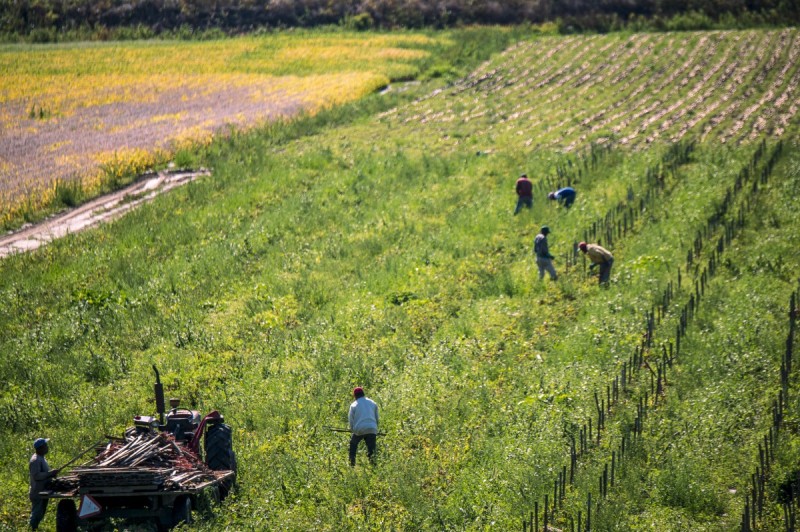
Migrant workers on the job in Norfolk County, Ontario. Photo by Michael Swan/Flickr.
The Office of the United States Trade Representative says Canada has failed to effectively enforce its prohibition on imports made with forced labour and has proposed an additional 10 percent tariff on Canadian goods, though products compliant with the Canada-United States-Mexico Agreement would be exempt.
Trump’s tariff threat deserves scepticism: after the US Supreme Court curtailed his ability to impose sweeping tariffs under the International Emergency Economic Powers Act, the administration’s new forced labour investigation under Section 301 of the Trade Act appears, as observers including former Conservative Party leader Erin O’Toole have noted, to reconstruct much of the same protectionist agenda on a different legal foundation.
Even so, Canada’s response has revealed a deeper problem. Our political debate still treats forced labour as something that happens elsewhere, rather than as a risk embedded in Canadian labour and immigration policy.
Canada’s forced labour problem is home grown
Both Washington and Ottawa have framed the issue primarily as a problem of goods crossing the border.
The US trade representative’s notice accused Canada of failing to effectively enforce its ban on imports made with forced labour. Prime Minister Mark Carney responded in kind, pointing to Canada’s supply-chain laws and insisting that “Canada has a very strong legislative regime against forced labour.” Canada’s Military Grievances External Review Committee similarly stated that it “has not been made aware of, nor does it possess, any information indicating that forced labour or child labour has occurred within its procurement activities or supply chain.”
Conservative leader Pierre Poilievre went even further, asking whether the government would “ban all products coming from the Xinjiang province and end slavery once and for all.”
All three responses—from Washington and from both major parties in Ottawa—treat forced labour as an external problem: produced elsewhere, hidden in imported goods, and solved at the border.
The more uncomfortable conclusion came from the United Nations. In his official report on Canada, UN Special Rapporteur Tomoya Obokata concluded in 2024 that Canada’s Temporary Foreign Worker Program “serves as a breeding ground for contemporary forms of slavery, as it institutionalizes asymmetries of power that favour employers and prevent workers from exercising their rights.”
The core problem identified by the UN is dependency. As labour scholar Jeff Shantz explains, “the contractual relations between employers and temporary workers specify who they are allowed to work for and where they are allowed to work.” Employers, he writes, “quickly realized” that the program could provide “a source of inexpensive and vulnerable labour, unlikely to organize or press for their rights.”
In Alberta, temporary foreign workers recruited from Belize to work at McDonald’s alleged that they were placed in employer-arranged housing, charged rent through payroll deductions, and left with little practical ability to object.
One worker told CBC: “When we arrived at the airport, they said, ‘We already have an apartment for you,’ so at that point we already know we don’t have a choice of where to live.”
Another said: “We had to live there. We were told this is what we are doing.”
Records cited by CBC show that workers made $11 an hour and that McDonald’s deducted $280 bi-weekly for rent, leaving some with roughly $350 in take-home pay for the same pay periods.
Other Canadian cases show the same pattern in more extreme form. In British Columbia, the Human Rights Tribunal considered complaints from 55 Black tree planters employed by Khaira Enterprises. The complaint alleged “deplorable” living conditions, “slave-like working conditions,” racial harassment, inadequate or unpaid wages, and workers who were “effectively prisoners” on campsites and worksites because they lacked the money to leave.
The tribunal found that all workers at Khaira experienced adverse treatment, citing the company’s “blatant disregard” for employment standards, including time of payment, overtime, vacation pay, hours of work, and camp conditions.
This is what Canada’s forced labour debate has missed. Canada has built domestic labour pathways in which migrant workers can become dependent on a single employer for wages, housing, immigration status, and survival.
The debate Canada has avoided
Canada does not lack a definition of forced labour. It has already adopted one.
In its Xinjiang supply-chain guidance, the Government of Canada relies on the International Labour Organization’s definition: forced labour is “all work or service which is exacted from any person under the threat of a penalty and for which the person has not offered himself or herself voluntarily.”
This shows that when Ottawa looks abroad, it can recognize that forced labour is not always a matter of chains or locked doors. It can arise through vulnerability, dependency, coercive housing arrangements, wage control, fear of retaliation, and the inability to leave. Yet when credible warning signs appear domestically, the political instinct is often to narrow the debate, soften the language, or dismiss comparisons that would be readily made elsewhere.
It does not take a seasoned political analyst to see that these novel tariffs are disingenuous. The Trump administration’s forced labour investigation emerged only after the US Supreme Court curtailed the president’s ability to impose sweeping tariffs under the International Emergency Economic Powers Act. The timing makes it difficult to avoid the conclusion that forced labour has become, at least in part, a new legal vehicle for an old protectionist agenda.
But focusing exclusively on Trump’s motives risks missing the more important point.
Whether Washington’s allegations are sincere or opportunistic, they have inadvertently resurfaced a debate that Canada has spent years avoiding. The discussion has been dominated by imported goods and foreign supply chains. Far less attention has been paid to the fact that Canada itself has faced repeated allegations from labour advocates, academics, human rights groups, investigative journalists, and the United Nations special rapporteur, that aspects of its own Temporary Foreign Worker Program create conditions associated with forced labour.
Canada can reject Trump’s tariff threat as opportunistic without pretending forced labour is only a foreign supply-chain problem. If Ottawa wants credibility on forced labour, it must confront the coercive dependencies built into its own labour system before pointing fingers abroad.
Elliot Goodell Ugalde is a PhD candidate and research fellow at the Centre for International and Defense Policy, Department of Political Studies, Queen’s University.