
Prime Minister Carney must halt the legislated extinction of First Nations

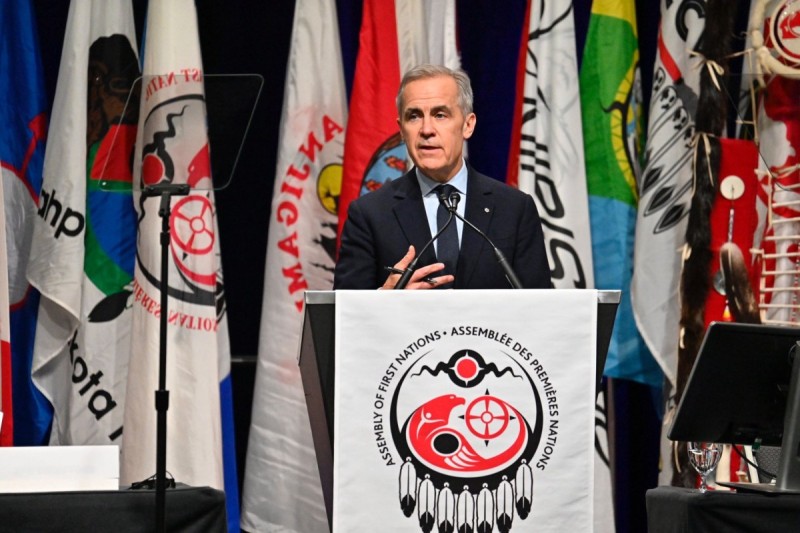
Mark Carney addresses the Assembly of First Nations Special Chiefs Assembly, which took place from December 2-4, 2025, at the Rogers Centre in Ottawa. Photo courtesy the Assembly of First Nations/X.
In 1920, Duncan Campbell Scott, the deputy superintendent general of the Department of Indian Affairs, testified before the House of Commons that the government’s intention was to “get rid of the Indian problem” and to “continue until there is not a single Indian in Canada.” That was more than a century ago, so one could be forgiven for believing that times have changed, especially with the current Liberal government’s stated commitment to reconciliation. Yet Ottawa is refusing to accept the Senate’s amendments to Bill S-2, which would eliminate the Indian Act’s second-generation cut-off provisions. These provisions place many First Nations on a path toward legislated extinction by preventing status from being passed to future generations indefinitely.
Bill S-2, An Act to amend the Indian Act (new registration entitlements), was introduced in the Senate in response to the BC Supreme Court’s 2025 decision in Nicholas v. Canada. Canada conceded that preventing the Nicholas plaintiffs from registering under the Indian Act, or from transmitting status to their descendants, constituted discrimination based on race or ethnic origin in violation of the Charter’s section 15 equality guarantee. The court set a deadline for the federal government to amend the Indian Act to be Charter-compliant.
When Bill S-2 was introduced in the Senate, the Standing Senate Committee on Indigenous Peoples (APPA) heard testimony from many First Nation women, leaders, and legal experts, as well as First Nation organizations representing the majority of First Nations in Canada. They were nearly unanimous. While they supported the provisions addressing the discrimination experienced by the Nicholas plaintiffs, they also testified that Bill S-2 did not go far enough. Without further amendments, they argued, the Indian Act would remain unconstitutional, given the other registration provisions that still discriminate on the basis of sex, race, ethnic origin, and/or family status.
In addition, First Nations urged the Senate committee to amend the bill to remove the second-generation cut-off. The Committee heard First Nation voices, passed the requested amendments, and, in a historic unanimous vote, the whole of the Senate voted to support Bill S-2 with its crucial amendments.
Zoë Craig-Sparrow from Musqueam and Chief Oirschott of Caldwell First Nation protest against the second-generation cut-off on Parliament Hill.
Introduced in the 1985 amendments to the Indian Act, the second-generation cut-off prevents many status Indians from passing status to their children. In practice, a person with only one status parent and one status grandparent cannot transmit status to the next generation. As more descendants lose eligibility over successive generations, many First Nations could eventually be left with few or no members recognized under the Indian Act, even though those nations would continue to exist as peoples and political communities. Estimates presented during the debate over Bill S-2 suggest that eliminating the cut-off could affect thousands of people who are currently excluded from status registration.
Over time, the Indian Act has had various formulas for ensuring the legal, political, and cultural disappearance of First Nations. Yet it introduced the second-generation cut-off in 1985 after it had already enacted the section 15 equality provisions in the Charter and the section 35 protections for Aboriginal, treaty, and land rights in the Constitution Act, 1982. In doing so, the federal government created a regime that has repeatedly been found discriminatory in courts and international human rights forums since the Charter came into force, including the McIvor, Descheneaux, Gehl, Matson, and Nicholas cases.
It has been over a year since Bill S-2 was introduced in the Senate, and six months since it was passed by the Senate with amendments. Now before the House of Commons Standing Committee on Indigenous and Northern Affairs, the bill remains stalled as the government resists the Senate’s amendments.
Indigenous Services Minister Mandy Gull-Masty has opposed the Senate amendments throughout the process, arguing that further consultation is required despite decades of consultation on this issue. First Nations have already shared their experiences and their views in many consultations, engagements, and collaborative processes, as well as the many House and Senate committee studies, all to no avail. They have also written letters, made submissions, signed a petition, and passed resolutions. Despite the consensus, the minister is choosing to ignore First Nations voices, and to delay in the name of fulfilling her duty to consult. Yet the duty to consult was never intended to be weaponized in this way.
With less than two weeks left before the House rises for the summer, the government is clearly trying to ensure the bill does not pass. This means the harm to our children and grandchildren will continue, while the legislated extinction clock keeps ticking. This is a serious rebuff to reconciliation.
Prime Minister Carney has the power to stop the clock. In a world where respect for the rule of law is increasingly under strain, this is an opportunity to demonstrate that Canada’s commitment to equality, constitutional rights, and reconciliation is more than rhetoric. We urge him to pass Bill S-2 with the Senate’s amendments.
Pam Palmater is a lawyer and member of Eel River Bar First Nation. Sharon McIvor is a lawyer and member of Lower Nicola Indian Band. Jeanette Corbiere Lavell is the Anishinabek Citizenship Commissioner and member of Wiikwemkoong Unceded Territory.