
Drawing the line against autocracy

Authoritarianism flourishes when pedagogies of conformity parade as neutral methodologies and when civic illiteracy replaces informed judgment, write Henry Giroux and William Paul. Photo courtesy Governor Maura Healey/Flickr.
For autocracy to succeed, its fingers need to be everywhere, plugging the leaks that might, in the tiniest way, threaten its claim to dominance. Lines of power may not be crossed other than by those who have access to them. Autocracy smothers any possibility of criticism, kills the imagination and often does so under the false claim of improving educational policy, classroom teaching, and pedagogy.
Last June, at her commencement celebration Ottawa student Elizabeth Yao got up in front of friends and families gathered at Bell High School and talked about her years there; the waffle fundraiser and dozing off as she read Shakespeare. But then she crossed a line. Expressing that awareness gratefully acquired from her studies and teachers, she added after the Indigenous land acknowledgement: “As a commitment to truth and reconciliation, I must acknowledge colonial and genocidal atrocities today, including the massacre of more than 17,000 Palestinian children in Gaza.”
The audience cheered. The principal of Bell High School did not. He told her that she had caused harm, that she shouldn’t come back to school on Monday. But, with the clarity of a young person who recognizes horror and speaks against it, she said she planned to return anyway. Ms. Yao did the unforgivable: she refused to treat her mind as a commodity and refused to toe the line of conformity, accept official orthodoxies, embrace shallow and predigested ideas or remain silent in the face of urgent social issues. Her speech revealed what authoritarian governments fear most: young people capable of connecting education to moral responsibility, historical consciousness, and democratic dissent.
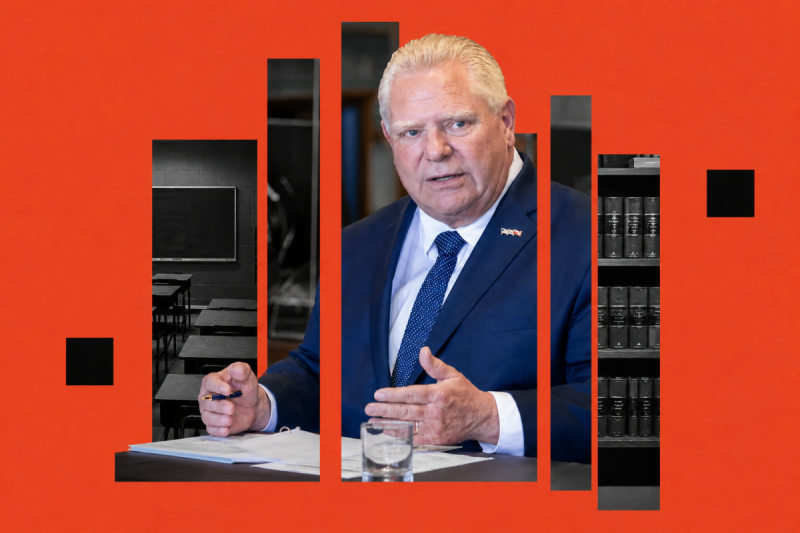
If Paul Calandra’s Ministry of Education wasn’t trying to make a political point, it would leave commencement ceremonies alone. But that’s not how the Ontario government operates under the Progressive Conservative Party of Doug Ford. Students, he said, “should be in the classroom learning about reading, writing, spelling, arithmetic—the whole shebang.” But the “shebang” doesn’t include culture, politics or anything else that Ford’s increasingly authoritarian government doesn’t want to offer students as it reshapes education in Ontario. The “shebang” functions as a command for learned stupidity, the acceptance of low expectations, and the refusal to challenge dominant assumptions. Removed from education is the crucial pedagogical task of questioning inherited beliefs, interrogating power and nurturing critical thought. Instead, under such circumstances, education is reduced to an empty formalism, method, and dead zone of the imagination.
What is lost in Calandra’s championing of the “shebang” is a notion of critical education in which students are given the opportunity to seek the truth, question authority, hold power accountable and embrace intellectual honesty and integrity as guiding principles. Pedagogy should always be a powerful moral and political force for giving students the opportunity to learn history, connect knowledge to the power of self-definition and critical agency and connect the search for truth to the search for justice.
After hearing of a memo sent out by the Hamilton Wentworth District School Board to consider these ceremonies from “an anti-oppressive/anti-racist/anti-colonial lens,” Calandra reminded educators across the province that there is a very large boot poised above their heads. Commencement ceremonies, he said, are to focus only on recognizing student achievement. Organizers must not “express political views or promote personal or institutional positions, or engage in divisive or contentious issues of any kind.” Any deviations and “I will not hesitate to consider every tool in the Education Act to ensure that students are always put first.”
Such ideological micro-management never puts students first. If Calandra and his Ford government colleagues wanted to do that, they would have developed a reasonable funding model and ensured that students had the resources they need. Instead he brought in Bill 33, making it easier to take over more school boards, place police in schools, and even decide what they will be named lest some liberal-minded board chooses a name that cuts against the Ford government’s neoliberal grain.
What is at stake here is not simply administrative overreach but a broader authoritarian attempt to depoliticize education itself. Fascist politics has always feared institutions capable of producing critical thought, historical memory, and civic courage. The language of “neutrality” and “keeping politics out of schools” functions as a form of ideological camouflage. It undermines critical inquiry, rejects the transformative possibilities of the imagination and advances a pedagogy lodged in the dead zone of consciousness, where dissent is muted, history is emptied of its lessons, and the capacity to imagine a more just and democratic future is steadily extinguished. It defines politics only as that which challenges power, while treating nationalism, colonialism, militarism, and market values as natural and unquestionable. In this discourse, dissent becomes dangerous because it threatens to expose how education is being reorganized around conformity, obedience, and civic illiteracy rather than democratic agency.
The threat is clear in Calandra’s memo to educators: stay away from issues he decides are political, that might reveal the camouflage. But what that means is vague enough to leave them wondering what they might say or do to trigger a painful response.
Education is always political because it is always bound up with questions of knowledge, values, identity, and power. The real issue is not whether schools are political, but which politics will shape them. Authoritarian governments seek to turn schools into pedagogical sites of adaptation rather than critical inquiry. Under the guise of neutrality, they wage war on any form of education that encourages students to question injustice, connect private troubles to public issues, or imagine alternatives to the existing order.
The antidote to the threat of enquiry and troublesome questions is intimidation. Two popular teachers raising concerns about a teaching model are peremptorily fired and eight others suspended at one Toronto school. An equity, diversity, and inclusion supportive director of education at the Toronto District School Board is let go after less than a year on the job, because it’s time for a “fresh start.”
Such tactics produce more than fear; they create a culture of manufactured silence. The goal is pedagogical. Teachers learn to self-censor, students learn that dissent carries punishment and schools increasingly function as training grounds for political conformity, if not outright ignorance and indoctrination. What emerges is a pedagogy of repression in which critical thinking is replaced by managerial obedience and civic engagement is recast as ideological contamination. The attack on critical education does not end with censorship and intimidation. It extends into the restructuring of governance itself.
Removing oversight and banning literature
Bill 101, the Putting Student Achievement First Act, cements Ford’s and Calandra’s commitment to autocracy in education. Calandra had already placed eight school boards under the control of supervisors who run them by decree, unimpeded by nettlesome arguments from trustees who no longer have a role, pay or access to their constituents. These supervisors needn’t engage with the community or answer questions. They operate in darkness and will continue to do so until Calandra is satisfied that whatever they are paid up to $350,000 a year to do is done.
There are still a handful of trustees left—five to 12 per board—but the discrepancy in representation under the legislation is bizarre. For example, the Rainy River District School Board has seven trustees to respond to the community needs of about 2,500 students while the Toronto District School Board drops from 22 trustees to 12 to support families of 234,000 kids. Trustee pay has been cut to a maximum of $10,000 per year and Calandra, a loyal member of the “gravy plane” party, promises to keep a sharp eye on their personal expenses.
In keeping with the Ford government’s corporatist principles, former directors of education are replaced by CEOs with business qualifications who will “provide confirmation” of trustees’ financial decisions and lead collective bargaining. There is little left for trustees to do other than be hapless advocates for more families facing desperate economic times with diminishing support.
The legislation is also a tool for Calandra to mandate the use of “approved learning resources” to ward off “inappropriate content” used in classrooms. He wants to centralize control over learning resources: what is “appropriate,” what may be “flexible.” The judgment of local educators is replaced by that of the ministry of education.
This is how authoritarianism works in its contemporary form. It centralizes control over knowledge, narrows the boundaries of acceptable speech, and substitutes bureaucratic oversight for democratic judgment. The attack on books, curricula, and critical educators is never simply about “inappropriate content.” It is about controlling memory itself, deciding whose histories matter, whose suffering counts, and which futures can be imagined. As authoritarian movements throughout history have recognized, controlling culture is indispensable to controlling consciousness, and treating education as a site of indoctrination.
Alberta leads the way in book banning in Canada. After the Alberta government ordered school boards to remove what it described as “sexually explicit” material, some of them went overboard to comply, including lists of banned novels: The Handmaid’s Tale, Nineteen Eighty-Four, Brave New World, and The Color Purple. PEN America reports that book banning is “rampant” in the United States—just part of school operations especially in places like Florida, Texas, and Tennessee. As Timothy Messer-Kruse reports in CounterPunch, Missouri is threatening to halve the budget of any school district found to be teaching “prohibited concepts.” He adds that Ohio and New Hampshire have both passed legislation in honour of right-wing activist Charlie Kirk who was murdered last September. In New Hampshire, the CHARLIE Act, prohibiting schools from introducing certain “critical theories,” is an acronym for “Countering Hate and Revolution Leftist Indoctrination in Education Act.”
Book banning and curricular policing are fundamental features of authoritarian politics because they attack the formative cultures that make democratic life possible. What is being erased is not only particular texts but the very capacity for historical consciousness, ethical judgment, and informed dissent. The ultimate goal is to produce citizens unable to recognize domination because the language and history necessary to name it have disappeared.
Given Ford’s antipathy for teachers who take their students to rallies supporting the Indigenous people of Grassy Narrows, Calandra looks to be following a dangerous but well-trod path in his effort to centralize decisions about learning resources. Truth is malleable with a government seeking more and more control over what is acceptable information.
Protest at Queen’s Park against education cuts, 2019. Photo by Mary Crandall/Flickr.
Guarding the grift
Naturally, rules and standards don’t apply to authoritarians themselves. After sitting for a grand total of 51 days during 2025, the Ford government took a very long break from December 2025 to March 23, 2026—not much time to answer questions from a curious opposition. But it was busy the whole time ensuring its continued existence by planning to remove fixed election dates of every four years while increasing individual political donations by 50 percent to $5,000.
It has also been fighting off claims that much of its $1.3 billion Skills Development Fund was being handed over to clients of lobbyists connected to the Ford government. This is nothing new for an administration famous for scandals surrounding the building of Highway 413 and selling off Ontario’s Greenbelt. News reports about these and similar dodgy practices prompted Ford to cut access, retroactively, to freedom of information requests for records from the premier’s office, cabinet ministers, parliamentary assistants or staff. Freedom of information is radioactive for this government.
Never a fan of democracy, Ford cut Toronto city council in half as soon as he came to office in 2018. He’s planning to appoint regional municipality chairs rather than let them be chosen by local mayors because, he says, they get in “the way of getting productivity done.” Bill 5 enabled Ford’s cabinet, without the bother of consulting the legislature, to declare “special economic zones” and speed up development and infrastructure projects while suspending any laws that might intrude. Everything—health, energy, transportation, housing, education—is controlled for the sake of centralized power, by a group of friends, party faithful and cronies.
What links these seemingly separate measures is a broader transformation in the meaning of governance itself. What emerges here is a form of neoliberal authoritarianism in which democratic institutions are hollowed out while power becomes increasingly concentrated in executive and corporate hands. Public institutions are stripped of their democratic function and reorganized according to the logic of command, efficiency, surveillance, and ideological discipline. Schools become especially important in this project because they shape how young people learn to relate to authority, public life, and the possibility of collective action itself.
Ford gets away with it. There are plenty of protests by educators, environmentalists, labour, health care workers and others outraged that he is gutting the public good. But they’re fragmented, with no mass movement or common front that would present a strong and unified opposition to autocracy. The official opposition party, the Ontario New Democrats, is unable to organize effective public opposition. The Green Party has two elected members and the Liberal Party is searching for a leader.
Autocrat’s escape hatch
One of the most useful tools for autocrats is Canada’s bizarre “notwithstanding clause,” or Section 33 of Canada’s Charter of Rights and Freedoms that allows governments to enact laws notwithstanding fundamental provisions like freedom of the press and the right to strike. Ford has reached for it several times to limit election advertising and threaten to break a strike.
Provincial governments have used it often to put citizens without favour in their place. Alberta, under the right-wing leadership of Danielle Smith, protected legislation breaking a teachers’ strike last fall. She used it again to squelch any hint of equity, diversity, and inclusion by passing three bills to ban the use of puberty blockers and reassignment surgery for trans youth; mandate permission from parents for kids under 16 to choose their preferred pronouns, and; prohibit athletes not designated female at birth from taking part in women’s sports. Saskatchewan has followed suit, using Section 33 to shield back-to-work legislation and require permission from parents for youngsters to use preferred names or gender identities.
Québec wins the prize. The “notwithstanding clause” helped the province’s Coalition Avenir Québec government to enact culture laws regarding secularism or laïcité. Its Bill 21 banned public sector workers like educators and childcare workers from wearing religious symbols on the job. The CAQ has gone further recently with the introduction of Bill 9 that limits praying in public parks and serving so-called religious food. Passing laws that needlessly restrict what people can wear and do has landed Bill 21 before the Supreme Court which may determine both the future of this legislation, and the “notwithstanding clause” itself.
That sheds a ray of hope. It raises the possibility that someone or some official body might draw a line through governments’ fixation on command and control. But this is a fraught undertaking in a world run by neoliberals with minimal interest in human rights.
Where is the opposition?
Authoritarianism survives not only through repression from above but also through fragmentation and political paralysis below. Who will draw the line against autocracy? Certainly not officialdom in Canada. Strong action is taken to weaken democratic norms, not restore them. There is some hope in the recent election of federal NDP leader Avi Lewis, unafraid, like New York City Mayor Zohran Mamdani, to call himself a socialist. But there’s a long road to travel before we’ll see any sign of what he is capable of doing. In the meantime, we need to develop a common front in this country, a well-coordinated opposition organized by people and groups determined to preserve the public good.
Resistance cannot be limited to elections, court challenges or policy reforms. Any viable struggle against authoritarianism must also be educational and cultural. Schools, universities, libraries, unions, independent media, and public institutions must be defended and reimagined as democratic public spheres where critical dialogue, historical memory, and collective agency can flourish. Democracy survives only when people possess the knowledge, civic literacy, and moral courage necessary to hold power accountable.
You can see signs of such resistance in the relentless protests in the US like the No Kings movement and resistance to ICE thugs. Organizer Jeremy Brecher calls for mass non-cooperation in the form of social strikes. These take aim at not just particular employers “but a political regime or social structure.” Like the civil rights marches of the 1960s, they are non-violent, yet clearly non-compliant. Their tools might include a day of refusal to work, shop or go to school. Strikers boycott, picket, and occupy organizations that feed the destruction of civil society. They march outside of politicians’ offices demanding more, not less, education.
And they work together. It’s not educators, health care workers, miners, environmentalists and so many others working in their small groups alone that will disrupt autocracy, but the combined forces of people who will not stand for the destruction of their norms and institutions and organize disruption.
At stake is more than educational policy. What is being contested is whether education will nurture critically engaged citizens capable of resistance, or produce subjects trained for adaptation, silence, and obedience. Authoritarianism flourishes when pedagogies of conformity parade as neutral methodologies and when civic illiteracy replaces informed judgment. In this sense, the struggle over schools is inseparable from the struggle over democracy itself, because education remains a crucial site for creating critically informed, ethically responsible citizens capable of resisting authoritarianism.
Henry A. Giroux currently holds the McMaster University Chair for Scholarship in the Public Interest in the English and Cultural Studies Department and is the Paulo Freire Distinguished Scholar in Critical Pedagogy.
William Paul is a retired principal and editor of School Magazine.